

15.2.1 Methodology
A benchmark soil moisture product obtained via naively merged soil moisture
datasets is introduced. This benchmark product is obtained via the merging of remote
sensing- and hydrological model-based soil moisture products using equal
weighting.
The units of soil moisture datasets are not similar such that some satellite-based
soil moisture datasets represent percentage soil wetness products (without explicitly
using porosity to obtain volumetric soil moisture content), while some hydrological
model products show estimates of volumetric soil moisture content. Even though
they present soil moisture in their own wetness interval, these products are overall
consistent in showing the locations of relatively drier and the wetter places. To
eliminate the scale differences between the products before the merging step,
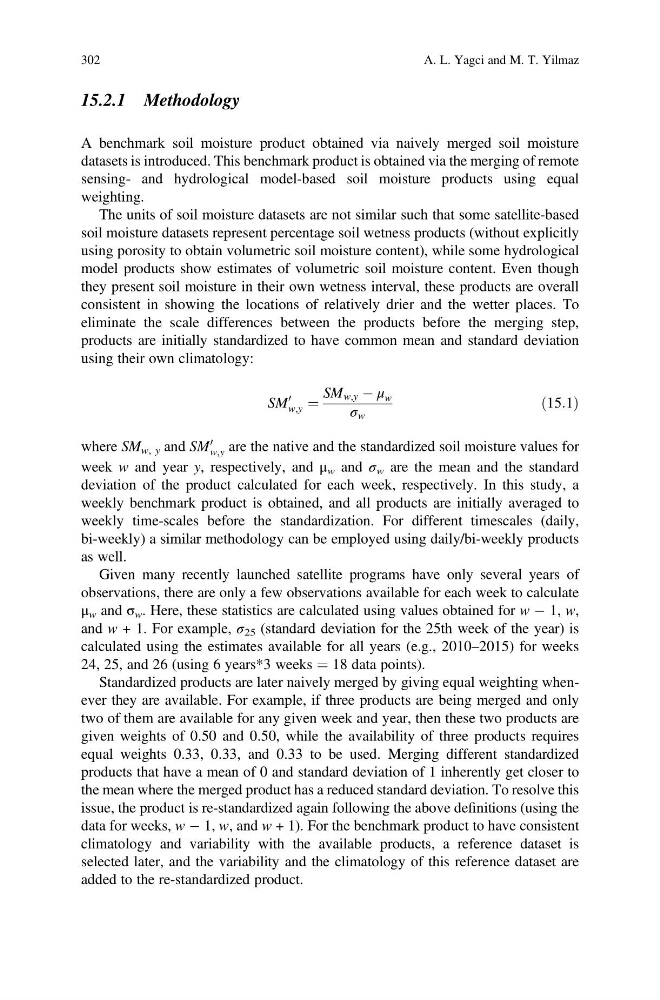
products are initially standardized to have common mean and standard deviation
using their own climatology:
SM
0
w,y ¼
SM w,y À μ w
σ w
ð15:1Þ
where SM w, y and SM
0
w,y are the native and the standardized soil moisture values for
week w and year y, respectively, and μ w and σ w are the mean and the standard
deviation of the product calculated for each week, respectively. In this study, a
weekly benchmark product is obtained, and all products are initially averaged to
weekly time-scales before the standardization. For different timescales (daily,
bi-weekly) a similar methodology can be employed using daily/bi-weekly products
as well.
Given many recently launched satellite programs have only several years of
observations, there are only a few observations available for each week to calculate
μ w and σ w . Here, these statistics are calculated using values obtained for w À 1, w,
and w + 1. For example, σ 25 (standard deviation for the 25th week of the year) is
calculated using the estimates available for all years (e.g., 2010–2015) for weeks
24, 25, and 26 (using 6 years*3 weeks ¼ 18 data points).
Standardized products are later naively merged by giving equal weighting whenever they are available. For example, if three products are being merged and only
two of them are available for any given week and year, then these two products are
given weights of 0.50 and 0.50, while the availability of three products requires
equal weights 0.33, 0.33, and 0.33 to be used. Merging different standardized
products that have a mean of 0 and standard deviation of 1 inherently get closer to
the mean where the merged product has a reduced standard deviation. To resolve this
issue, the product is re-standardized again following the above definitions (using the
data for weeks, w À 1, w, and w + 1). For the benchmark product to have consistent
climatology and variability with the available products, a reference dataset is
selected later, and the variability and the climatology of this reference dataset are
added to the re-standardized product.
302
A. L. Yagci and M. T. Yilmaz
A benchmark soil moisture product obtained via naively merged soil moisture
datasets is introduced. This benchmark product is obtained via the merging of remote
sensing- and hydrological model-based soil moisture products using equal
weighting.
The units of soil moisture datasets are not similar such that some satellite-based
soil moisture datasets represent percentage soil wetness products (without explicitly
using porosity to obtain volumetric soil moisture content), while some hydrological
model products show estimates of volumetric soil moisture content. Even though
they present soil moisture in their own wetness interval, these products are overall
consistent in showing the locations of relatively drier and the wetter places. To
eliminate the scale differences between the products before the merging step,
products are initially standardized to have common mean and standard deviation
using their own climatology:
SM
0
w,y ¼
SM w,y À μ w
σ w
ð15:1Þ
where SM w, y and SM
0
w,y are the native and the standardized soil moisture values for
week w and year y, respectively, and μ w and σ w are the mean and the standard
deviation of the product calculated for each week, respectively. In this study, a
weekly benchmark product is obtained, and all products are initially averaged to
weekly time-scales before the standardization. For different timescales (daily,
bi-weekly) a similar methodology can be employed using daily/bi-weekly products
as well.
Given many recently launched satellite programs have only several years of
observations, there are only a few observations available for each week to calculate
μ w and σ w . Here, these statistics are calculated using values obtained for w À 1, w,
and w + 1. For example, σ 25 (standard deviation for the 25th week of the year) is
calculated using the estimates available for all years (e.g., 2010–2015) for weeks
24, 25, and 26 (using 6 years*3 weeks ¼ 18 data points).
Standardized products are later naively merged by giving equal weighting whenever they are available. For example, if three products are being merged and only
two of them are available for any given week and year, then these two products are
given weights of 0.50 and 0.50, while the availability of three products requires
equal weights 0.33, 0.33, and 0.33 to be used. Merging different standardized
products that have a mean of 0 and standard deviation of 1 inherently get closer to
the mean where the merged product has a reduced standard deviation. To resolve this
issue, the product is re-standardized again following the above definitions (using the
data for weeks, w À 1, w, and w + 1). For the benchmark product to have consistent
climatology and variability with the available products, a reference dataset is
selected later, and the variability and the climatology of this reference dataset are
added to the re-standardized product.
302
A. L. Yagci and M. T. Yilmaz