

• Tile cutting to cut the seamless orthoimage mosaic according to the ortho tile
dimensions and name the tiles according to the defined naming convention.
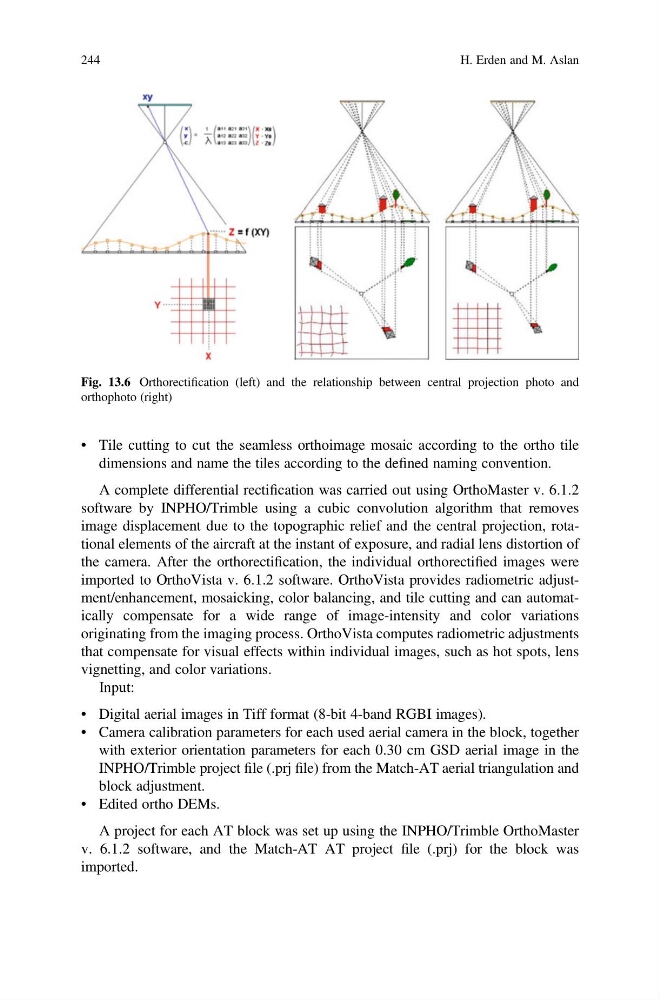
A complete differential rectification was carried out using OrthoMaster v. 6.1.2
software by INPHO/Trimble using a cubic convolution algorithm that removes
image displacement due to the topographic relief and the central projection, rotational elements of the aircraft at the instant of exposure, and radial lens distortion of
the camera. After the orthorectification, the individual orthorectified images were
imported to OrthoVista v. 6.1.2 software. OrthoVista provides radiometric adjustment/enhancement, mosaicking, color balancing, and tile cutting and can automatically compensate for a wide range of image-intensity and color variations
originating from the imaging process. OrthoVista computes radiometric adjustments
that compensate for visual effects within individual images, such as hot spots, lens
vignetting, and color variations.
Input:
• Digital aerial images in Tiff format (8-bit 4-band RGBI images).
• Camera calibration parameters for each used aerial camera in the block, together
with exterior orientation parameters for each 0.30 cm GSD aerial image in the
INPHO/Trimble project file (.prj file) from the Match-AT aerial triangulation and
block adjustment.
• Edited ortho DEMs.
A project for each AT block was set up using the INPHO/Trimble OrthoMaster
v. 6.1.2 software, and the Match-AT AT project file (.prj) for the block was
imported.
Fig. 13.6 Orthorectification (left) and the relationship between central projection photo and
orthophoto (right)
244
H. Erden and M. Aslan
dimensions and name the tiles according to the defined naming convention.
A complete differential rectification was carried out using OrthoMaster v. 6.1.2
software by INPHO/Trimble using a cubic convolution algorithm that removes
image displacement due to the topographic relief and the central projection, rotational elements of the aircraft at the instant of exposure, and radial lens distortion of
the camera. After the orthorectification, the individual orthorectified images were
imported to OrthoVista v. 6.1.2 software. OrthoVista provides radiometric adjustment/enhancement, mosaicking, color balancing, and tile cutting and can automatically compensate for a wide range of image-intensity and color variations
originating from the imaging process. OrthoVista computes radiometric adjustments
that compensate for visual effects within individual images, such as hot spots, lens
vignetting, and color variations.
Input:
• Digital aerial images in Tiff format (8-bit 4-band RGBI images).
• Camera calibration parameters for each used aerial camera in the block, together
with exterior orientation parameters for each 0.30 cm GSD aerial image in the
INPHO/Trimble project file (.prj file) from the Match-AT aerial triangulation and
block adjustment.
• Edited ortho DEMs.
A project for each AT block was set up using the INPHO/Trimble OrthoMaster
v. 6.1.2 software, and the Match-AT AT project file (.prj) for the block was
imported.
Fig. 13.6 Orthorectification (left) and the relationship between central projection photo and
orthophoto (right)
244
H. Erden and M. Aslan