

11.3 Physiological/Physical-Based Modeling
Physiological/physical-based modeling has been successfully developed and used
over time, providing additional information to decision makers on how to accomplish sustainable agriculture, and used to understand the effects of climate change on
crop growth and yield (Palosuo et al. 2011b; White et al. 2011). There are numerous
different types of crop growth models that have been developed with different
complexity levels and different crop types over the past years. Compared with
statistical models, crop growth models can describe the main progress during crop
growth and production as a soil-plant-atmosphere system, such as solar radiation
absorption, photosynthesis, phenology, biomass partitioning, organ building, nitrogen processes, and water balance (Gowda et al. 2014). These models simulate crop
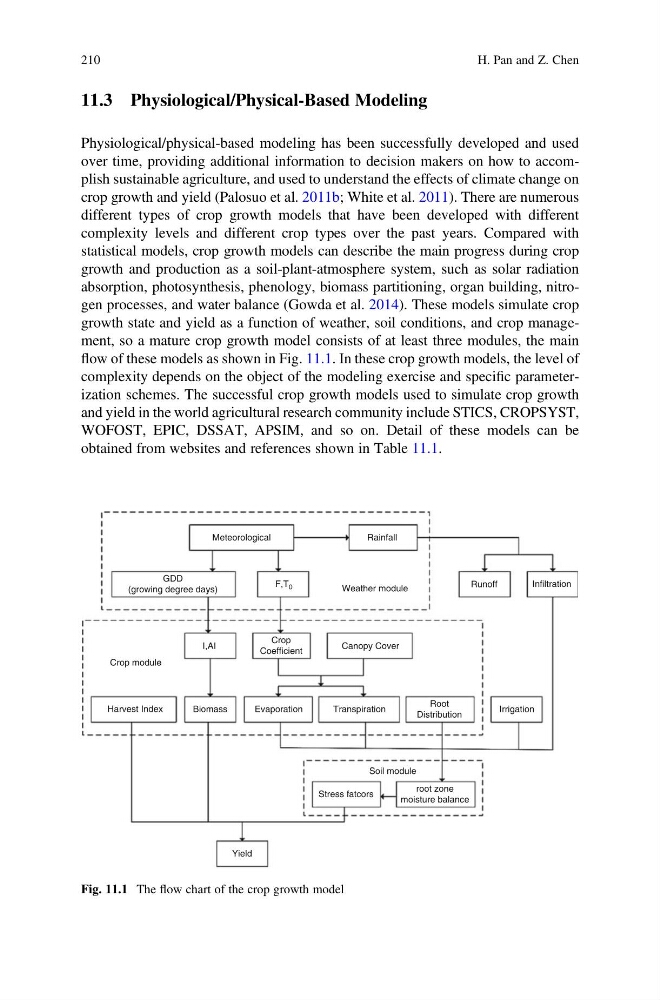
growth state and yield as a function of weather, soil conditions, and crop management, so a mature crop growth model consists of at least three modules, the main
flow of these models as shown in Fig. 11.1. In these crop growth models, the level of
complexity depends on the object of the modeling exercise and specific parameterization schemes. The successful crop growth models used to simulate crop growth
and yield in the world agricultural research community include STICS, CROPSYST,
WOFOST, EPIC, DSSAT, APSIM, and so on. Detail of these models can be
obtained from websites and references shown in Table 11.1.
Meteorological
Rainfall
Weather module
Runoff
Infiltration
GDD
(growing degree days)
F,T 0
I,AI
Crop module
Harvest Index
Biomass
Evaporation
Transpiration
Root
Distribution
Irrigation
root zone
moisture balance
Yield
Stress fatcors
Soil module
Crop
Coefficient
Canopy Cover
Fig. 11.1 The flow chart of the crop growth model
210
H. Pan and Z. Chen
Physiological/physical-based modeling has been successfully developed and used
over time, providing additional information to decision makers on how to accomplish sustainable agriculture, and used to understand the effects of climate change on
crop growth and yield (Palosuo et al. 2011b; White et al. 2011). There are numerous
different types of crop growth models that have been developed with different
complexity levels and different crop types over the past years. Compared with
statistical models, crop growth models can describe the main progress during crop
growth and production as a soil-plant-atmosphere system, such as solar radiation
absorption, photosynthesis, phenology, biomass partitioning, organ building, nitrogen processes, and water balance (Gowda et al. 2014). These models simulate crop
growth state and yield as a function of weather, soil conditions, and crop management, so a mature crop growth model consists of at least three modules, the main
flow of these models as shown in Fig. 11.1. In these crop growth models, the level of
complexity depends on the object of the modeling exercise and specific parameterization schemes. The successful crop growth models used to simulate crop growth
and yield in the world agricultural research community include STICS, CROPSYST,
WOFOST, EPIC, DSSAT, APSIM, and so on. Detail of these models can be
obtained from websites and references shown in Table 11.1.
Meteorological
Rainfall
Weather module
Runoff
Infiltration
GDD
(growing degree days)
F,T 0
I,AI
Crop module
Harvest Index
Biomass
Evaporation
Transpiration
Root
Distribution
Irrigation
root zone
moisture balance
Yield
Stress fatcors
Soil module
Crop
Coefficient
Canopy Cover
Fig. 11.1 The flow chart of the crop growth model
210
H. Pan and Z. Chen