

Some meteorological factors or crop-related indices are used as X i in these models,
such as evapotranspiration, temperature, precipitation, soil moisture, and NDVI.
NDVI is often considered a valuable index for crop growth condition analysis. For
example, Prasad (Prasad et al. 2006) developed a corn and soybean yield prediction
model based on surface temperature (ST), rainfall (RF), soil moisture (SM), and
NDVI in Iowa, USA; the model is as follows:
Yield ¼ a 1 NDVI þ a 2 SM þ a 3 ST þ a 4 RF þ c 1
where model parameters a 1 , a 2 , a 3 , a 4 , and c 1 have different values when the
forecasted yield is less or greater than breakpoint; the breakpoint is the mean of
19-year corn or soybean crop yield in Iowa. The coefficients for the corn and
soybean yield model are 0.78 and 0.86, respectively. Several researchers use this
approach to analyze responses of crop yield to climate change (Lobell and Burke
2010; Thornton et al. 2009). Besides the linear regression model, more research
works use nonlinear regression models to estimate crop growth state and forecast
yield. Various types of nonlinear regression models were used such as exponential,
logistic, and Gaussian, for example, crop growth variable leaf area index (LAI)
nonlinear regression model found using growing degree-days (GDD) accumulated
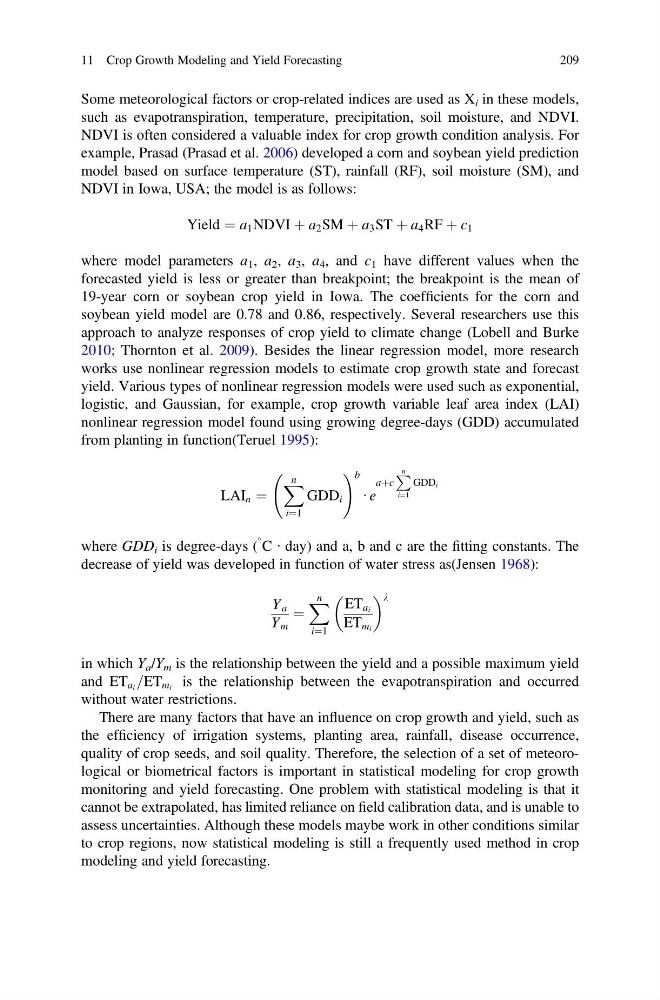
from planting in function(Teruel 1995):
LAI n ¼
X n
i¼1
GDD i
! b
∙ e
aþc
P n
i¼1
GDD i
where GDD i is degree-days (
C ∙ day) and a, b and c are the fitting constants. The
decrease of yield was developed in function of water stress as(Jensen 1968):
Y a
Y m
¼
X n
i¼1
ET a i
ET m i
λ
in which Y a /Y m is the relationship between the yield and a possible maximum yield
and ET a i =ET m i is the relationship between the evapotranspiration and occurred
without water restrictions.
There are many factors that have an influence on crop growth and yield, such as
the efficiency of irrigation systems, planting area, rainfall, disease occurrence,
quality of crop seeds, and soil quality. Therefore, the selection of a set of meteorological or biometrical factors is important in statistical modeling for crop growth
monitoring and yield forecasting. One problem with statistical modeling is that it
cannot be extrapolated, has limited reliance on field calibration data, and is unable to
assess uncertainties. Although these models maybe work in other conditions similar
to crop regions, now statistical modeling is still a frequently used method in crop
modeling and yield forecasting.
11 Crop Growth Modeling and Yield Forecasting
209
such as evapotranspiration, temperature, precipitation, soil moisture, and NDVI.
NDVI is often considered a valuable index for crop growth condition analysis. For
example, Prasad (Prasad et al. 2006) developed a corn and soybean yield prediction
model based on surface temperature (ST), rainfall (RF), soil moisture (SM), and
NDVI in Iowa, USA; the model is as follows:
Yield ¼ a 1 NDVI þ a 2 SM þ a 3 ST þ a 4 RF þ c 1
where model parameters a 1 , a 2 , a 3 , a 4 , and c 1 have different values when the
forecasted yield is less or greater than breakpoint; the breakpoint is the mean of
19-year corn or soybean crop yield in Iowa. The coefficients for the corn and
soybean yield model are 0.78 and 0.86, respectively. Several researchers use this
approach to analyze responses of crop yield to climate change (Lobell and Burke
2010; Thornton et al. 2009). Besides the linear regression model, more research
works use nonlinear regression models to estimate crop growth state and forecast
yield. Various types of nonlinear regression models were used such as exponential,
logistic, and Gaussian, for example, crop growth variable leaf area index (LAI)
nonlinear regression model found using growing degree-days (GDD) accumulated
from planting in function(Teruel 1995):
LAI n ¼
X n
i¼1
GDD i
! b
∙ e
aþc
P n
i¼1
GDD i
where GDD i is degree-days (
C ∙ day) and a, b and c are the fitting constants. The
decrease of yield was developed in function of water stress as(Jensen 1968):
Y a
Y m
¼
X n
i¼1
ET a i
ET m i
λ
in which Y a /Y m is the relationship between the yield and a possible maximum yield
and ET a i =ET m i is the relationship between the evapotranspiration and occurred
without water restrictions.
There are many factors that have an influence on crop growth and yield, such as
the efficiency of irrigation systems, planting area, rainfall, disease occurrence,
quality of crop seeds, and soil quality. Therefore, the selection of a set of meteorological or biometrical factors is important in statistical modeling for crop growth
monitoring and yield forecasting. One problem with statistical modeling is that it
cannot be extrapolated, has limited reliance on field calibration data, and is unable to
assess uncertainties. Although these models maybe work in other conditions similar
to crop regions, now statistical modeling is still a frequently used method in crop
modeling and yield forecasting.
11 Crop Growth Modeling and Yield Forecasting
209