

between crops, e.g., 2-week difference of corn and soybean in Iowa, may be used
to improve the differentiation of crop types if time series of quality data are
available.
6. Validation: Accuracy assessment is very important. There are several aspects of
accuracy evaluations: training accuracy, model selection accuracy, and verification accuracy. Training accuracy is evaluated during the training stage for a
classifier to evaluate its prediction against training set. Cross-validation may be
helpful in evaluating the model and determining the fitness of models that rotates
the leave-out samples to verify its learning capability. Validation is to evaluate the
classifier against some unseen samples in order to verify its general applicability.
These accuracy evaluations help to keep the balance of generalization and
specialization on trained classifiers. If a classifier is too specialized or overfit, it
loses the capability to correctly classify unseen data although its accuracy on
training set may be extremely high. If a classifier is too generalized or underfit, the
accuracy of the classifier would be too low to correctly classify most croplands.
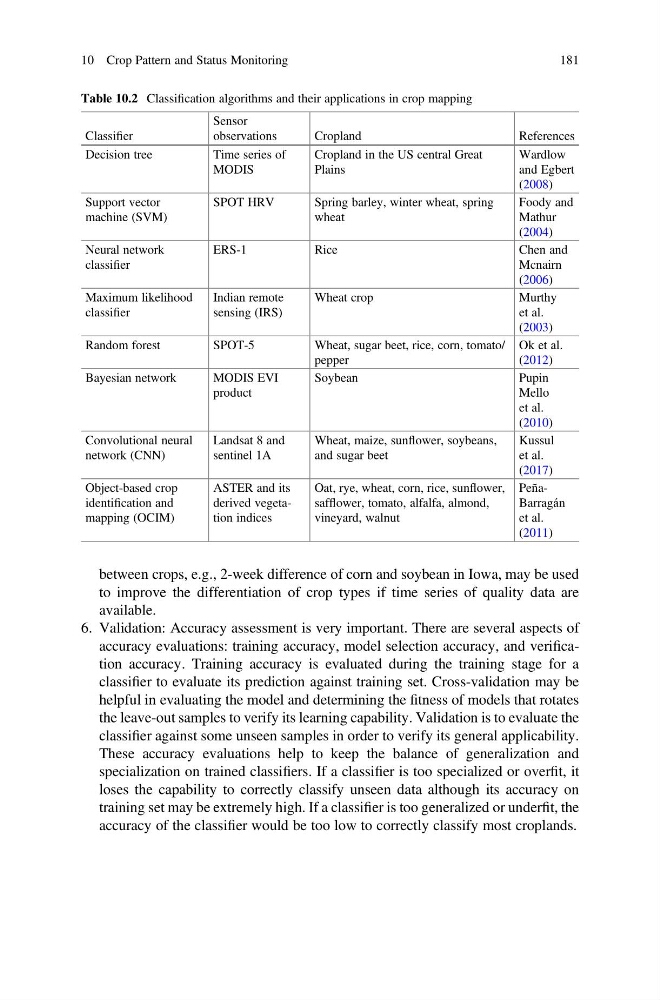
Table 10.2 Classification algorithms and their applications in crop mapping
Classifier
Sensor
observations
Cropland
References
Decision tree
Time series of
MODIS
Cropland in the US central Great
Plains
Wardlow
and Egbert
(2008)
Support vector
machine (SVM)
SPOT HRV
Spring barley, winter wheat, spring
wheat
Foody and
Mathur
(2004)
Neural network
classifier
ERS-1
Rice
Chen and
Mcnairn
(2006)
Maximum likelihood
classifier
Indian remote
sensing (IRS)
Wheat crop
Murthy
et al.
(2003)
Random forest
SPOT-5
Wheat, sugar beet, rice, corn, tomato/
pepper
Ok et al.
(2012)
Bayesian network
MODIS EVI
product
Soybean
Pupin
Mello
et al.
(2010)
Convolutional neural
network (CNN)
Landsat 8 and
sentinel 1A
Wheat, maize, sunflower, soybeans,
and sugar beet
Kussul
et al.
(2017)
Object-based crop
identification and
mapping (OCIM)
ASTER and its
derived vegetation indices
Oat, rye, wheat, corn, rice, sunflower,
safflower, tomato, alfalfa, almond,
vineyard, walnut
PeñaBarragán
et al.
(2011)
10 Crop Pattern and Status Monitoring
181
to improve the differentiation of crop types if time series of quality data are
available.
6. Validation: Accuracy assessment is very important. There are several aspects of
accuracy evaluations: training accuracy, model selection accuracy, and verification accuracy. Training accuracy is evaluated during the training stage for a
classifier to evaluate its prediction against training set. Cross-validation may be
helpful in evaluating the model and determining the fitness of models that rotates
the leave-out samples to verify its learning capability. Validation is to evaluate the
classifier against some unseen samples in order to verify its general applicability.
These accuracy evaluations help to keep the balance of generalization and
specialization on trained classifiers. If a classifier is too specialized or overfit, it
loses the capability to correctly classify unseen data although its accuracy on
training set may be extremely high. If a classifier is too generalized or underfit, the
accuracy of the classifier would be too low to correctly classify most croplands.
Table 10.2 Classification algorithms and their applications in crop mapping
Classifier
Sensor
observations
Cropland
References
Decision tree
Time series of
MODIS
Cropland in the US central Great
Plains
Wardlow
and Egbert
(2008)
Support vector
machine (SVM)
SPOT HRV
Spring barley, winter wheat, spring
wheat
Foody and
Mathur
(2004)
Neural network
classifier
ERS-1
Rice
Chen and
Mcnairn
(2006)
Maximum likelihood
classifier
Indian remote
sensing (IRS)
Wheat crop
Murthy
et al.
(2003)
Random forest
SPOT-5
Wheat, sugar beet, rice, corn, tomato/
pepper
Ok et al.
(2012)
Bayesian network
MODIS EVI
product
Soybean
Pupin
Mello
et al.
(2010)
Convolutional neural
network (CNN)
Landsat 8 and
sentinel 1A
Wheat, maize, sunflower, soybeans,
and sugar beet
Kussul
et al.
(2017)
Object-based crop
identification and
mapping (OCIM)
ASTER and its
derived vegetation indices
Oat, rye, wheat, corn, rice, sunflower,
safflower, tomato, alfalfa, almond,
vineyard, walnut
PeñaBarragán
et al.
(2011)
10 Crop Pattern and Status Monitoring
181