

digital computational devices. An efficient and widely used discrete wavelet implementation method is the lifting scheme (Sweldens 1997). Lifting scheme enables the
exact inversion of the transform, and every reconstructable filter bank can be
expressed in terms of lifting steps.
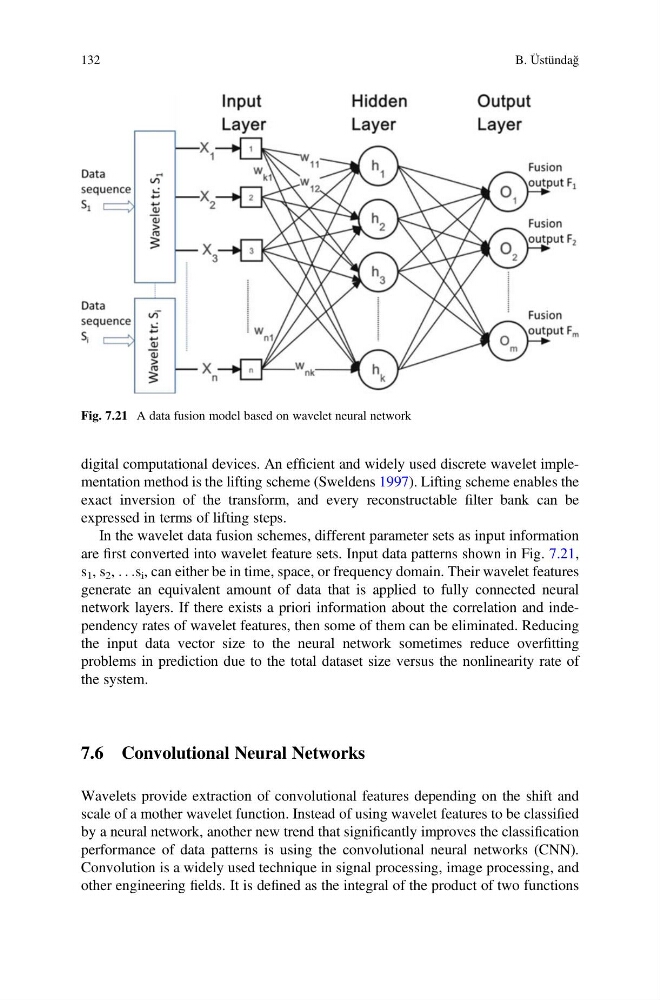
In the wavelet data fusion schemes, different parameter sets as input information
are first converted into wavelet feature sets. Input data patterns shown in Fig. 7.21,
s 1 , s 2 , . . .s i , can either be in time, space, or frequency domain. Their wavelet features
generate an equivalent amount of data that is applied to fully connected neural
network layers. If there exists a priori information about the correlation and independency rates of wavelet features, then some of them can be eliminated. Reducing
the input data vector size to the neural network sometimes reduce overfitting
problems in prediction due to the total dataset size versus the nonlinearity rate of
the system.
7.6 Convolutional Neural Networks
Wavelets provide extraction of convolutional features depending on the shift and
scale of a mother wavelet function. Instead of using wavelet features to be classified
by a neural network, another new trend that significantly improves the classification
performance of data patterns is using the convolutional neural networks (CNN).
Convolution is a widely used technique in signal processing, image processing, and
other engineering fields. It is defined as the integral of the product of two functions
Fig. 7.21 A data fusion model based on wavelet neural network
132
B. Üstündağ
exact inversion of the transform, and every reconstructable filter bank can be
expressed in terms of lifting steps.
In the wavelet data fusion schemes, different parameter sets as input information
are first converted into wavelet feature sets. Input data patterns shown in Fig. 7.21,
s 1 , s 2 , . . .s i , can either be in time, space, or frequency domain. Their wavelet features
generate an equivalent amount of data that is applied to fully connected neural
network layers. If there exists a priori information about the correlation and independency rates of wavelet features, then some of them can be eliminated. Reducing
the input data vector size to the neural network sometimes reduce overfitting
problems in prediction due to the total dataset size versus the nonlinearity rate of
the system.
7.6 Convolutional Neural Networks
Wavelets provide extraction of convolutional features depending on the shift and
scale of a mother wavelet function. Instead of using wavelet features to be classified
by a neural network, another new trend that significantly improves the classification
performance of data patterns is using the convolutional neural networks (CNN).
Convolution is a widely used technique in signal processing, image processing, and
other engineering fields. It is defined as the integral of the product of two functions
Fig. 7.21 A data fusion model based on wavelet neural network
132
B. Üstündağ