

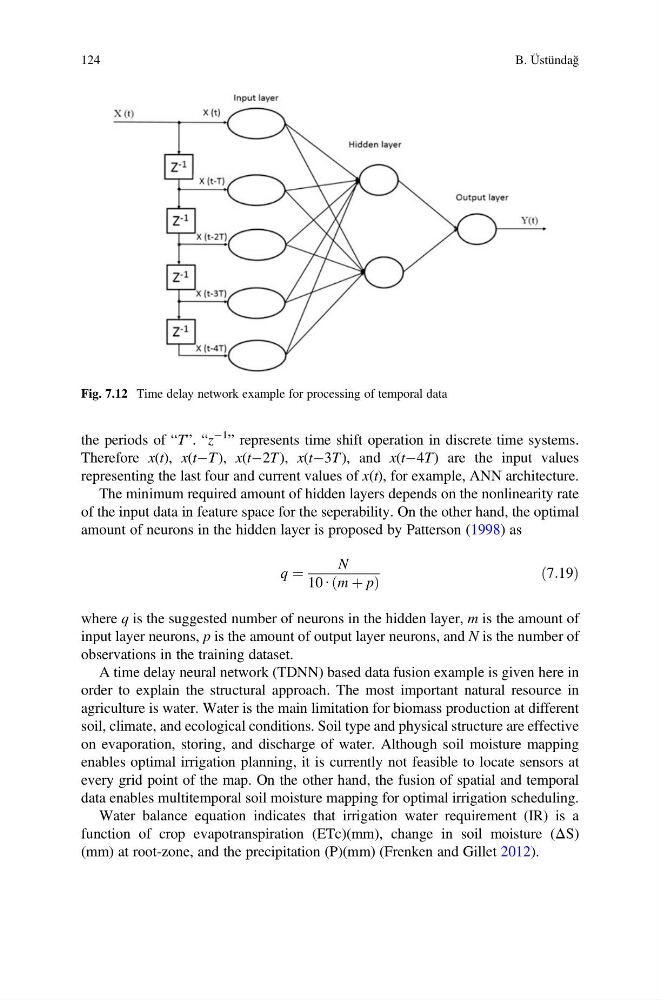
the periods of “T”. “z
À1
” represents time shift operation in discrete time systems.
Therefore x(t), x(tÀT ), x(tÀ2T), x(tÀ3T), and x(tÀ4T) are the input values
representing the last four and current values of x(t), for example, ANN architecture.
The minimum required amount of hidden layers depends on the nonlinearity rate
of the input data in feature space for the seperability. On the other hand, the optimal
amount of neurons in the hidden layer is proposed by Patterson (1998) as
q ¼
N
10 ∙ m þ p
ð
Þ
ð7:19Þ
where q is the suggested number of neurons in the hidden layer, m is the amount of
input layer neurons, p is the amount of output layer neurons, and N is the number of
observations in the training dataset.
A time delay neural network (TDNN) based data fusion example is given here in
order to explain the structural approach. The most important natural resource in
agriculture is water. Water is the main limitation for biomass production at different
soil, climate, and ecological conditions. Soil type and physical structure are effective
on evaporation, storing, and discharge of water. Although soil moisture mapping
enables optimal irrigation planning, it is currently not feasible to locate sensors at
every grid point of the map. On the other hand, the fusion of spatial and temporal
data enables multitemporal soil moisture mapping for optimal irrigation scheduling.
Water balance equation indicates that irrigation water requirement (IR) is a
function of crop evapotranspiration (ETc)(mm), change in soil moisture (ΔS)
(mm) at root-zone, and the precipitation (P)(mm) (Frenken and Gillet 2012).
Fig. 7.12 Time delay network example for processing of temporal data
124
B. Üstündağ
À1
” represents time shift operation in discrete time systems.
Therefore x(t), x(tÀT ), x(tÀ2T), x(tÀ3T), and x(tÀ4T) are the input values
representing the last four and current values of x(t), for example, ANN architecture.
The minimum required amount of hidden layers depends on the nonlinearity rate
of the input data in feature space for the seperability. On the other hand, the optimal
amount of neurons in the hidden layer is proposed by Patterson (1998) as
q ¼
N
10 ∙ m þ p
ð
Þ
ð7:19Þ
where q is the suggested number of neurons in the hidden layer, m is the amount of
input layer neurons, p is the amount of output layer neurons, and N is the number of
observations in the training dataset.
A time delay neural network (TDNN) based data fusion example is given here in
order to explain the structural approach. The most important natural resource in
agriculture is water. Water is the main limitation for biomass production at different
soil, climate, and ecological conditions. Soil type and physical structure are effective
on evaporation, storing, and discharge of water. Although soil moisture mapping
enables optimal irrigation planning, it is currently not feasible to locate sensors at
every grid point of the map. On the other hand, the fusion of spatial and temporal
data enables multitemporal soil moisture mapping for optimal irrigation scheduling.
Water balance equation indicates that irrigation water requirement (IR) is a
function of crop evapotranspiration (ETc)(mm), change in soil moisture (ΔS)
(mm) at root-zone, and the precipitation (P)(mm) (Frenken and Gillet 2012).
Fig. 7.12 Time delay network example for processing of temporal data
124
B. Üstündağ