

varying and statistical characteristics of the probable signals to be applied and so the
relevant interacting systems is important for selection of the proper neural network
type before defining its internal organization.
Artificial neural network (ANN) is a computational method to accomplish a
variety of tasks in NN applications. ANN approaches offer algorithms for network training based on supervised learning, unsupervised learning or the reinforcement learning depending on type of the problem. Basically supervised learning
provides the ability to learn the input-output correlation by training the input to
produce the familiar or previously labeled (known) output so that predictions can be
made when unknown (test) data set is applied to the input. The block diagram of a
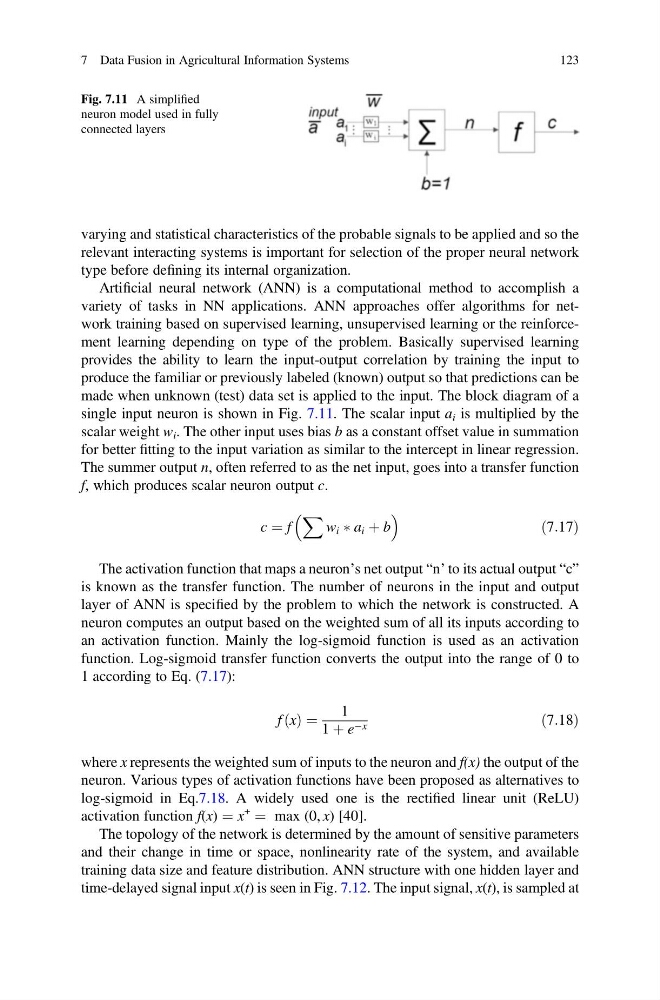
single input neuron is shown in Fig. 7.11. The scalar input a i is multiplied by the
scalar weight w i . The other input uses bias b as a constant offset value in summation
for better fitting to the input variation as similar to the intercept in linear regression.
The summer output n, often referred to as the net input, goes into a transfer function
f, which produces scalar neuron output c.
c ¼ f
X
w i à a i þ b
ð7:17Þ
The activation function that maps a neuron’s net output “n’ to its actual output “c”
is known as the transfer function. The number of neurons in the input and output
layer of ANN is specified by the problem to which the network is constructed. A
neuron computes an output based on the weighted sum of all its inputs according to
an activation function. Mainly the log-sigmoid function is used as an activation
function. Log-sigmoid transfer function converts the output into the range of 0 to
1 according to Eq. (7.17):
f x
ð Þ ¼
1
1 þ e Àx
ð7:18Þ
where x represents the weighted sum of inputs to the neuron and f(x) the output of the
neuron. Various types of activation functions have been proposed as alternatives to
log-sigmoid in Eq.7.18. A widely used one is the rectified linear unit (ReLU)
activation function f(x) ¼ x
+
¼ max (0, x) [40].
The topology of the network is determined by the amount of sensitive parameters
and their change in time or space, nonlinearity rate of the system, and available
training data size and feature distribution. ANN structure with one hidden layer and
time-delayed signal input x(t) is seen in Fig. 7.12. The input signal, x(t), is sampled at
Fig. 7.11 A simplified
neuron model used in fully
connected layers
7 Data Fusion in Agricultural Information Systems
123
relevant interacting systems is important for selection of the proper neural network
type before defining its internal organization.
Artificial neural network (ANN) is a computational method to accomplish a
variety of tasks in NN applications. ANN approaches offer algorithms for network training based on supervised learning, unsupervised learning or the reinforcement learning depending on type of the problem. Basically supervised learning
provides the ability to learn the input-output correlation by training the input to
produce the familiar or previously labeled (known) output so that predictions can be
made when unknown (test) data set is applied to the input. The block diagram of a
single input neuron is shown in Fig. 7.11. The scalar input a i is multiplied by the
scalar weight w i . The other input uses bias b as a constant offset value in summation
for better fitting to the input variation as similar to the intercept in linear regression.
The summer output n, often referred to as the net input, goes into a transfer function
f, which produces scalar neuron output c.
c ¼ f
X
w i à a i þ b
ð7:17Þ
The activation function that maps a neuron’s net output “n’ to its actual output “c”
is known as the transfer function. The number of neurons in the input and output
layer of ANN is specified by the problem to which the network is constructed. A
neuron computes an output based on the weighted sum of all its inputs according to
an activation function. Mainly the log-sigmoid function is used as an activation
function. Log-sigmoid transfer function converts the output into the range of 0 to
1 according to Eq. (7.17):
f x
ð Þ ¼
1
1 þ e Àx
ð7:18Þ
where x represents the weighted sum of inputs to the neuron and f(x) the output of the
neuron. Various types of activation functions have been proposed as alternatives to
log-sigmoid in Eq.7.18. A widely used one is the rectified linear unit (ReLU)
activation function f(x) ¼ x
+
¼ max (0, x) [40].
The topology of the network is determined by the amount of sensitive parameters
and their change in time or space, nonlinearity rate of the system, and available
training data size and feature distribution. ANN structure with one hidden layer and
time-delayed signal input x(t) is seen in Fig. 7.12. The input signal, x(t), is sampled at
Fig. 7.11 A simplified
neuron model used in fully
connected layers
7 Data Fusion in Agricultural Information Systems
123