

7.3.1 Phenological Stage-Based Data Segmentation
Phenological stage change is the main nonlinearity of the plant system models. Plant
growth requirements, as well as risk-related loss estimations, depend on the phenological stage of the plant. Phenological stages can be considered as the states in the
Markov models. State transition function is related to imposed physical parameters,
and it varies depending on the state. For example, instead of seasonal precipitation,
its distribution in terms of phenological stage duration has a higher correlation to
yield. Simple linear regression does not fit well, especially when the long-term
volatility is high in agrometeorological conditions. Segmenting the data into phenological stages or groups of consecutive phenological stages provides convergence to
a piecewise linear model.
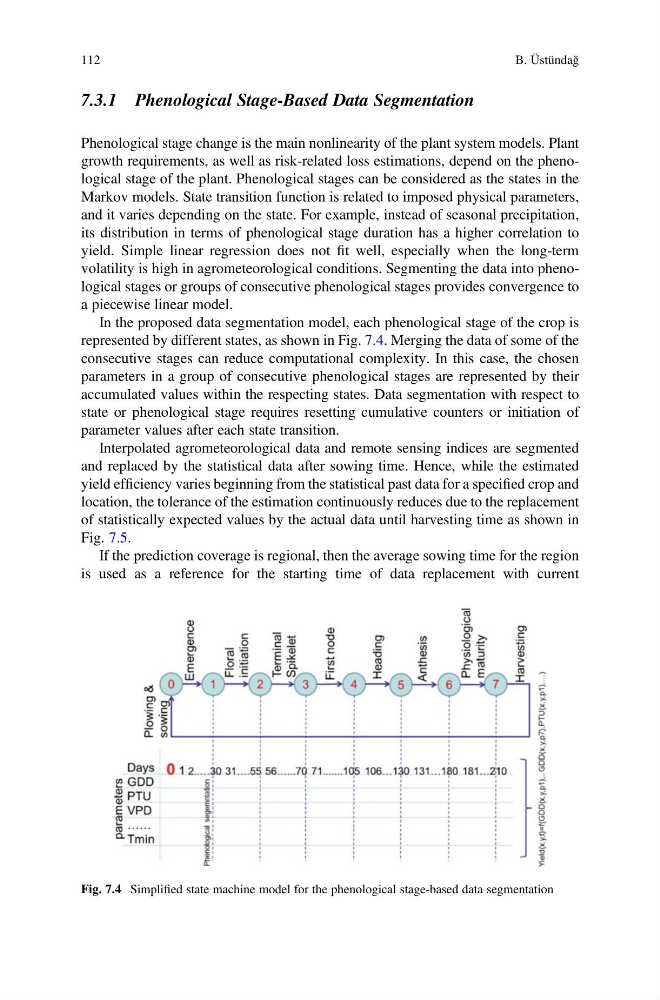
In the proposed data segmentation model, each phenological stage of the crop is
represented by different states, as shown in Fig. 7.4. Merging the data of some of the
consecutive stages can reduce computational complexity. In this case, the chosen
parameters in a group of consecutive phenological stages are represented by their
accumulated values within the respecting states. Data segmentation with respect to
state or phenological stage requires resetting cumulative counters or initiation of
parameter values after each state transition.
Interpolated agrometeorological data and remote sensing indices are segmented
and replaced by the statistical data after sowing time. Hence, while the estimated
yield efficiency varies beginning from the statistical past data for a specified crop and
location, the tolerance of the estimation continuously reduces due to the replacement
of statistically expected values by the actual data until harvesting time as shown in
Fig. 7.5.
If the prediction coverage is regional, then the average sowing time for the region
is used as a reference for the starting time of data replacement with current
Fig. 7.4 Simplified state machine model for the phenological stage-based data segmentation
112
B. Üstündağ
Phenological stage change is the main nonlinearity of the plant system models. Plant
growth requirements, as well as risk-related loss estimations, depend on the phenological stage of the plant. Phenological stages can be considered as the states in the
Markov models. State transition function is related to imposed physical parameters,
and it varies depending on the state. For example, instead of seasonal precipitation,
its distribution in terms of phenological stage duration has a higher correlation to
yield. Simple linear regression does not fit well, especially when the long-term
volatility is high in agrometeorological conditions. Segmenting the data into phenological stages or groups of consecutive phenological stages provides convergence to
a piecewise linear model.
In the proposed data segmentation model, each phenological stage of the crop is
represented by different states, as shown in Fig. 7.4. Merging the data of some of the
consecutive stages can reduce computational complexity. In this case, the chosen
parameters in a group of consecutive phenological stages are represented by their
accumulated values within the respecting states. Data segmentation with respect to
state or phenological stage requires resetting cumulative counters or initiation of
parameter values after each state transition.
Interpolated agrometeorological data and remote sensing indices are segmented
and replaced by the statistical data after sowing time. Hence, while the estimated
yield efficiency varies beginning from the statistical past data for a specified crop and
location, the tolerance of the estimation continuously reduces due to the replacement
of statistically expected values by the actual data until harvesting time as shown in
Fig. 7.5.
If the prediction coverage is regional, then the average sowing time for the region
is used as a reference for the starting time of data replacement with current
Fig. 7.4 Simplified state machine model for the phenological stage-based data segmentation
112
B. Üstündağ