

35
products is coming from regions most vulnerable to climate change, with high rates
of population growth and low rates of agricultural productivity, such as South Asia
and sub-Saharan Africa. These regions are characterized by small farms, with little
access to productive inputs, and a substantial proportion of the rural workforce
represented by women. As production increases to meet the growing demand,
Box 2.2 Meeting India’s Milk Demand (Steensland and Zeigler 2018)
Over the next decade, India will account for 54% of the increase in global
demand for fresh dairy products, requiring an additional 56 million tons of
milk. India is already the largest dairy producer in the world, but dairy cattle
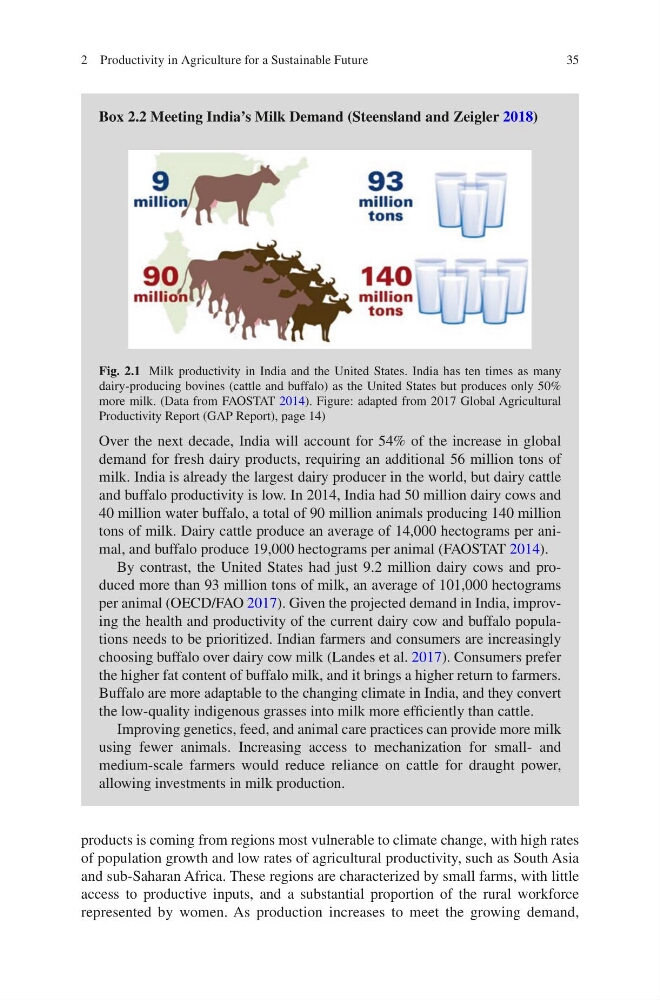
and buffalo productivity is low. In 2014, India had 50 million dairy cows and
40 million water buffalo, a total of 90 million animals producing 140 million
tons of milk. Dairy cattle produce an average of 14,000 hectograms per animal, and buffalo produce 19,000 hectograms per animal (FAOSTAT 2014).
By contrast, the United States had just 9.2 million dairy cows and produced more than 93 million tons of milk, an average of 101,000 hectograms
per animal (OECD/FAO 2017). Given the projected demand in India, improving the health and productivity of the current dairy cow and buffalo populations needs to be prioritized. Indian farmers and consumers are increasingly
choosing buffalo over dairy cow milk (Landes et al. 2017). Consumers prefer
the higher fat content of buffalo milk, and it brings a higher return to farmers.
Buffalo are more adaptable to the changing climate in India, and they convert
the low-quality indigenous grasses into milk more efficiently than cattle.
Improving genetics, feed, and animal care practices can provide more milk
using fewer animals. Increasing access to mechanization for small- and
medium-scale farmers would reduce reliance on cattle for draught power,
allowing investments in milk production.
Fig. 2.1 Milk productivity in India and the United States. India has ten times as many
dairy- producing bovines (cattle and buffalo) as the United States but produces only 50%
more milk. (Data from FAOSTAT 2014). Figure: adapted from 2017 Global Agricultural
Productivity Report (GAP Report), page 14)
2 Productivity in Agriculture for a Sustainable Future
products is coming from regions most vulnerable to climate change, with high rates
of population growth and low rates of agricultural productivity, such as South Asia
and sub-Saharan Africa. These regions are characterized by small farms, with little
access to productive inputs, and a substantial proportion of the rural workforce
represented by women. As production increases to meet the growing demand,
Box 2.2 Meeting India’s Milk Demand (Steensland and Zeigler 2018)
Over the next decade, India will account for 54% of the increase in global
demand for fresh dairy products, requiring an additional 56 million tons of
milk. India is already the largest dairy producer in the world, but dairy cattle
and buffalo productivity is low. In 2014, India had 50 million dairy cows and
40 million water buffalo, a total of 90 million animals producing 140 million
tons of milk. Dairy cattle produce an average of 14,000 hectograms per animal, and buffalo produce 19,000 hectograms per animal (FAOSTAT 2014).
By contrast, the United States had just 9.2 million dairy cows and produced more than 93 million tons of milk, an average of 101,000 hectograms
per animal (OECD/FAO 2017). Given the projected demand in India, improving the health and productivity of the current dairy cow and buffalo populations needs to be prioritized. Indian farmers and consumers are increasingly
choosing buffalo over dairy cow milk (Landes et al. 2017). Consumers prefer
the higher fat content of buffalo milk, and it brings a higher return to farmers.
Buffalo are more adaptable to the changing climate in India, and they convert
the low-quality indigenous grasses into milk more efficiently than cattle.
Improving genetics, feed, and animal care practices can provide more milk
using fewer animals. Increasing access to mechanization for small- and
medium-scale farmers would reduce reliance on cattle for draught power,
allowing investments in milk production.
Fig. 2.1 Milk productivity in India and the United States. India has ten times as many
dairy- producing bovines (cattle and buffalo) as the United States but produces only 50%
more milk. (Data from FAOSTAT 2014). Figure: adapted from 2017 Global Agricultural
Productivity Report (GAP Report), page 14)
2 Productivity in Agriculture for a Sustainable Future