

34
Volatile agricultural business cycles also create challenges for farmers as they
seek to manage risk and invest for the future. Conflict and migration generate famine and human suffering. And global health is compromised by malnutrition, poor
diets, and disease.
The previous 10 years have witnessed unprecedented demand for agricultural
commodities, driven by income increases and population growth in China and India,
as well as demand for biofuels stimulated by high energy prices.
Over the decade 2017–2026, the OECD and the United Nations Food and
Agriculture Organization (FAO) project that the rate of demand growth for all agricultural commodities will slow compared with the prior decade (OECD/FAO 2017).
The rate of demand growth for cereal grains, meat, fish, and vegetable oil will be cut
nearly in half, the notable exception being increasing demand for fresh dairy (Box
2.2 and Fig. 2.1). OECD and FAO attribute the decline in the rate of demand growth
to moderating rates of economic growth, particularly in China, and a decline in
demand for biofuels.
While the rate of demand growth may be slowing (compared to the previous
10 years), the overall demand for food and agriculture products is still rising, as is
the global population. In fact, the highest demand growth for many agricultural
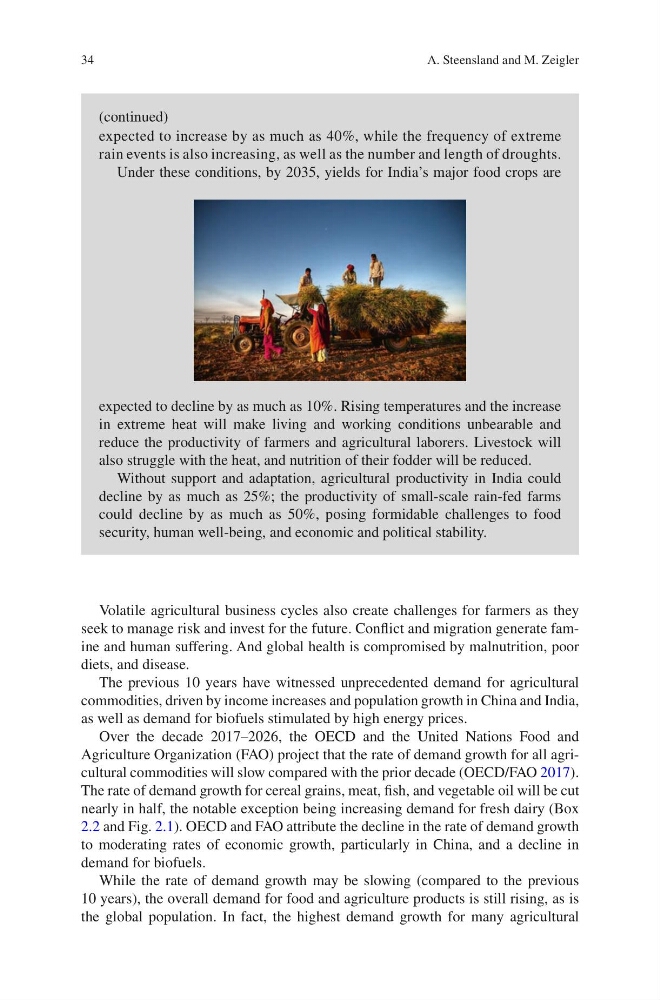
expected to increase by as much as 40%, while the frequency of extreme
rain events is also increasing, as well as the number and length of droughts.
Under these conditions, by 2035, yields for India’s major food crops are
expected to decline by as much as 10%. Rising temperatures and the increase
in extreme heat will make living and working conditions unbearable and
reduce the productivity of farmers and agricultural laborers. Livestock will
also struggle with the heat, and nutrition of their fodder will be reduced.
Without support and adaptation, agricultural productivity in India could
decline by as much as 25%; the productivity of small-scale rain-fed farms
could decline by as much as 50%, posing formidable challenges to food
security, human well-being, and economic and political stability.
(continued)
A. Steensland and M. Zeigler
Volatile agricultural business cycles also create challenges for farmers as they
seek to manage risk and invest for the future. Conflict and migration generate famine and human suffering. And global health is compromised by malnutrition, poor
diets, and disease.
The previous 10 years have witnessed unprecedented demand for agricultural
commodities, driven by income increases and population growth in China and India,
as well as demand for biofuels stimulated by high energy prices.
Over the decade 2017–2026, the OECD and the United Nations Food and
Agriculture Organization (FAO) project that the rate of demand growth for all agricultural commodities will slow compared with the prior decade (OECD/FAO 2017).
The rate of demand growth for cereal grains, meat, fish, and vegetable oil will be cut
nearly in half, the notable exception being increasing demand for fresh dairy (Box
2.2 and Fig. 2.1). OECD and FAO attribute the decline in the rate of demand growth
to moderating rates of economic growth, particularly in China, and a decline in
demand for biofuels.
While the rate of demand growth may be slowing (compared to the previous
10 years), the overall demand for food and agriculture products is still rising, as is
the global population. In fact, the highest demand growth for many agricultural
expected to increase by as much as 40%, while the frequency of extreme
rain events is also increasing, as well as the number and length of droughts.
Under these conditions, by 2035, yields for India’s major food crops are
expected to decline by as much as 10%. Rising temperatures and the increase
in extreme heat will make living and working conditions unbearable and
reduce the productivity of farmers and agricultural laborers. Livestock will
also struggle with the heat, and nutrition of their fodder will be reduced.
Without support and adaptation, agricultural productivity in India could
decline by as much as 25%; the productivity of small-scale rain-fed farms
could decline by as much as 50%, posing formidable challenges to food
security, human well-being, and economic and political stability.
(continued)
A. Steensland and M. Zeigler