

216
8.4 Dimensions of Big Data
Although of relatively recent origin, numerous attempts have been made to define
big data. For example:
• The phrase “big data” refers to large, diverse, complex, longitudinal, and/or
distributed datasets generated from instruments, sensors, Internet transactions,
email, video, click streams, and/or all other digital sources available today and in
the future (National Science Foundation 2012).
• Big data shall mean the datasets that could not be perceived, acquired, managed,
and processed by traditional IT and software/hardware tools within a tolerable
time (Chen et al. 2014)
• Big data is where the data volume, acquisition velocity, or data representation
(variety) limits the ability to perform effective analysis using traditional relational approaches or requires the use of significant horizontal scaling for efficient
processing (Cooper and Mell 2012).
• Big data is a high-volume, high-velocity, and high-variety information asset that
demands cost-effective, innovative forms of information processing for enhanced
insight and decision making (Gartner IT Glossary 2012).
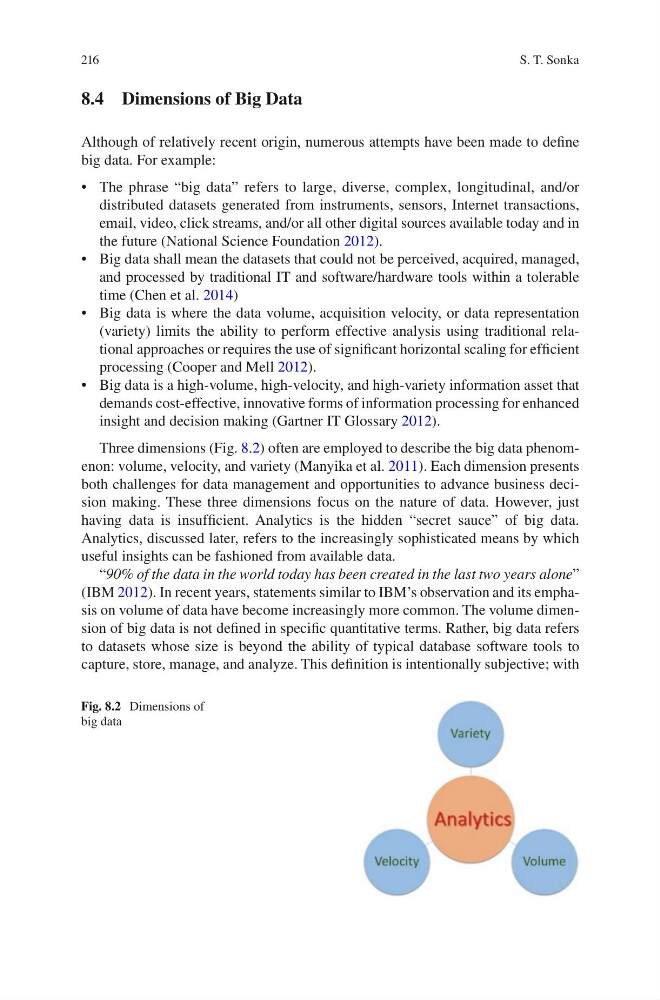
Three dimensions (Fig. 8.2) often are employed to describe the big data phenomenon: volume, velocity, and variety (Manyika et al. 2011). Each dimension presents
both challenges for data management and opportunities to advance business decision making. These three dimensions focus on the nature of data. However, just
having data is insufficient. Analytics is the hidden “secret sauce” of big data.
Analytics, discussed later, refers to the increasingly sophisticated means by which
useful insights can be fashioned from available data.
“90% of the data in the world today has been created in the last two years alone”
(IBM 2012). In recent years, statements similar to IBM’s observation and its emphasis on volume of data have become increasingly more common. The volume dimension of big data is not defined in specific quantitative terms. Rather, big data refers
to datasets whose size is beyond the ability of typical database software tools to
capture, store, manage, and analyze. This definition is intentionally subjective; with
Fig. 8.2 Dimensions of
big data
S. T. Sonka
8.4 Dimensions of Big Data
Although of relatively recent origin, numerous attempts have been made to define
big data. For example:
• The phrase “big data” refers to large, diverse, complex, longitudinal, and/or
distributed datasets generated from instruments, sensors, Internet transactions,
email, video, click streams, and/or all other digital sources available today and in
the future (National Science Foundation 2012).
• Big data shall mean the datasets that could not be perceived, acquired, managed,
and processed by traditional IT and software/hardware tools within a tolerable
time (Chen et al. 2014)
• Big data is where the data volume, acquisition velocity, or data representation
(variety) limits the ability to perform effective analysis using traditional relational approaches or requires the use of significant horizontal scaling for efficient
processing (Cooper and Mell 2012).
• Big data is a high-volume, high-velocity, and high-variety information asset that
demands cost-effective, innovative forms of information processing for enhanced
insight and decision making (Gartner IT Glossary 2012).
Three dimensions (Fig. 8.2) often are employed to describe the big data phenomenon: volume, velocity, and variety (Manyika et al. 2011). Each dimension presents
both challenges for data management and opportunities to advance business decision making. These three dimensions focus on the nature of data. However, just
having data is insufficient. Analytics is the hidden “secret sauce” of big data.
Analytics, discussed later, refers to the increasingly sophisticated means by which
useful insights can be fashioned from available data.
“90% of the data in the world today has been created in the last two years alone”
(IBM 2012). In recent years, statements similar to IBM’s observation and its emphasis on volume of data have become increasingly more common. The volume dimension of big data is not defined in specific quantitative terms. Rather, big data refers
to datasets whose size is beyond the ability of typical database software tools to
capture, store, manage, and analyze. This definition is intentionally subjective; with
Fig. 8.2 Dimensions of
big data
S. T. Sonka