

215
single- digit levels. Since then, steady increases in the extent of acreage covered
have occurred. However, the most utilized practice, application of lime, is only now
achieving coverage on 40% of the total acreage. These patterns also are interesting
because of the very different price regimes that existed for corn and soybeans over
these 15 years. When output prices were low prior to 2008, the driver for adoption
likely was cost reduction. Possibly, increasing yields were a more significant factor
in later years when prices were higher.
Media and marketing attention sometimes blur distinctions between precision
agriculture and big data. Some communications seem to suggest that big data is just
an updated buzzword for precision agriculture practices. That is not the case, and
the main differences among these two concepts are as follows:
• While the farmer has several types of precision data from each field, additional
sources of data naturally reside and originate beyond the fencerow. Accessing
that information raises both technical and organizational challenges.
• Precision agriculture employs comparisons across field map layers as its dominant method of analysis. The effect of a single factor, such as a blocked tile line
or a buried fencerow, often is observable from a map. However, identifying complex interactions across several production factors and multiple years requires
much more sophisticated tools.
• As noted previously, precision agriculture has had 20+ years of experience.
Aggregating all the digital information collected from yield monitors and sitespecific input operations would result in an extremely large set of data. However,
that data currently is located on innumerable thumb drives, disk drives, and desktop computers. Large-scale analysis would not be possible unless/until that data
can be accessed and aggregated.
Both precision agriculture and big data arise from the advent and application of
information and communication technologies. As noted previously, they are not
synonymous. That said, it is hard to foresee that big data approaches will have significant impact without employing the data generated by precision agriculture
practices.
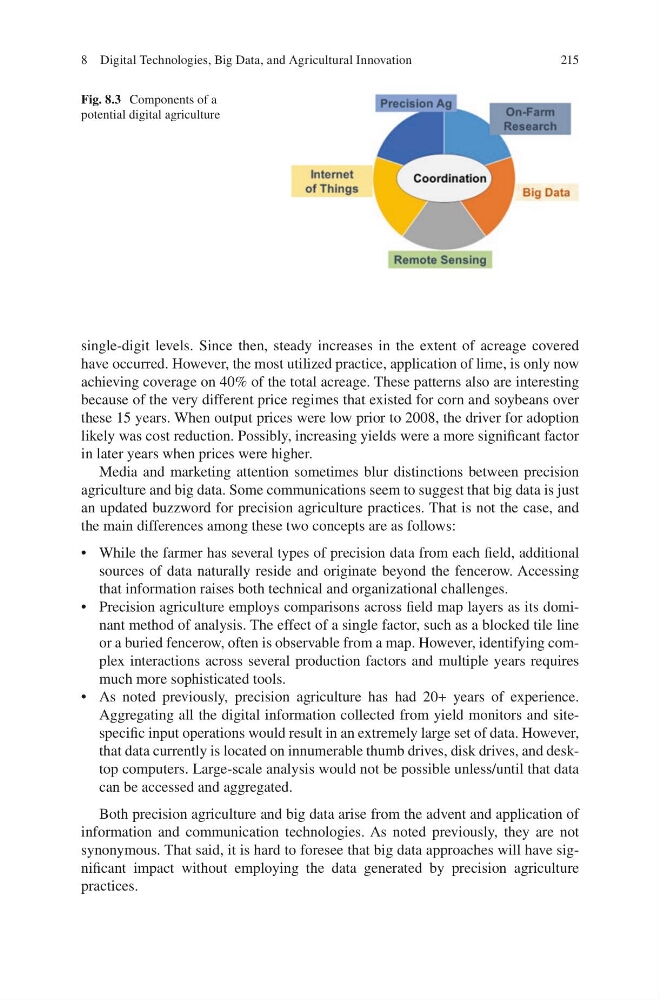
Fig. 8.3 Components of a
potential digital agriculture
8 Digital Technologies, Big Data, and Agricultural Innovation
single- digit levels. Since then, steady increases in the extent of acreage covered
have occurred. However, the most utilized practice, application of lime, is only now
achieving coverage on 40% of the total acreage. These patterns also are interesting
because of the very different price regimes that existed for corn and soybeans over
these 15 years. When output prices were low prior to 2008, the driver for adoption
likely was cost reduction. Possibly, increasing yields were a more significant factor
in later years when prices were higher.
Media and marketing attention sometimes blur distinctions between precision
agriculture and big data. Some communications seem to suggest that big data is just
an updated buzzword for precision agriculture practices. That is not the case, and
the main differences among these two concepts are as follows:
• While the farmer has several types of precision data from each field, additional
sources of data naturally reside and originate beyond the fencerow. Accessing
that information raises both technical and organizational challenges.
• Precision agriculture employs comparisons across field map layers as its dominant method of analysis. The effect of a single factor, such as a blocked tile line
or a buried fencerow, often is observable from a map. However, identifying complex interactions across several production factors and multiple years requires
much more sophisticated tools.
• As noted previously, precision agriculture has had 20+ years of experience.
Aggregating all the digital information collected from yield monitors and sitespecific input operations would result in an extremely large set of data. However,
that data currently is located on innumerable thumb drives, disk drives, and desktop computers. Large-scale analysis would not be possible unless/until that data
can be accessed and aggregated.
Both precision agriculture and big data arise from the advent and application of
information and communication technologies. As noted previously, they are not
synonymous. That said, it is hard to foresee that big data approaches will have significant impact without employing the data generated by precision agriculture
practices.
Fig. 8.3 Components of a
potential digital agriculture
8 Digital Technologies, Big Data, and Agricultural Innovation