

181
Today (2018), hunger has been dramatically reduced around the world. According
to FAO “State of Food Security and Nutrition 2018,” out of a world population of
well over 7.6 billion, only approximately 821 million are undernourished (FAO,
IFAD, UNICEF, WFP and WHO 2018). This is a dramatic decrease from 30 years
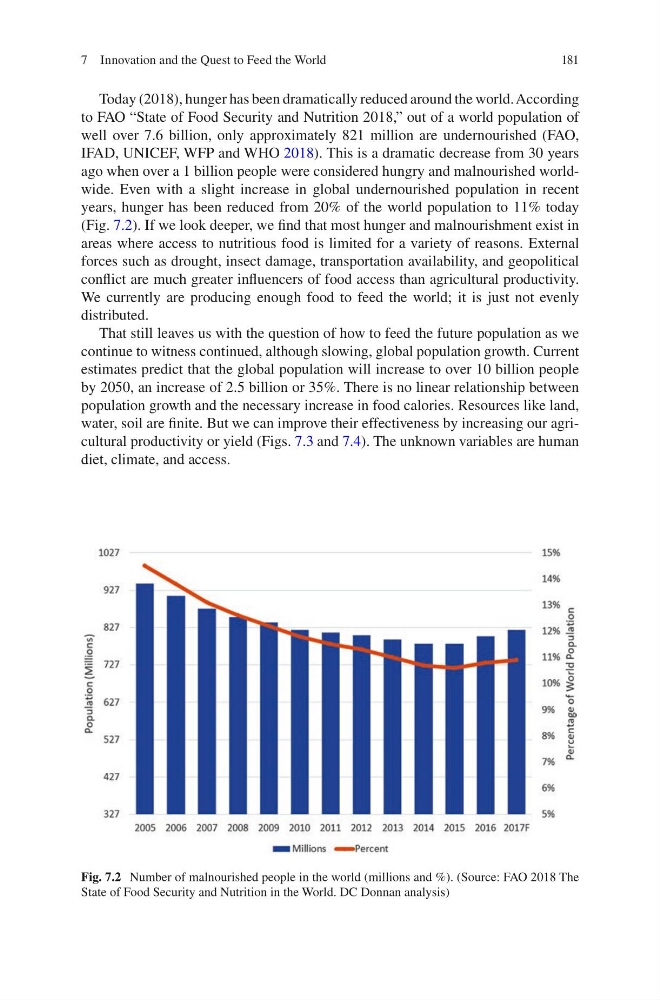
ago when over a 1 billion people were considered hungry and malnourished worldwide. Even with a slight increase in global undernourished population in recent
years, hunger has been reduced from 20% of the world population to 11% today
(Fig. 7.2). If we look deeper, we find that most hunger and malnourishment exist in
areas where access to nutritious food is limited for a variety of reasons. External
forces such as drought, insect damage, transportation availability, and geopolitical
conflict are much greater influencers of food access than agricultural productivity.
We currently are producing enough food to feed the world; it is just not evenly
distributed.
That still leaves us with the question of how to feed the future population as we
continue to witness continued, although slowing, global population growth. Current
estimates predict that the global population will increase to over 10 billion people
by 2050, an increase of 2.5 billion or 35%. There is no linear relationship between
population growth and the necessary increase in food calories. Resources like land,
water, soil are finite. But we can improve their effectiveness by increasing our agricultural productivity or yield (Figs. 7.3 and 7.4). The unknown variables are human
diet, climate, and access.
Fig. 7.2 Number of malnourished people in the world (millions and %). (Source: FAO 2018 The
State of Food Security and Nutrition in the World. DC Donnan analysis)
7 Innovation and the Quest to Feed the World
Today (2018), hunger has been dramatically reduced around the world. According
to FAO “State of Food Security and Nutrition 2018,” out of a world population of
well over 7.6 billion, only approximately 821 million are undernourished (FAO,
IFAD, UNICEF, WFP and WHO 2018). This is a dramatic decrease from 30 years
ago when over a 1 billion people were considered hungry and malnourished worldwide. Even with a slight increase in global undernourished population in recent
years, hunger has been reduced from 20% of the world population to 11% today
(Fig. 7.2). If we look deeper, we find that most hunger and malnourishment exist in
areas where access to nutritious food is limited for a variety of reasons. External
forces such as drought, insect damage, transportation availability, and geopolitical
conflict are much greater influencers of food access than agricultural productivity.
We currently are producing enough food to feed the world; it is just not evenly
distributed.
That still leaves us with the question of how to feed the future population as we
continue to witness continued, although slowing, global population growth. Current
estimates predict that the global population will increase to over 10 billion people
by 2050, an increase of 2.5 billion or 35%. There is no linear relationship between
population growth and the necessary increase in food calories. Resources like land,
water, soil are finite. But we can improve their effectiveness by increasing our agricultural productivity or yield (Figs. 7.3 and 7.4). The unknown variables are human
diet, climate, and access.
Fig. 7.2 Number of malnourished people in the world (millions and %). (Source: FAO 2018 The
State of Food Security and Nutrition in the World. DC Donnan analysis)
7 Innovation and the Quest to Feed the World