

180
Structured, sustainable agriculture allowed civilization to take root and develop.
Small tribal encampments became villages, then city-states, and eventually nations
(Harari 2015).
The development of agriculture and subsequent agricultural revolutions allowed
for accelerated population growth. Eventually it evolved from simply enabling population growth to reducing hunger resulting from population growth. As population
centers grew, fewer people were involved in agriculture and farmers role shifted
from self-sufficient harvests for their families to feeding all the members of the
community. How to feed a growing planet has been an issue of public discourse for
centuries, perhaps since Thomas Malthus wrote in 1798 that “the power of population is so superior to the power of the earth to produce subsistence for man, that
premature death must in some shape or other visit the human race” (Malthus 1798).
Fortunately Malthus’s warning has not come to pass, thanks largely to various technological innovations (first mechanized farming tools, later nitrogen fertilizers, and
subsequently the genetic improvement of crops which through the green revolution,
the development of transgenic crops and other scientific progress has enabled dramatic increases of productivity in most crops) that have aided the “power of the
earth” to meet the demands of a population that has increased eightfold since the
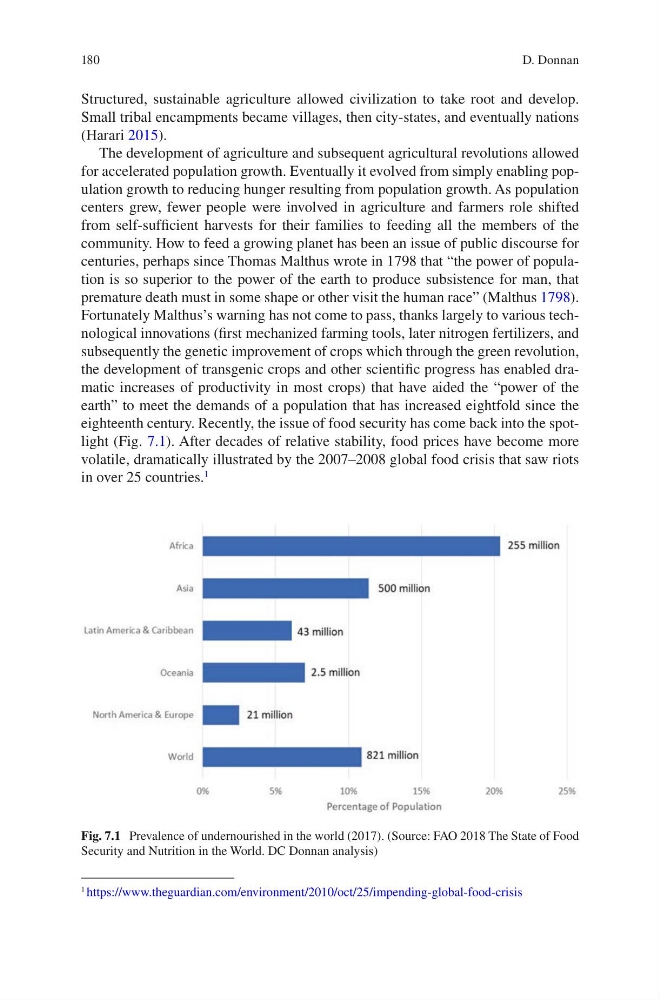
eighteenth century. Recently, the issue of food security has come back into the spotlight (Fig. 7.1). After decades of relative stability, food prices have become more
volatile, dramatically illustrated by the 2007–2008 global food crisis that saw riots
in over 25 countries.
1
1 https://www.theguardian.com/environment/2010/oct/25/impending-global-food-crisis
Fig. 7.1 Prevalence of undernourished in the world (2017). (Source: FAO 2018 The State of Food
Security and Nutrition in the World. DC Donnan analysis)
D. Donnan
Structured, sustainable agriculture allowed civilization to take root and develop.
Small tribal encampments became villages, then city-states, and eventually nations
(Harari 2015).
The development of agriculture and subsequent agricultural revolutions allowed
for accelerated population growth. Eventually it evolved from simply enabling population growth to reducing hunger resulting from population growth. As population
centers grew, fewer people were involved in agriculture and farmers role shifted
from self-sufficient harvests for their families to feeding all the members of the
community. How to feed a growing planet has been an issue of public discourse for
centuries, perhaps since Thomas Malthus wrote in 1798 that “the power of population is so superior to the power of the earth to produce subsistence for man, that
premature death must in some shape or other visit the human race” (Malthus 1798).
Fortunately Malthus’s warning has not come to pass, thanks largely to various technological innovations (first mechanized farming tools, later nitrogen fertilizers, and
subsequently the genetic improvement of crops which through the green revolution,
the development of transgenic crops and other scientific progress has enabled dramatic increases of productivity in most crops) that have aided the “power of the
earth” to meet the demands of a population that has increased eightfold since the
eighteenth century. Recently, the issue of food security has come back into the spotlight (Fig. 7.1). After decades of relative stability, food prices have become more
volatile, dramatically illustrated by the 2007–2008 global food crisis that saw riots
in over 25 countries.
1
1 https://www.theguardian.com/environment/2010/oct/25/impending-global-food-crisis
Fig. 7.1 Prevalence of undernourished in the world (2017). (Source: FAO 2018 The State of Food
Security and Nutrition in the World. DC Donnan analysis)
D. Donnan