

126
5.3.2 Eight Sustainable Business Model Archetypes
The research framework, which was used to address the research questions stated
above, namely, (i) “How do Swedish agri-companies apply sustainable innovation
practices?”, (ii) “Which sustainable business models do Swedish agri-companies
use” and (iii) “How can these innovation practices and sustainable business models
be understood?”, is also based on Bocken et al.’s (2014) eight SBM archetypes. In
turn, they build their archetypes on the nine business model “building blocks” of the
business model canvas (Osterwalder and Pigneur (2012), Boons and Lüdeke-Freund
(2013) reference. Among the blocks most relevant to our study are value propositions, key activities, key partnerships and revenue streams. Building on this key tool
for the analysis of business models, Bocken et al. (2014) add sustainable social and
environmental activities. They (p. 44) define SBMs as follows:
Innovations that create significant positive and/or significantly reduced negative impacts for
the environment and/or society, through changes in the way the organisation and its valuenetwork create, deliver value and capture value (i.e. create economic value) or change their
value propositions.
Table 5.4 presents Bocken et al.’s (2014) eight SBM archetypes. These archetypes
can be used in order to identify patterns and attributes that facilitate the categorization of the business model innovations for social and environmental sustainability.
The archetypes can constitute a base for the development of a common language for
the development of sustainable business models in research and practice.
5.3.3 A Combined SOI and SBM Archetypes Framework
In this chapter, the framework developed by Adams et al. (2016) focusing on
sustainability- oriented innovations (SOI) is integrated with the framework containing eight different SBM archetypes developed by Bocken et al. (2014) (see
Table 5.5). The idea behind combining these two frameworks, which was developed
by Ulvenblad et al. (2019), is to categorize the business model innovations and
study the organizational development (the sustainability-oriented innovation practices and processes) taken by agri-companies in Sweden.
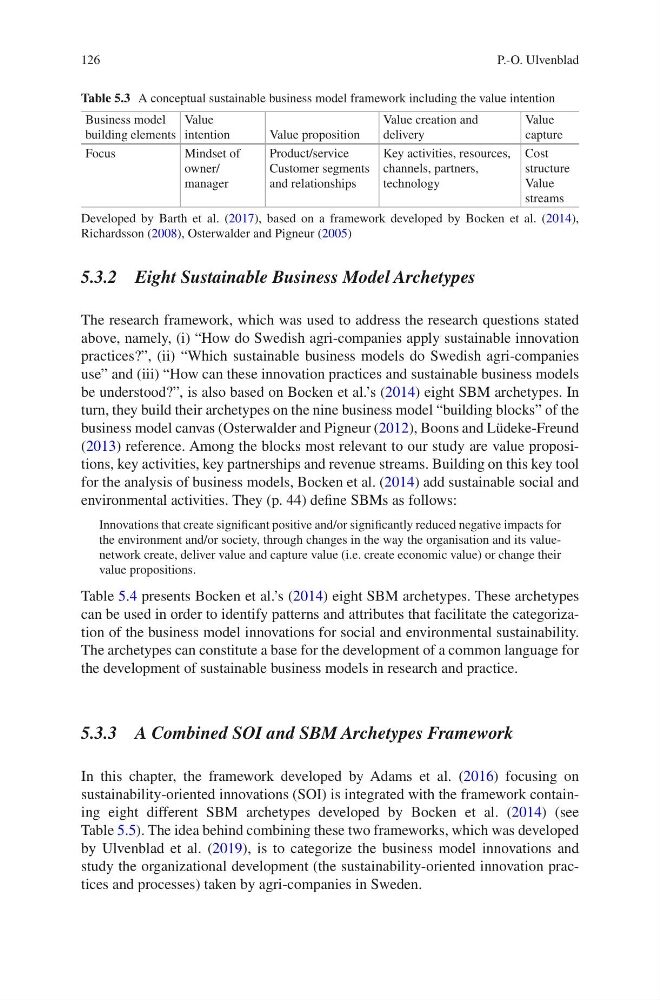
Table 5.3 A conceptual sustainable business model framework including the value intention
Business model
building elements
Value
intention
Value proposition
Value creation and
delivery
Value
capture
Focus
Mindset of
owner/
manager
Product/service
Customer segments
and relationships
Key activities, resources,
channels, partners,
technology
Cost
structure
Value
streams
Developed by Barth et al. (2017), based on a framework developed by Bocken et al. (2014),
Richardsson (2008), Osterwalder and Pigneur (2005)
P.-O. Ulvenblad
5.3.2 Eight Sustainable Business Model Archetypes
The research framework, which was used to address the research questions stated
above, namely, (i) “How do Swedish agri-companies apply sustainable innovation
practices?”, (ii) “Which sustainable business models do Swedish agri-companies
use” and (iii) “How can these innovation practices and sustainable business models
be understood?”, is also based on Bocken et al.’s (2014) eight SBM archetypes. In
turn, they build their archetypes on the nine business model “building blocks” of the
business model canvas (Osterwalder and Pigneur (2012), Boons and Lüdeke-Freund
(2013) reference. Among the blocks most relevant to our study are value propositions, key activities, key partnerships and revenue streams. Building on this key tool
for the analysis of business models, Bocken et al. (2014) add sustainable social and
environmental activities. They (p. 44) define SBMs as follows:
Innovations that create significant positive and/or significantly reduced negative impacts for
the environment and/or society, through changes in the way the organisation and its valuenetwork create, deliver value and capture value (i.e. create economic value) or change their
value propositions.
Table 5.4 presents Bocken et al.’s (2014) eight SBM archetypes. These archetypes
can be used in order to identify patterns and attributes that facilitate the categorization of the business model innovations for social and environmental sustainability.
The archetypes can constitute a base for the development of a common language for
the development of sustainable business models in research and practice.
5.3.3 A Combined SOI and SBM Archetypes Framework
In this chapter, the framework developed by Adams et al. (2016) focusing on
sustainability- oriented innovations (SOI) is integrated with the framework containing eight different SBM archetypes developed by Bocken et al. (2014) (see
Table 5.5). The idea behind combining these two frameworks, which was developed
by Ulvenblad et al. (2019), is to categorize the business model innovations and
study the organizational development (the sustainability-oriented innovation practices and processes) taken by agri-companies in Sweden.
Table 5.3 A conceptual sustainable business model framework including the value intention
Business model
building elements
Value
intention
Value proposition
Value creation and
delivery
Value
capture
Focus
Mindset of
owner/
manager
Product/service
Customer segments
and relationships
Key activities, resources,
channels, partners,
technology
Cost
structure
Value
streams
Developed by Barth et al. (2017), based on a framework developed by Bocken et al. (2014),
Richardsson (2008), Osterwalder and Pigneur (2005)
P.-O. Ulvenblad