

124
proposition is typically concerned with the product and/or service offering to generate economic return (Boons and Lüdeke-Freund 2013). Value creation and delivery
is at the centre of any business model, and companies create and deliver value by
seizing new business opportunities, new markets and new revenue streams
(Beltramello et al. 2013; Teece 2010). Value capture is about considering how to
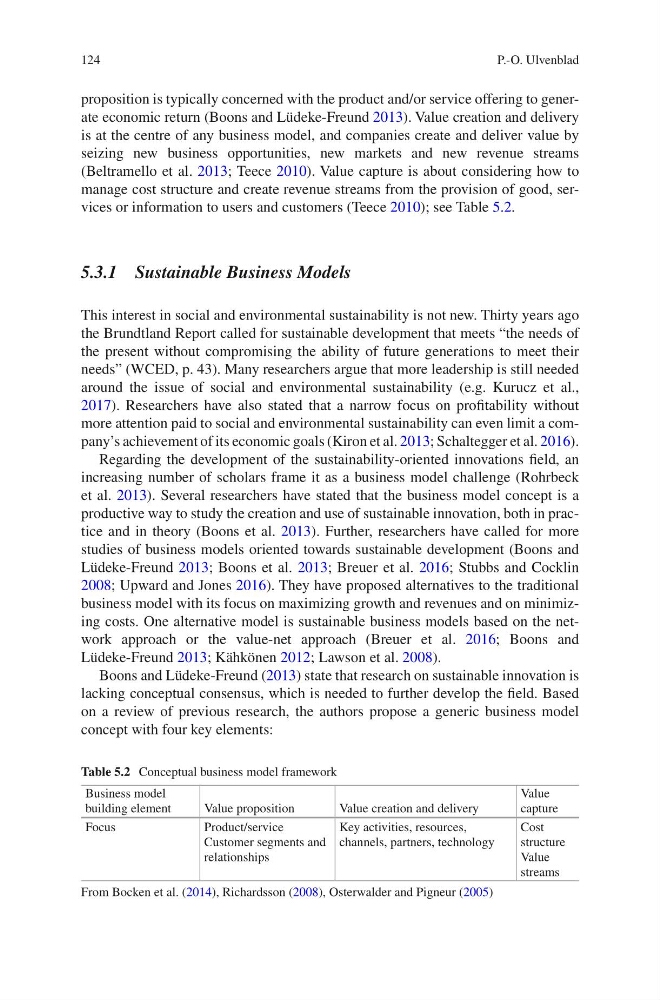
manage cost structure and create revenue streams from the provision of good, services or information to users and customers (Teece 2010); see Table 5.2.
5.3.1 Sustainable Business Models
This interest in social and environmental sustainability is not new. Thirty years ago
the Brundtland Report called for sustainable development that meets “the needs of
the present without compromising the ability of future generations to meet their
needs” (WCED, p. 43). Many researchers argue that more leadership is still needed
around the issue of social and environmental sustainability (e.g. Kurucz et al.,
2017). Researchers have also stated that a narrow focus on profitability without
more attention paid to social and environmental sustainability can even limit a company’s achievement of its economic goals (Kiron et al. 2013; Schaltegger et al. 2016).
Regarding the development of the sustainability-oriented innovations field, an
increasing number of scholars frame it as a business model challenge (Rohrbeck
et al. 2013). Several researchers have stated that the business model concept is a
productive way to study the creation and use of sustainable innovation, both in practice and in theory (Boons et al. 2013). Further, researchers have called for more
studies of business models oriented towards sustainable development (Boons and
Lüdeke-Freund 2013; Boons et al. 2013; Breuer et al. 2016; Stubbs and Cocklin
2008; Upward and Jones 2016). They have proposed alternatives to the traditional
business model with its focus on maximizing growth and revenues and on minimizing costs. One alternative model is sustainable business models based on the network approach or the value-net approach (Breuer et al. 2016; Boons and
Lüdeke-Freund 2013; Kähkönen 2012; Lawson et al. 2008).
Boons and Lüdeke-Freund (2013) state that research on sustainable innovation is
lacking conceptual consensus, which is needed to further develop the field. Based
on a review of previous research, the authors propose a generic business model
concept with four key elements:
Table 5.2 Conceptual business model framework
Business model
building element
Value proposition
Value creation and delivery
Value
capture
Focus
Product/service
Customer segments and
relationships
Key activities, resources,
channels, partners, technology
Cost
structure
Value
streams
From Bocken et al. (2014), Richardsson (2008), Osterwalder and Pigneur (2005)
P.-O. Ulvenblad
proposition is typically concerned with the product and/or service offering to generate economic return (Boons and Lüdeke-Freund 2013). Value creation and delivery
is at the centre of any business model, and companies create and deliver value by
seizing new business opportunities, new markets and new revenue streams
(Beltramello et al. 2013; Teece 2010). Value capture is about considering how to
manage cost structure and create revenue streams from the provision of good, services or information to users and customers (Teece 2010); see Table 5.2.
5.3.1 Sustainable Business Models
This interest in social and environmental sustainability is not new. Thirty years ago
the Brundtland Report called for sustainable development that meets “the needs of
the present without compromising the ability of future generations to meet their
needs” (WCED, p. 43). Many researchers argue that more leadership is still needed
around the issue of social and environmental sustainability (e.g. Kurucz et al.,
2017). Researchers have also stated that a narrow focus on profitability without
more attention paid to social and environmental sustainability can even limit a company’s achievement of its economic goals (Kiron et al. 2013; Schaltegger et al. 2016).
Regarding the development of the sustainability-oriented innovations field, an
increasing number of scholars frame it as a business model challenge (Rohrbeck
et al. 2013). Several researchers have stated that the business model concept is a
productive way to study the creation and use of sustainable innovation, both in practice and in theory (Boons et al. 2013). Further, researchers have called for more
studies of business models oriented towards sustainable development (Boons and
Lüdeke-Freund 2013; Boons et al. 2013; Breuer et al. 2016; Stubbs and Cocklin
2008; Upward and Jones 2016). They have proposed alternatives to the traditional
business model with its focus on maximizing growth and revenues and on minimizing costs. One alternative model is sustainable business models based on the network approach or the value-net approach (Breuer et al. 2016; Boons and
Lüdeke-Freund 2013; Kähkönen 2012; Lawson et al. 2008).
Boons and Lüdeke-Freund (2013) state that research on sustainable innovation is
lacking conceptual consensus, which is needed to further develop the field. Based
on a review of previous research, the authors propose a generic business model
concept with four key elements:
Table 5.2 Conceptual business model framework
Business model
building element
Value proposition
Value creation and delivery
Value
capture
Focus
Product/service
Customer segments and
relationships
Key activities, resources,
channels, partners, technology
Cost
structure
Value
streams
From Bocken et al. (2014), Richardsson (2008), Osterwalder and Pigneur (2005)
P.-O. Ulvenblad