

123
5.3 Business Models
Business models are descriptions of how companies create value through exploitation of business opportunities (Rosca et al. 2017). Business models can be regarded
as structured management tools, which are considered especially relevant for success (Magretta 2002). The research regarding business models has been growing
since the mid-1990s (Osterwalder and Pigneur 2012). In recent years, research has
put a steadily increasing focus on business models (Wirtz et al. 2016).
Most of this research addresses the importance of business models for companies’ competitiveness, renewal and growth (Chesbrough and Rosenbloom 2002;
Johnson 2010; Lambert and Davidson 2013; Teece 2010). Companies can apply
several business models simultaneously, regarding, e.g. different products or markets (e.g. Aspara et al. 2013; Casadesus-Masanell and Tarziján 2012).
Researchers have used a variety of business models’ definitions and settings in
their studies, from the single company to the entire value network (Johnson 2010,
Zott et al. 2011, Osterwalder and Pigneur, 2012). Even though empirical research on
business models in 1996–2010 has focused on media, information technology and
biotechnology industries (Lambert and Davidson 2013), a newly conducted structured literature review shows that the number of articles published regarding business models in food production has grown during the last 5 years (Tell et al. 2016).
However, Wirtz et al. (2016) state that the growing field of research for the business
model is in a consolidation phase, which still contains research gaps and thus offers
possibilities for future research. The researchers suggest that research about business models’ forms and components should be empirically validated, since a certain
heterogeneity regarding this research area’s focus has been determined.
Several researchers have discussed the central building elements of a business
model: (i) value proposition, (ii) value creation and delivery and (iii) value capture
(Bocken et al. 2014; Richardsson 2008; Osterwalder and Pigneur 2005). The value
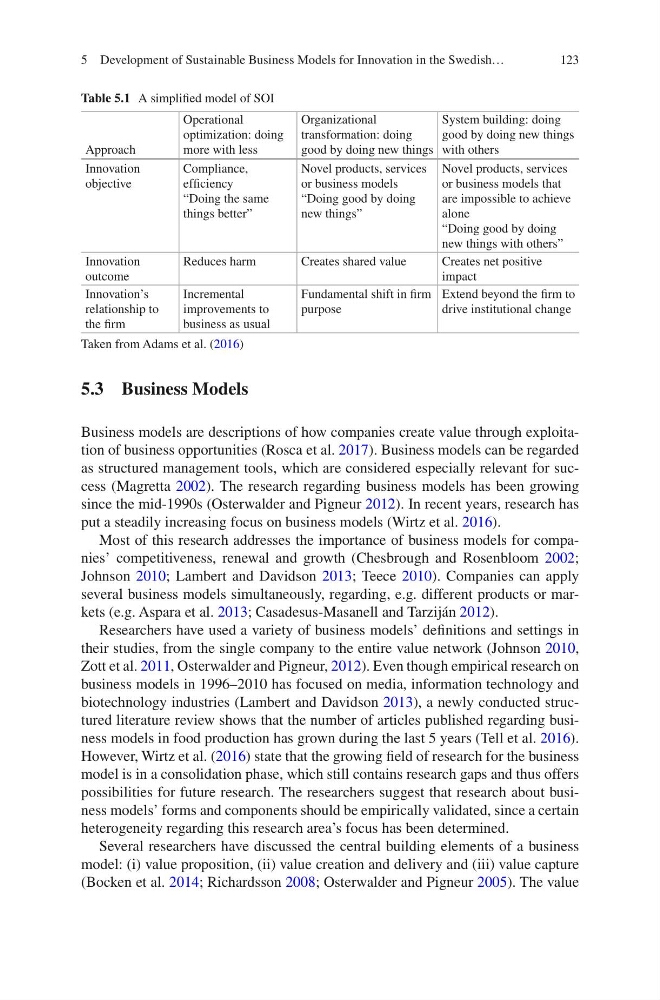
Table 5.1 A simplified model of SOI
Approach
Operational
optimization: doing
more with less
Organizational
transformation: doing
good by doing new things
System building: doing
good by doing new things
with others
Innovation
objective
Compliance,
efficiency
“Doing the same
things better”
Novel products, services
or business models
“Doing good by doing
new things”
Novel products, services
or business models that
are impossible to achieve
alone
“Doing good by doing
new things with others”
Innovation
outcome
Reduces harm
Creates shared value
Creates net positive
impact
Innovation’s
relationship to
the firm
Incremental
improvements to
business as usual
Fundamental shift in firm
purpose
Extend beyond the firm to
drive institutional change
Taken from Adams et al. (2016)
5 Development of Sustainable Business Models for Innovation in the Swedish…
5.3 Business Models
Business models are descriptions of how companies create value through exploitation of business opportunities (Rosca et al. 2017). Business models can be regarded
as structured management tools, which are considered especially relevant for success (Magretta 2002). The research regarding business models has been growing
since the mid-1990s (Osterwalder and Pigneur 2012). In recent years, research has
put a steadily increasing focus on business models (Wirtz et al. 2016).
Most of this research addresses the importance of business models for companies’ competitiveness, renewal and growth (Chesbrough and Rosenbloom 2002;
Johnson 2010; Lambert and Davidson 2013; Teece 2010). Companies can apply
several business models simultaneously, regarding, e.g. different products or markets (e.g. Aspara et al. 2013; Casadesus-Masanell and Tarziján 2012).
Researchers have used a variety of business models’ definitions and settings in
their studies, from the single company to the entire value network (Johnson 2010,
Zott et al. 2011, Osterwalder and Pigneur, 2012). Even though empirical research on
business models in 1996–2010 has focused on media, information technology and
biotechnology industries (Lambert and Davidson 2013), a newly conducted structured literature review shows that the number of articles published regarding business models in food production has grown during the last 5 years (Tell et al. 2016).
However, Wirtz et al. (2016) state that the growing field of research for the business
model is in a consolidation phase, which still contains research gaps and thus offers
possibilities for future research. The researchers suggest that research about business models’ forms and components should be empirically validated, since a certain
heterogeneity regarding this research area’s focus has been determined.
Several researchers have discussed the central building elements of a business
model: (i) value proposition, (ii) value creation and delivery and (iii) value capture
(Bocken et al. 2014; Richardsson 2008; Osterwalder and Pigneur 2005). The value
Table 5.1 A simplified model of SOI
Approach
Operational
optimization: doing
more with less
Organizational
transformation: doing
good by doing new things
System building: doing
good by doing new things
with others
Innovation
objective
Compliance,
efficiency
“Doing the same
things better”
Novel products, services
or business models
“Doing good by doing
new things”
Novel products, services
or business models that
are impossible to achieve
alone
“Doing good by doing
new things with others”
Innovation
outcome
Reduces harm
Creates shared value
Creates net positive
impact
Innovation’s
relationship to
the firm
Incremental
improvements to
business as usual
Fundamental shift in firm
purpose
Extend beyond the firm to
drive institutional change
Taken from Adams et al. (2016)
5 Development of Sustainable Business Models for Innovation in the Swedish…