

107
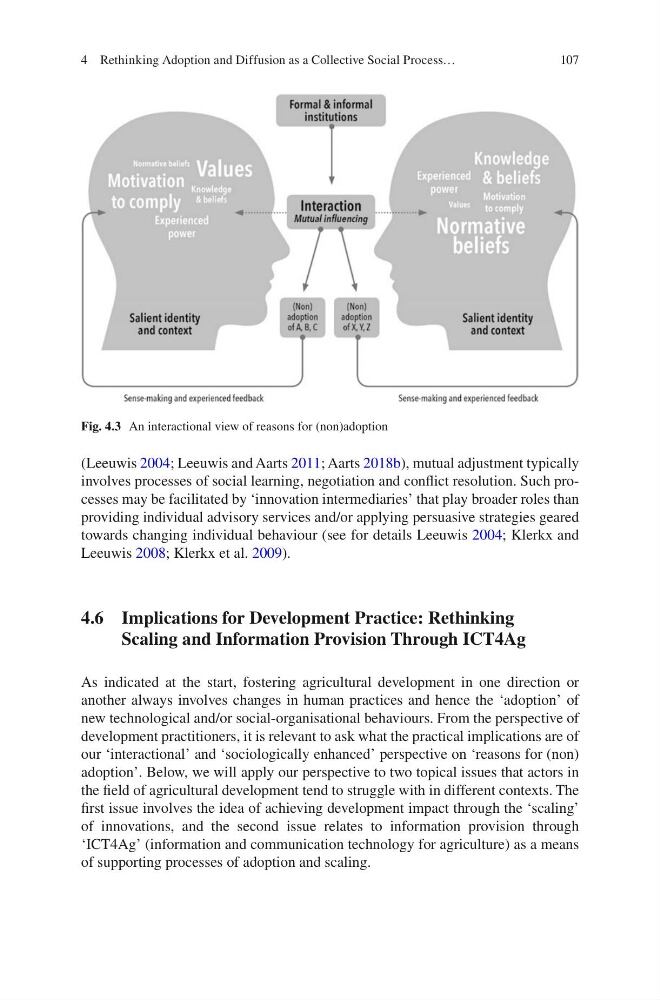
(Leeuwis 2004; Leeuwis and Aarts 2011; Aarts 2018b), mutual adjustment typically
involves processes of social learning, negotiation and conflict resolution. Such processes may be facilitated by ‘innovation intermediaries’ that play broader roles than
providing individual advisory services and/or applying persuasive strategies geared
towards changing individual behaviour (see for details Leeuwis 2004; Klerkx and
Leeuwis 2008; Klerkx et al. 2009).
4.6 Implications for Development Practice: Rethinking
Scaling and Information Provision Through ICT4Ag
As indicated at the start, fostering agricultural development in one direction or
another always involves changes in human practices and hence the ‘adoption’ of
new technological and/or social-organisational behaviours. From the perspective of
development practitioners, it is relevant to ask what the practical implications are of
our ‘interactional’ and ‘sociologically enhanced’ perspective on ‘reasons for (non)
adoption’. Below, we will apply our perspective to two topical issues that actors in
the field of agricultural development tend to struggle with in different contexts. The
first issue involves the idea of achieving development impact through the ‘scaling’
of innovations, and the second issue relates to information provision through
‘ICT4Ag’ (information and communication technology for agriculture) as a means
of supporting processes of adoption and scaling.
Fig. 4.3 An interactional view of reasons for (non)adoption
4 Rethinking Adoption and Diffusion as a Collective Social Process…
(Leeuwis 2004; Leeuwis and Aarts 2011; Aarts 2018b), mutual adjustment typically
involves processes of social learning, negotiation and conflict resolution. Such processes may be facilitated by ‘innovation intermediaries’ that play broader roles than
providing individual advisory services and/or applying persuasive strategies geared
towards changing individual behaviour (see for details Leeuwis 2004; Klerkx and
Leeuwis 2008; Klerkx et al. 2009).
4.6 Implications for Development Practice: Rethinking
Scaling and Information Provision Through ICT4Ag
As indicated at the start, fostering agricultural development in one direction or
another always involves changes in human practices and hence the ‘adoption’ of
new technological and/or social-organisational behaviours. From the perspective of
development practitioners, it is relevant to ask what the practical implications are of
our ‘interactional’ and ‘sociologically enhanced’ perspective on ‘reasons for (non)
adoption’. Below, we will apply our perspective to two topical issues that actors in
the field of agricultural development tend to struggle with in different contexts. The
first issue involves the idea of achieving development impact through the ‘scaling’
of innovations, and the second issue relates to information provision through
‘ICT4Ag’ (information and communication technology for agriculture) as a means
of supporting processes of adoption and scaling.
Fig. 4.3 An interactional view of reasons for (non)adoption
4 Rethinking Adoption and Diffusion as a Collective Social Process…