

106
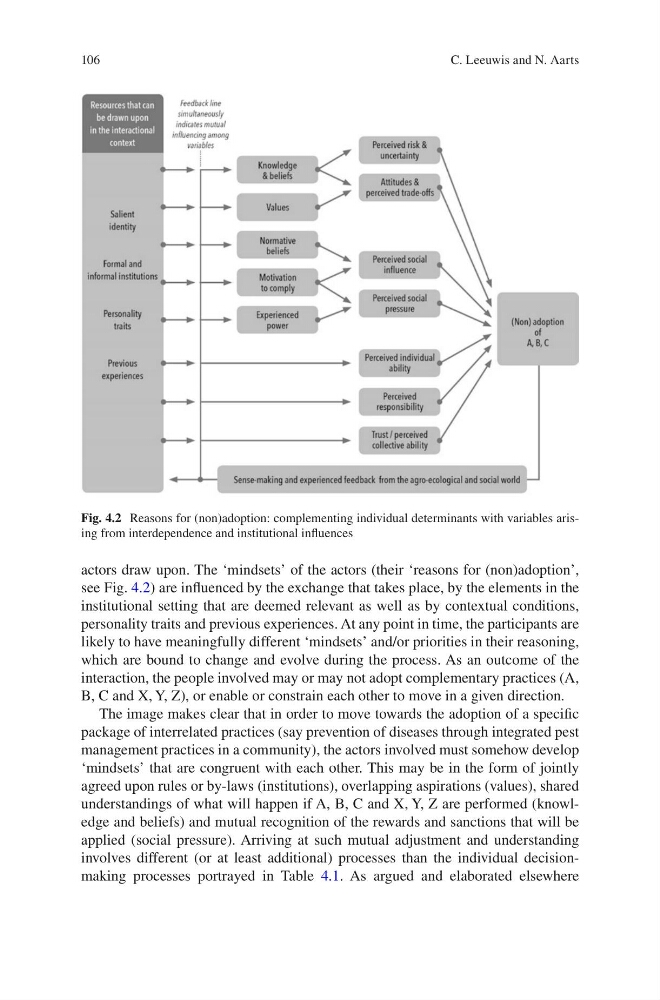
actors draw upon. The ‘mindsets’ of the actors (their ‘reasons for (non)adoption’,
see Fig. 4.2) are influenced by the exchange that takes place, by the elements in the
institutional setting that are deemed relevant as well as by contextual conditions,
personality traits and previous experiences. At any point in time, the participants are
likely to have meaningfully different ‘mindsets’ and/or priorities in their reasoning,
which are bound to change and evolve during the process. As an outcome of the
interaction, the people involved may or may not adopt complementary practices (A,
B, C and X, Y, Z), or enable or constrain each other to move in a given direction.
The image makes clear that in order to move towards the adoption of a specific
package of interrelated practices (say prevention of diseases through integrated pest
management practices in a community), the actors involved must somehow develop
‘mindsets’ that are congruent with each other. This may be in the form of jointly
agreed upon rules or by-laws (institutions), overlapping aspirations (values), shared
understandings of what will happen if A, B, C and X, Y, Z are performed (knowledge and beliefs) and mutual recognition of the rewards and sanctions that will be
applied (social pressure). Arriving at such mutual adjustment and understanding
involves different (or at least additional) processes than the individual decisionmaking processes portrayed in Table 4.1. As argued and elaborated elsewhere
Fig. 4.2 Reasons for (non)adoption: complementing individual determinants with variables arising from interdependence and institutional influences
C. Leeuwis and N. Aarts
actors draw upon. The ‘mindsets’ of the actors (their ‘reasons for (non)adoption’,
see Fig. 4.2) are influenced by the exchange that takes place, by the elements in the
institutional setting that are deemed relevant as well as by contextual conditions,
personality traits and previous experiences. At any point in time, the participants are
likely to have meaningfully different ‘mindsets’ and/or priorities in their reasoning,
which are bound to change and evolve during the process. As an outcome of the
interaction, the people involved may or may not adopt complementary practices (A,
B, C and X, Y, Z), or enable or constrain each other to move in a given direction.
The image makes clear that in order to move towards the adoption of a specific
package of interrelated practices (say prevention of diseases through integrated pest
management practices in a community), the actors involved must somehow develop
‘mindsets’ that are congruent with each other. This may be in the form of jointly
agreed upon rules or by-laws (institutions), overlapping aspirations (values), shared
understandings of what will happen if A, B, C and X, Y, Z are performed (knowledge and beliefs) and mutual recognition of the rewards and sanctions that will be
applied (social pressure). Arriving at such mutual adjustment and understanding
involves different (or at least additional) processes than the individual decisionmaking processes portrayed in Table 4.1. As argued and elaborated elsewhere
Fig. 4.2 Reasons for (non)adoption: complementing individual determinants with variables arising from interdependence and institutional influences
C. Leeuwis and N. Aarts