

100
credit and/or whether farm labourers will be able to make themselves available at
the required time of harvesting. If indeed the variety is new, it is likely to require
adapted behaviours of actors along the value chain, which means that adoption of
the variety by the farmer is dependent on the simultaneous adoption of complementary behaviours by others in the value chain.
Horizontal interdependencies There are many practices in farming that farmers
can only sensibly adopt when other farmers adopt them as well or where adoption
is otherwise dependent on the behaviour of other farmers. There exist many crop
protection strategies, for example, that are only effective when implemented by the
large majority of farmers. If not, sources of infection and disease will continue to
exist, rendering adoption useless. Similarly, the growing of new varieties or crops
may only be profitable when sufficient farmers in the region join, as buyers may
require a certain volume meeting specific quality requirements. Or somewhat differently, farmers in an irrigation scheme or catchment area may only be able to grow a
new variety or crop if upstream farmers refrain from using all the water that is available. Again, we see that adoption by one farmer is dependent on the simultaneous
adoption of the same or complementary behaviours by other farmers.
Intra-individual interdependencies The adoption of a specific behaviour or technology by an individual often presupposes the acceptance and/or implementation of
complementary behaviours by the same individual at more or less the same period
in time. Adopting the use of sanitary gloves when milking cows requires several
‘preparatory behaviours’ such as buying the gloves and instructing family members
how to use them. Similarly, adopting a new crop variety may necessitate an earlier
or later planting or harvesting date, as well as a different spacing of plants in the
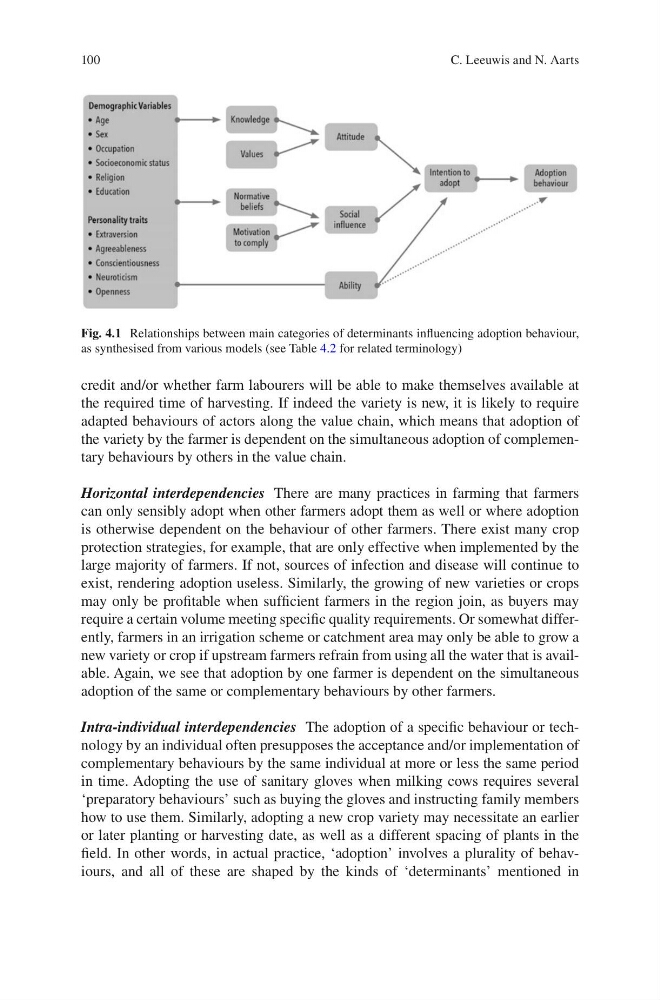
field. In other words, in actual practice, ‘adoption’ involves a plurality of behaviours, and all of these are shaped by the kinds of ‘determinants’ mentioned in
Fig. 4.1 Relationships between main categories of determinants influencing adoption behaviour,
as synthesised from various models (see Table 4.2 for related terminology)
C. Leeuwis and N. Aarts
credit and/or whether farm labourers will be able to make themselves available at
the required time of harvesting. If indeed the variety is new, it is likely to require
adapted behaviours of actors along the value chain, which means that adoption of
the variety by the farmer is dependent on the simultaneous adoption of complementary behaviours by others in the value chain.
Horizontal interdependencies There are many practices in farming that farmers
can only sensibly adopt when other farmers adopt them as well or where adoption
is otherwise dependent on the behaviour of other farmers. There exist many crop
protection strategies, for example, that are only effective when implemented by the
large majority of farmers. If not, sources of infection and disease will continue to
exist, rendering adoption useless. Similarly, the growing of new varieties or crops
may only be profitable when sufficient farmers in the region join, as buyers may
require a certain volume meeting specific quality requirements. Or somewhat differently, farmers in an irrigation scheme or catchment area may only be able to grow a
new variety or crop if upstream farmers refrain from using all the water that is available. Again, we see that adoption by one farmer is dependent on the simultaneous
adoption of the same or complementary behaviours by other farmers.
Intra-individual interdependencies The adoption of a specific behaviour or technology by an individual often presupposes the acceptance and/or implementation of
complementary behaviours by the same individual at more or less the same period
in time. Adopting the use of sanitary gloves when milking cows requires several
‘preparatory behaviours’ such as buying the gloves and instructing family members
how to use them. Similarly, adopting a new crop variety may necessitate an earlier
or later planting or harvesting date, as well as a different spacing of plants in the
field. In other words, in actual practice, ‘adoption’ involves a plurality of behaviours, and all of these are shaped by the kinds of ‘determinants’ mentioned in
Fig. 4.1 Relationships between main categories of determinants influencing adoption behaviour,
as synthesised from various models (see Table 4.2 for related terminology)
C. Leeuwis and N. Aarts