

whether acrylamide actually causes cancer in humans,
but as yet there is sparse evidence that this is the
case. However, acrylamide has been categorized by the
International Agency for Research on Cancer (IARC)
as a probable human carcinogen (Belkova et al. 2018;
Gökmen & Palazo˘ glu 2008). The biological effect and
risks associated with continued consumption of foods
with acrylamide have been assessed by many international bodies including the European Food Safety
Authority, the Food and Agriculture Organization of
the United Nations (FAO), and the World Health
Organization (WHO).
A Norwegian exposure assessment reported dietary
acrylamide exposure with the mean and median exposure in adolescents and adults ranging between 0.3–0.5
µg/kg bodyweight per day. These estimates are in the
same range as the mean daily exposures estimated by
the European Food and Safety Authority (EFSA) for
adolescents (0.4–0.9 µg/kg) body weight and adults
(0.4–0.5 µg/kg body weight. Consumption patterns
and dietary intake vary among people of different cultures and backgrounds (Normandin et al. 2013; Wyka
et al. 2015).
Some foods analyzed for acrylamide, including
infant powdered formula, coffee and chocolate powders, corn snacks, bakery products, and tuber-, meat-,
and vegetable-based foods, showed that the levels
of acrylamide present were variable among different
foods and within different brands of the same food,
as reported by European Union Authority (Authority
2012; Pacetti et al. 2015; Wilson et al. 2006). In a toxicological evaluation of acrylamide carried out by the
Joint FAO/WHO Expert Committee on Food Additives
(JECFA) in February 2005, it was noted that no data
or limited information from Latin America and Africa
were submitted. It was recommended that for useful
assessment and mitigation of effects of acrylamide to
reduce human exposure there was a need to have occurrence data on acrylamide in the foods consumed in
developing countries (Arisseto et al. 2007).
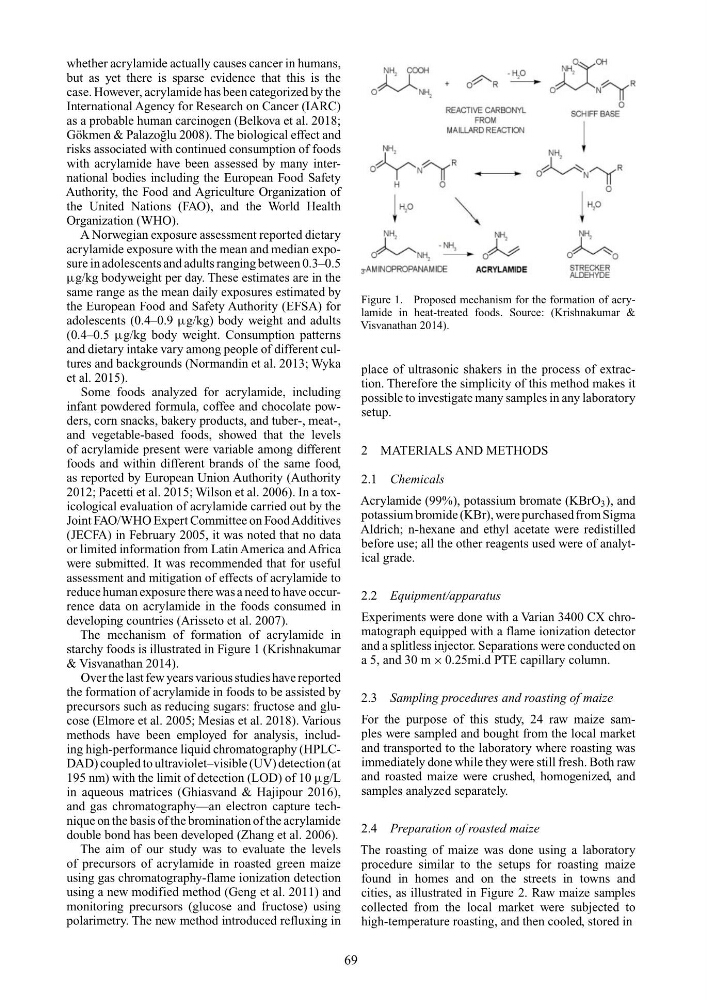
The mechanism of formation of acrylamide in
starchy foods is illustrated in Figure 1 (Krishnakumar
& Visvanathan 2014).
Over the last few years various studies have reported
the formation of acrylamide in foods to be assisted by
precursors such as reducing sugars: fructose and glucose (Elmore et al. 2005; Mesias et al. 2018). Various
methods have been employed for analysis, including high-performance liquid chromatography (HPLCDAD) coupled to ultraviolet–visible (UV) detection (at
195 nm) with the limit of detection (LOD) of 10 µg/L
in aqueous matrices (Ghiasvand & Hajipour 2016),
and gas chromatography—an electron capture technique on the basis of the bromination of the acrylamide
double bond has been developed (Zhang et al. 2006).
The aim of our study was to evaluate the levels
of precursors of acrylamide in roasted green maize
using gas chromatography-flame ionization detection
using a new modified method (Geng et al. 2011) and
monitoring precursors (glucose and fructose) using
polarimetry. The new method introduced refluxing in
Figure 1. Proposed mechanism for the formation of acrylamide in heat-treated foods. Source: (Krishnakumar &
Visvanathan 2014).
place of ultrasonic shakers in the process of extraction. Therefore the simplicity of this method makes it
possible to investigate many samples in any laboratory
setup.
2 MATERIALS AND METHODS
2.1 Chemicals
Acrylamide (99%), potassium bromate (KBrO 3 ), and
potassium bromide (KBr), were purchased from Sigma
Aldrich; n-hexane and ethyl acetate were redistilled
before use; all the other reagents used were of analytical grade.
2.2 Equipment/apparatus
Experiments were done with a Varian 3400 CX chromatograph equipped with a flame ionization detector
and a splitless injector. Separations were conducted on
a 5, and 30 m × 0.25mi.d PTE capillary column.
2.3 Sampling procedures and roasting of maize
For the purpose of this study, 24 raw maize samples were sampled and bought from the local market
and transported to the laboratory where roasting was
immediately done while they were still fresh. Both raw
and roasted maize were crushed, homogenized, and
samples analyzed separately.
2.4 Preparation of roasted maize
The roasting of maize was done using a laboratory
procedure similar to the setups for roasting maize
found in homes and on the streets in towns and
cities, as illustrated in Figure 2. Raw maize samples
collected from the local market were subjected to
high-temperature roasting, and then cooled, stored in
69
but as yet there is sparse evidence that this is the
case. However, acrylamide has been categorized by the
International Agency for Research on Cancer (IARC)
as a probable human carcinogen (Belkova et al. 2018;
Gökmen & Palazo˘ glu 2008). The biological effect and
risks associated with continued consumption of foods
with acrylamide have been assessed by many international bodies including the European Food Safety
Authority, the Food and Agriculture Organization of
the United Nations (FAO), and the World Health
Organization (WHO).
A Norwegian exposure assessment reported dietary
acrylamide exposure with the mean and median exposure in adolescents and adults ranging between 0.3–0.5
µg/kg bodyweight per day. These estimates are in the
same range as the mean daily exposures estimated by
the European Food and Safety Authority (EFSA) for
adolescents (0.4–0.9 µg/kg) body weight and adults
(0.4–0.5 µg/kg body weight. Consumption patterns
and dietary intake vary among people of different cultures and backgrounds (Normandin et al. 2013; Wyka
et al. 2015).
Some foods analyzed for acrylamide, including
infant powdered formula, coffee and chocolate powders, corn snacks, bakery products, and tuber-, meat-,
and vegetable-based foods, showed that the levels
of acrylamide present were variable among different
foods and within different brands of the same food,
as reported by European Union Authority (Authority
2012; Pacetti et al. 2015; Wilson et al. 2006). In a toxicological evaluation of acrylamide carried out by the
Joint FAO/WHO Expert Committee on Food Additives
(JECFA) in February 2005, it was noted that no data
or limited information from Latin America and Africa
were submitted. It was recommended that for useful
assessment and mitigation of effects of acrylamide to
reduce human exposure there was a need to have occurrence data on acrylamide in the foods consumed in
developing countries (Arisseto et al. 2007).
The mechanism of formation of acrylamide in
starchy foods is illustrated in Figure 1 (Krishnakumar
& Visvanathan 2014).
Over the last few years various studies have reported
the formation of acrylamide in foods to be assisted by
precursors such as reducing sugars: fructose and glucose (Elmore et al. 2005; Mesias et al. 2018). Various
methods have been employed for analysis, including high-performance liquid chromatography (HPLCDAD) coupled to ultraviolet–visible (UV) detection (at
195 nm) with the limit of detection (LOD) of 10 µg/L
in aqueous matrices (Ghiasvand & Hajipour 2016),
and gas chromatography—an electron capture technique on the basis of the bromination of the acrylamide
double bond has been developed (Zhang et al. 2006).
The aim of our study was to evaluate the levels
of precursors of acrylamide in roasted green maize
using gas chromatography-flame ionization detection
using a new modified method (Geng et al. 2011) and
monitoring precursors (glucose and fructose) using
polarimetry. The new method introduced refluxing in
Figure 1. Proposed mechanism for the formation of acrylamide in heat-treated foods. Source: (Krishnakumar &
Visvanathan 2014).
place of ultrasonic shakers in the process of extraction. Therefore the simplicity of this method makes it
possible to investigate many samples in any laboratory
setup.
2 MATERIALS AND METHODS
2.1 Chemicals
Acrylamide (99%), potassium bromate (KBrO 3 ), and
potassium bromide (KBr), were purchased from Sigma
Aldrich; n-hexane and ethyl acetate were redistilled
before use; all the other reagents used were of analytical grade.
2.2 Equipment/apparatus
Experiments were done with a Varian 3400 CX chromatograph equipped with a flame ionization detector
and a splitless injector. Separations were conducted on
a 5, and 30 m × 0.25mi.d PTE capillary column.
2.3 Sampling procedures and roasting of maize
For the purpose of this study, 24 raw maize samples were sampled and bought from the local market
and transported to the laboratory where roasting was
immediately done while they were still fresh. Both raw
and roasted maize were crushed, homogenized, and
samples analyzed separately.
2.4 Preparation of roasted maize
The roasting of maize was done using a laboratory
procedure similar to the setups for roasting maize
found in homes and on the streets in towns and
cities, as illustrated in Figure 2. Raw maize samples
collected from the local market were subjected to
high-temperature roasting, and then cooled, stored in
69