

To complement the results in Table 2, graphs of the
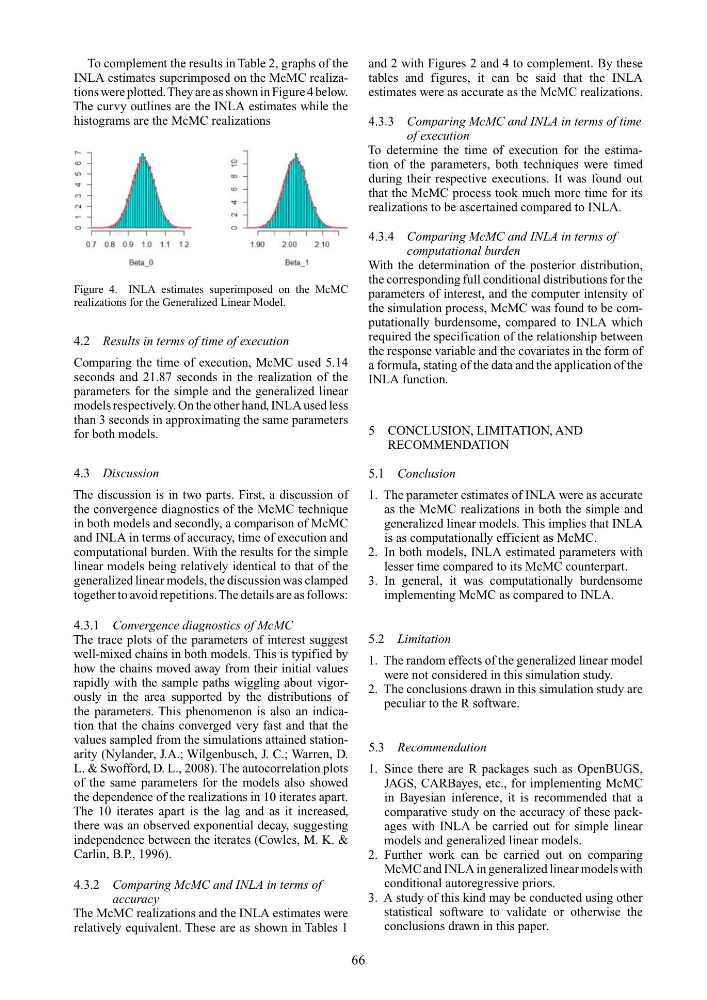
INLA estimates superimposed on the McMC realizations were plotted.They are as shown in Figure 4 below.
The curvy outlines are the INLA estimates while the
histograms are the McMC realizations
Figure 4. INLA estimates superimposed on the McMC
realizations for the Generalized Linear Model.
4.2 Results in terms of time of execution
Comparing the time of execution, McMC used 5.14
seconds and 21.87 seconds in the realization of the
parameters for the simple and the generalized linear
models respectively. On the other hand, INLA used less
than 3 seconds in approximating the same parameters
for both models.
4.3 Discussion
The discussion is in two parts. First, a discussion of
the convergence diagnostics of the McMC technique
in both models and secondly, a comparison of McMC
and INLA in terms of accuracy, time of execution and
computational burden. With the results for the simple
linear models being relatively identical to that of the
generalized linear models, the discussion was clamped
together to avoid repetitions. The details are as follows:
4.3.1 Convergence diagnostics of McMC
The trace plots of the parameters of interest suggest
well-mixed chains in both models. This is typified by
how the chains moved away from their initial values
rapidly with the sample paths wiggling about vigorously in the area supported by the distributions of
the parameters. This phenomenon is also an indication that the chains converged very fast and that the
values sampled from the simulations attained stationarity (Nylander, J.A.; Wilgenbusch, J. C.; Warren, D.
L. & Swofford, D. L., 2008). The autocorrelation plots
of the same parameters for the models also showed
the dependence of the realizations in 10 iterates apart.
The 10 iterates apart is the lag and as it increased,
there was an observed exponential decay, suggesting
independence between the iterates (Cowles, M. K. &
Carlin, B.P., 1996).
4.3.2 Comparing McMC and INLA in terms of
accuracy
The McMC realizations and the INLA estimates were
relatively equivalent. These are as shown in Tables 1
and 2 with Figures 2 and 4 to complement. By these
tables and figures, it can be said that the INLA
estimates were as accurate as the McMC realizations.
4.3.3 Comparing McMC and INLA in terms of time
of execution
To determine the time of execution for the estimation of the parameters, both techniques were timed
during their respective executions. It was found out
that the McMC process took much more time for its
realizations to be ascertained compared to INLA.
4.3.4 Comparing McMC and INLA in terms of
computational burden
With the determination of the posterior distribution,
the corresponding full conditional distributions for the
parameters of interest, and the computer intensity of
the simulation process, McMC was found to be computationally burdensome, compared to INLA which
required the specification of the relationship between
the response variable and the covariates in the form of
a formula, stating of the data and the application of the
INLA function.
5 CONCLUSION, LIMITATION, AND
RECOMMENDATION
5.1 Conclusion
1. The parameter estimates of INLA were as accurate
as the McMC realizations in both the simple and
generalized linear models. This implies that INLA
is as computationally efficient as McMC.
2. In both models, INLA estimated parameters with
lesser time compared to its McMC counterpart.
3. In general, it was computationally burdensome
implementing McMC as compared to INLA.
5.2 Limitation
1. The random effects of the generalized linear model
were not considered in this simulation study.
2. The conclusions drawn in this simulation study are
peculiar to the R software.
5.3 Recommendation
1. Since there are R packages such as OpenBUGS,
JAGS, CARBayes, etc., for implementing McMC
in Bayesian inference, it is recommended that a
comparative study on the accuracy of these packages with INLA be carried out for simple linear
models and generalized linear models.
2. Further work can be carried out on comparing
McMC and INLA in generalized linear models with
conditional autoregressive priors.
3. A study of this kind may be conducted using other
statistical software to validate or otherwise the
conclusions drawn in this paper.
66
INLA estimates superimposed on the McMC realizations were plotted.They are as shown in Figure 4 below.
The curvy outlines are the INLA estimates while the
histograms are the McMC realizations
Figure 4. INLA estimates superimposed on the McMC
realizations for the Generalized Linear Model.
4.2 Results in terms of time of execution
Comparing the time of execution, McMC used 5.14
seconds and 21.87 seconds in the realization of the
parameters for the simple and the generalized linear
models respectively. On the other hand, INLA used less
than 3 seconds in approximating the same parameters
for both models.
4.3 Discussion
The discussion is in two parts. First, a discussion of
the convergence diagnostics of the McMC technique
in both models and secondly, a comparison of McMC
and INLA in terms of accuracy, time of execution and
computational burden. With the results for the simple
linear models being relatively identical to that of the
generalized linear models, the discussion was clamped
together to avoid repetitions. The details are as follows:
4.3.1 Convergence diagnostics of McMC
The trace plots of the parameters of interest suggest
well-mixed chains in both models. This is typified by
how the chains moved away from their initial values
rapidly with the sample paths wiggling about vigorously in the area supported by the distributions of
the parameters. This phenomenon is also an indication that the chains converged very fast and that the
values sampled from the simulations attained stationarity (Nylander, J.A.; Wilgenbusch, J. C.; Warren, D.
L. & Swofford, D. L., 2008). The autocorrelation plots
of the same parameters for the models also showed
the dependence of the realizations in 10 iterates apart.
The 10 iterates apart is the lag and as it increased,
there was an observed exponential decay, suggesting
independence between the iterates (Cowles, M. K. &
Carlin, B.P., 1996).
4.3.2 Comparing McMC and INLA in terms of
accuracy
The McMC realizations and the INLA estimates were
relatively equivalent. These are as shown in Tables 1
and 2 with Figures 2 and 4 to complement. By these
tables and figures, it can be said that the INLA
estimates were as accurate as the McMC realizations.
4.3.3 Comparing McMC and INLA in terms of time
of execution
To determine the time of execution for the estimation of the parameters, both techniques were timed
during their respective executions. It was found out
that the McMC process took much more time for its
realizations to be ascertained compared to INLA.
4.3.4 Comparing McMC and INLA in terms of
computational burden
With the determination of the posterior distribution,
the corresponding full conditional distributions for the
parameters of interest, and the computer intensity of
the simulation process, McMC was found to be computationally burdensome, compared to INLA which
required the specification of the relationship between
the response variable and the covariates in the form of
a formula, stating of the data and the application of the
INLA function.
5 CONCLUSION, LIMITATION, AND
RECOMMENDATION
5.1 Conclusion
1. The parameter estimates of INLA were as accurate
as the McMC realizations in both the simple and
generalized linear models. This implies that INLA
is as computationally efficient as McMC.
2. In both models, INLA estimated parameters with
lesser time compared to its McMC counterpart.
3. In general, it was computationally burdensome
implementing McMC as compared to INLA.
5.2 Limitation
1. The random effects of the generalized linear model
were not considered in this simulation study.
2. The conclusions drawn in this simulation study are
peculiar to the R software.
5.3 Recommendation
1. Since there are R packages such as OpenBUGS,
JAGS, CARBayes, etc., for implementing McMC
in Bayesian inference, it is recommended that a
comparative study on the accuracy of these packages with INLA be carried out for simple linear
models and generalized linear models.
2. Further work can be carried out on comparing
McMC and INLA in generalized linear models with
conditional autoregressive priors.
3. A study of this kind may be conducted using other
statistical software to validate or otherwise the
conclusions drawn in this paper.
66