

These network capabilities aid the device to transmit and receive information. The IoT system creates a
platform for connectivity among computing and digital systems for data transfer over a network without
requiring human-to-human/computer interaction.
4.3 IoT environment pollution monitoring
architecture
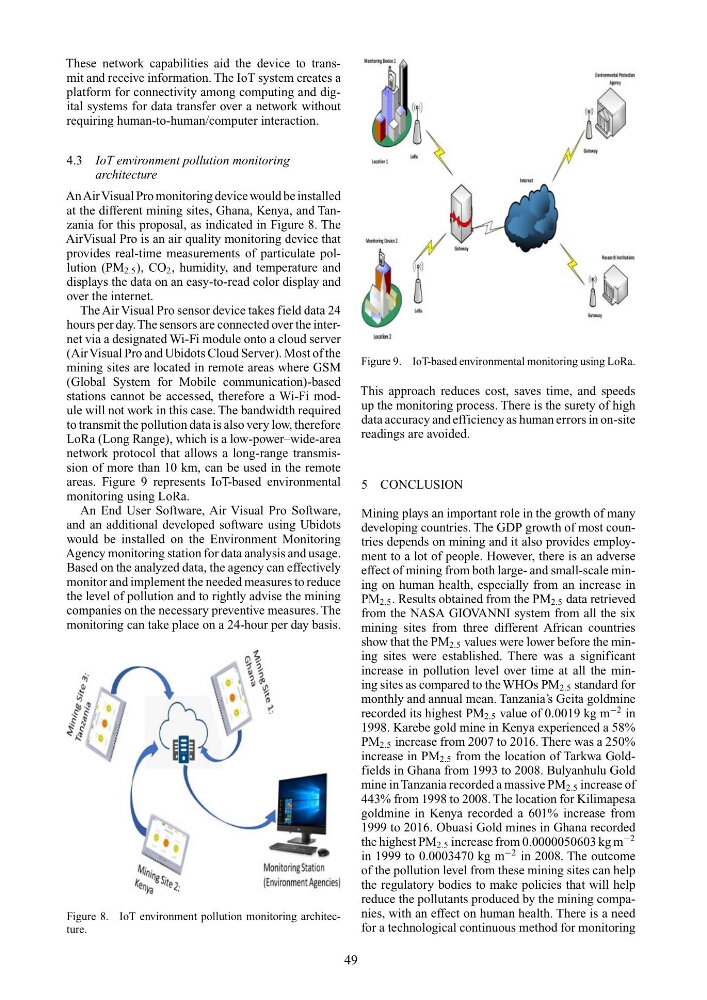
AnAirVisual Pro monitoring device would be installed
at the different mining sites, Ghana, Kenya, and Tanzania for this proposal, as indicated in Figure 8. The
AirVisual Pro is an air quality monitoring device that
provides real-time measurements of particulate pollution (PM 2.5 ), CO 2 , humidity, and temperature and
displays the data on an easy-to-read color display and
over the internet.
The Air Visual Pro sensor device takes field data 24
hours per day. The sensors are connected over the internet via a designated Wi-Fi module onto a cloud server
(Air Visual Pro and Ubidots Cloud Server). Most of the
mining sites are located in remote areas where GSM
(Global System for Mobile communication)-based
stations cannot be accessed, therefore a Wi-Fi module will not work in this case. The bandwidth required
to transmit the pollution data is also very low, therefore
LoRa (Long Range), which is a low-power–wide-area
network protocol that allows a long-range transmission of more than 10 km, can be used in the remote
areas. Figure 9 represents IoT-based environmental
monitoring using LoRa.
An End User Software, Air Visual Pro Software,
and an additional developed software using Ubidots
would be installed on the Environment Monitoring
Agency monitoring station for data analysis and usage.
Based on the analyzed data, the agency can effectively
monitor and implement the needed measures to reduce
the level of pollution and to rightly advise the mining
companies on the necessary preventive measures. The
monitoring can take place on a 24-hour per day basis.
Figure 8. IoT environment pollution monitoring architecture.
Figure 9. IoT-based environmental monitoring using LoRa.
This approach reduces cost, saves time, and speeds
up the monitoring process. There is the surety of high
data accuracy and efficiency as human errors in on-site
readings are avoided.
5 CONCLUSION
Mining plays an important role in the growth of many
developing countries. The GDP growth of most countries depends on mining and it also provides employment to a lot of people. However, there is an adverse
effect of mining from both large- and small-scale mining on human health, especially from an increase in
PM 2.5 . Results obtained from the PM 2.5 data retrieved
from the NASA GIOVANNI system from all the six
mining sites from three different African countries
show that the PM 2.5 values were lower before the mining sites were established. There was a significant
increase in pollution level over time at all the mining sites as compared to the WHOs PM 2.5 standard for
monthly and annual mean. Tanzania’s Geita goldmine
recorded its highest PM 2.5 value of 0.0019 kg m
−2 in
1998. Karebe gold mine in Kenya experienced a 58%
PM 2.5 increase from 2007 to 2016. There was a 250%
increase in PM 2.5 from the location of Tarkwa Goldfields in Ghana from 1993 to 2008. Bulyanhulu Gold
mine in Tanzania recorded a massive PM 2.5 increase of
443% from 1998 to 2008. The location for Kilimapesa
goldmine in Kenya recorded a 601% increase from
1999 to 2016. Obuasi Gold mines in Ghana recorded
the highest PM 2.5 increase from 0.0000050603 kg m
−2
in 1999 to 0.0003470 kg m
−2 in 2008. The outcome
of the pollution level from these mining sites can help
the regulatory bodies to make policies that will help
reduce the pollutants produced by the mining companies, with an effect on human health. There is a need
for a technological continuous method for monitoring
49
platform for connectivity among computing and digital systems for data transfer over a network without
requiring human-to-human/computer interaction.
4.3 IoT environment pollution monitoring
architecture
AnAirVisual Pro monitoring device would be installed
at the different mining sites, Ghana, Kenya, and Tanzania for this proposal, as indicated in Figure 8. The
AirVisual Pro is an air quality monitoring device that
provides real-time measurements of particulate pollution (PM 2.5 ), CO 2 , humidity, and temperature and
displays the data on an easy-to-read color display and
over the internet.
The Air Visual Pro sensor device takes field data 24
hours per day. The sensors are connected over the internet via a designated Wi-Fi module onto a cloud server
(Air Visual Pro and Ubidots Cloud Server). Most of the
mining sites are located in remote areas where GSM
(Global System for Mobile communication)-based
stations cannot be accessed, therefore a Wi-Fi module will not work in this case. The bandwidth required
to transmit the pollution data is also very low, therefore
LoRa (Long Range), which is a low-power–wide-area
network protocol that allows a long-range transmission of more than 10 km, can be used in the remote
areas. Figure 9 represents IoT-based environmental
monitoring using LoRa.
An End User Software, Air Visual Pro Software,
and an additional developed software using Ubidots
would be installed on the Environment Monitoring
Agency monitoring station for data analysis and usage.
Based on the analyzed data, the agency can effectively
monitor and implement the needed measures to reduce
the level of pollution and to rightly advise the mining
companies on the necessary preventive measures. The
monitoring can take place on a 24-hour per day basis.
Figure 8. IoT environment pollution monitoring architecture.
Figure 9. IoT-based environmental monitoring using LoRa.
This approach reduces cost, saves time, and speeds
up the monitoring process. There is the surety of high
data accuracy and efficiency as human errors in on-site
readings are avoided.
5 CONCLUSION
Mining plays an important role in the growth of many
developing countries. The GDP growth of most countries depends on mining and it also provides employment to a lot of people. However, there is an adverse
effect of mining from both large- and small-scale mining on human health, especially from an increase in
PM 2.5 . Results obtained from the PM 2.5 data retrieved
from the NASA GIOVANNI system from all the six
mining sites from three different African countries
show that the PM 2.5 values were lower before the mining sites were established. There was a significant
increase in pollution level over time at all the mining sites as compared to the WHOs PM 2.5 standard for
monthly and annual mean. Tanzania’s Geita goldmine
recorded its highest PM 2.5 value of 0.0019 kg m
−2 in
1998. Karebe gold mine in Kenya experienced a 58%
PM 2.5 increase from 2007 to 2016. There was a 250%
increase in PM 2.5 from the location of Tarkwa Goldfields in Ghana from 1993 to 2008. Bulyanhulu Gold
mine in Tanzania recorded a massive PM 2.5 increase of
443% from 1998 to 2008. The location for Kilimapesa
goldmine in Kenya recorded a 601% increase from
1999 to 2016. Obuasi Gold mines in Ghana recorded
the highest PM 2.5 increase from 0.0000050603 kg m
−2
in 1999 to 0.0003470 kg m
−2 in 2008. The outcome
of the pollution level from these mining sites can help
the regulatory bodies to make policies that will help
reduce the pollutants produced by the mining companies, with an effect on human health. There is a need
for a technological continuous method for monitoring
49