

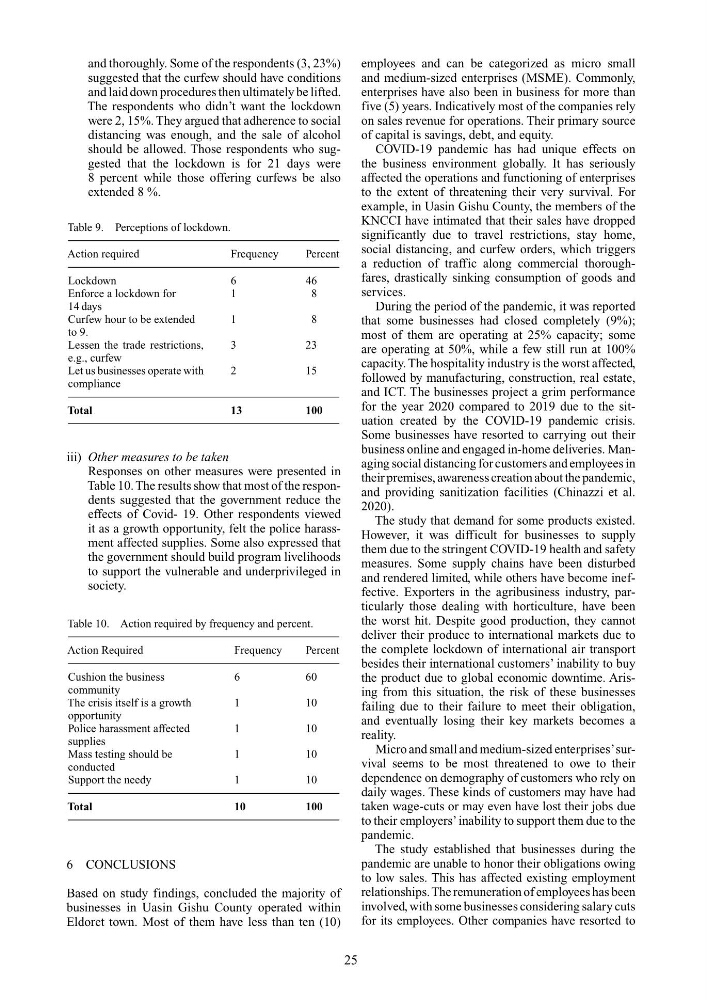
and thoroughly. Some of the respondents (3, 23%)
suggested that the curfew should have conditions
and laid down procedures then ultimately be lifted.
The respondents who didn’t want the lockdown
were 2, 15%. They argued that adherence to social
distancing was enough, and the sale of alcohol
should be allowed. Those respondents who suggested that the lockdown is for 21 days were
8 percent while those offering curfews be also
extended 8 %.
Table 9. Perceptions of lockdown.
Action required
Frequency
Percent
Lockdown
6
46
Enforce a lockdown for
14 days
1
8
Curfew hour to be extended
to 9.
1
8
Lessen the trade restrictions,
e.g., curfew
3
2 3
Let us businesses operate with
compliance
2
1 5
Total
13
100
iii) Other measures to be taken
Responses on other measures were presented in
Table 10. The results show that most of the respondents suggested that the government reduce the
effects of Covid- 19. Other respondents viewed
it as a growth opportunity, felt the police harassment affected supplies. Some also expressed that
the government should build program livelihoods
to support the vulnerable and underprivileged in
society.
Table 10. Action required by frequency and percent.
Action Required
Frequency
Percent
Cushion the business
community
6
6 0
The crisis itself is a growth
opportunity
1
1 0
Police harassment affected
supplies
1
1 0
Mass testing should be
conducted
1
1 0
Support the needy
1
10
Total
10
100
6 CONCLUSIONS
Based on study findings, concluded the majority of
businesses in Uasin Gishu County operated within
Eldoret town. Most of them have less than ten (10)
employees and can be categorized as micro small
and medium-sized enterprises (MSME). Commonly,
enterprises have also been in business for more than
five (5) years. Indicatively most of the companies rely
on sales revenue for operations. Their primary source
of capital is savings, debt, and equity.
COVID-19 pandemic has had unique effects on
the business environment globally. It has seriously
affected the operations and functioning of enterprises
to the extent of threatening their very survival. For
example, in Uasin Gishu County, the members of the
KNCCI have intimated that their sales have dropped
significantly due to travel restrictions, stay home,
social distancing, and curfew orders, which triggers
a reduction of traffic along commercial thoroughfares, drastically sinking consumption of goods and
services.
During the period of the pandemic, it was reported
that some businesses had closed completely (9%);
most of them are operating at 25% capacity; some
are operating at 50%, while a few still run at 100%
capacity. The hospitality industry is the worst affected,
followed by manufacturing, construction, real estate,
and ICT. The businesses project a grim performance
for the year 2020 compared to 2019 due to the situation created by the COVID-19 pandemic crisis.
Some businesses have resorted to carrying out their
business online and engaged in-home deliveries. Managing social distancing for customers and employees in
their premises, awareness creation about the pandemic,
and providing sanitization facilities (Chinazzi et al.
2020).
The study that demand for some products existed.
However, it was difficult for businesses to supply
them due to the stringent COVID-19 health and safety
measures. Some supply chains have been disturbed
and rendered limited, while others have become ineffective. Exporters in the agribusiness industry, particularly those dealing with horticulture, have been
the worst hit. Despite good production, they cannot
deliver their produce to international markets due to
the complete lockdown of international air transport
besides their international customers’ inability to buy
the product due to global economic downtime. Arising from this situation, the risk of these businesses
failing due to their failure to meet their obligation,
and eventually losing their key markets becomes a
reality.
Micro and small and medium-sized enterprises’survival seems to be most threatened to owe to their
dependence on demography of customers who rely on
daily wages. These kinds of customers may have had
taken wage-cuts or may even have lost their jobs due
to their employers’ inability to support them due to the
pandemic.
The study established that businesses during the
pandemic are unable to honor their obligations owing
to low sales. This has affected existing employment
relationships.The remuneration of employees has been
involved, with some businesses considering salary cuts
for its employees. Other companies have resorted to
25
suggested that the curfew should have conditions
and laid down procedures then ultimately be lifted.
The respondents who didn’t want the lockdown
were 2, 15%. They argued that adherence to social
distancing was enough, and the sale of alcohol
should be allowed. Those respondents who suggested that the lockdown is for 21 days were
8 percent while those offering curfews be also
extended 8 %.
Table 9. Perceptions of lockdown.
Action required
Frequency
Percent
Lockdown
6
46
Enforce a lockdown for
14 days
1
8
Curfew hour to be extended
to 9.
1
8
Lessen the trade restrictions,
e.g., curfew
3
2 3
Let us businesses operate with
compliance
2
1 5
Total
13
100
iii) Other measures to be taken
Responses on other measures were presented in
Table 10. The results show that most of the respondents suggested that the government reduce the
effects of Covid- 19. Other respondents viewed
it as a growth opportunity, felt the police harassment affected supplies. Some also expressed that
the government should build program livelihoods
to support the vulnerable and underprivileged in
society.
Table 10. Action required by frequency and percent.
Action Required
Frequency
Percent
Cushion the business
community
6
6 0
The crisis itself is a growth
opportunity
1
1 0
Police harassment affected
supplies
1
1 0
Mass testing should be
conducted
1
1 0
Support the needy
1
10
Total
10
100
6 CONCLUSIONS
Based on study findings, concluded the majority of
businesses in Uasin Gishu County operated within
Eldoret town. Most of them have less than ten (10)
employees and can be categorized as micro small
and medium-sized enterprises (MSME). Commonly,
enterprises have also been in business for more than
five (5) years. Indicatively most of the companies rely
on sales revenue for operations. Their primary source
of capital is savings, debt, and equity.
COVID-19 pandemic has had unique effects on
the business environment globally. It has seriously
affected the operations and functioning of enterprises
to the extent of threatening their very survival. For
example, in Uasin Gishu County, the members of the
KNCCI have intimated that their sales have dropped
significantly due to travel restrictions, stay home,
social distancing, and curfew orders, which triggers
a reduction of traffic along commercial thoroughfares, drastically sinking consumption of goods and
services.
During the period of the pandemic, it was reported
that some businesses had closed completely (9%);
most of them are operating at 25% capacity; some
are operating at 50%, while a few still run at 100%
capacity. The hospitality industry is the worst affected,
followed by manufacturing, construction, real estate,
and ICT. The businesses project a grim performance
for the year 2020 compared to 2019 due to the situation created by the COVID-19 pandemic crisis.
Some businesses have resorted to carrying out their
business online and engaged in-home deliveries. Managing social distancing for customers and employees in
their premises, awareness creation about the pandemic,
and providing sanitization facilities (Chinazzi et al.
2020).
The study that demand for some products existed.
However, it was difficult for businesses to supply
them due to the stringent COVID-19 health and safety
measures. Some supply chains have been disturbed
and rendered limited, while others have become ineffective. Exporters in the agribusiness industry, particularly those dealing with horticulture, have been
the worst hit. Despite good production, they cannot
deliver their produce to international markets due to
the complete lockdown of international air transport
besides their international customers’ inability to buy
the product due to global economic downtime. Arising from this situation, the risk of these businesses
failing due to their failure to meet their obligation,
and eventually losing their key markets becomes a
reality.
Micro and small and medium-sized enterprises’survival seems to be most threatened to owe to their
dependence on demography of customers who rely on
daily wages. These kinds of customers may have had
taken wage-cuts or may even have lost their jobs due
to their employers’ inability to support them due to the
pandemic.
The study established that businesses during the
pandemic are unable to honor their obligations owing
to low sales. This has affected existing employment
relationships.The remuneration of employees has been
involved, with some businesses considering salary cuts
for its employees. Other companies have resorted to
25