

vulnerable members. Responses on other measures such as staying at home, concentrate on
searching for the vaccine, avail food to the weak
constituted 4 percent each.
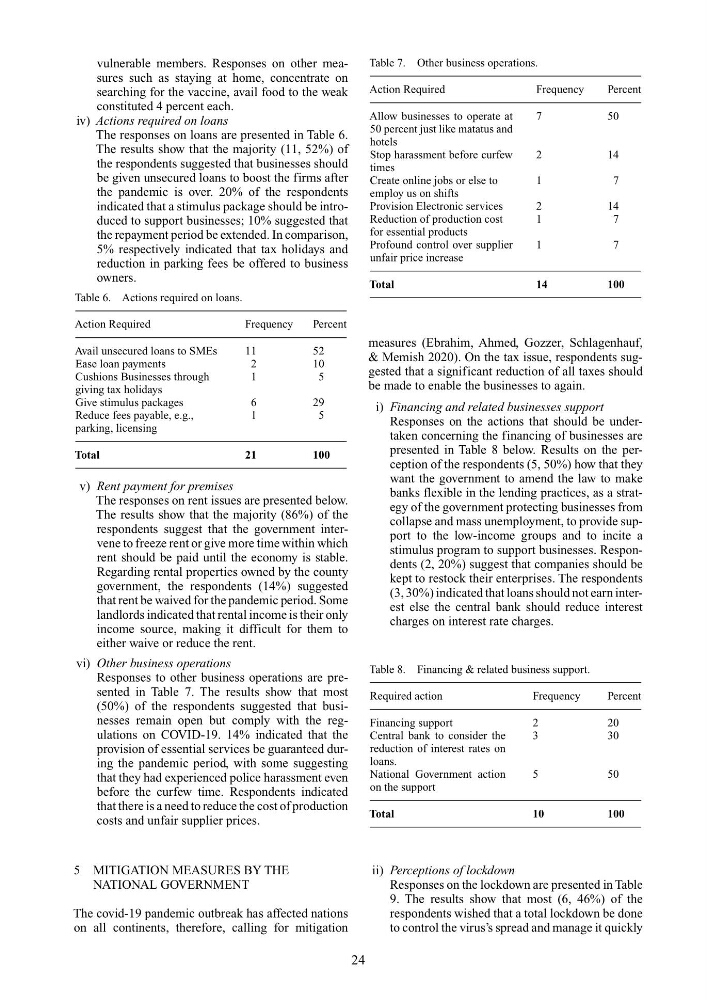
iv) Actions required on loans
The responses on loans are presented in Table 6.
The results show that the majority (11, 52%) of
the respondents suggested that businesses should
be given unsecured loans to boost the firms after
the pandemic is over. 20% of the respondents
indicated that a stimulus package should be introduced to support businesses; 10% suggested that
the repayment period be extended. In comparison,
5% respectively indicated that tax holidays and
reduction in parking fees be offered to business
owners.
Table 6. Actions required on loans.
Action Required
Frequency
Percent
Avail unsecured loans to SMEs
11
52
Ease loan payments
2
10
Cushions Businesses through
giving tax holidays
1
5
Give stimulus packages
6
29
Reduce fees payable, e.g.,
parking, licensing
1
5
Total
21
100
v) Rent payment for premises
The responses on rent issues are presented below.
The results show that the majority (86%) of the
respondents suggest that the government intervene to freeze rent or give more time within which
rent should be paid until the economy is stable.
Regarding rental properties owned by the county
government, the respondents (14%) suggested
that rent be waived for the pandemic period. Some
landlords indicated that rental income is their only
income source, making it difficult for them to
either waive or reduce the rent.
vi) Other business operations
Responses to other business operations are presented in Table 7. The results show that most
(50%) of the respondents suggested that businesses remain open but comply with the regulations on COVID-19. 14% indicated that the
provision of essential services be guaranteed during the pandemic period, with some suggesting
that they had experienced police harassment even
before the curfew time. Respondents indicated
that there is a need to reduce the cost of production
costs and unfair supplier prices.
5 MITIGATION MEASURES BY THE
NATIONAL GOVERNMENT
The covid-19 pandemic outbreak has affected nations
on all continents, therefore, calling for mitigation
Table 7. Other business operations.
Action Required
Frequency
Percent
Allow businesses to operate at
50 percent just like matatus and
hotels
7
5 0
Stop harassment before curfew
times
2
1 4
Create online jobs or else to
employ us on shifts
1
7
Provision Electronic services
2
14
Reduction of production cost
for essential products
1
7
Profound control over supplier
unfair price increase
1
7
Total
14
100
measures (Ebrahim, Ahmed, Gozzer, Schlagenhauf,
& Memish 2020). On the tax issue, respondents suggested that a significant reduction of all taxes should
be made to enable the businesses to again.
i) Financing and related businesses support
Responses on the actions that should be undertaken concerning the financing of businesses are
presented in Table 8 below. Results on the perception of the respondents (5, 50%) how that they
want the government to amend the law to make
banks flexible in the lending practices, as a strategy of the government protecting businesses from
collapse and mass unemployment, to provide support to the low-income groups and to incite a
stimulus program to support businesses. Respondents (2, 20%) suggest that companies should be
kept to restock their enterprises. The respondents
(3, 30%) indicated that loans should not earn interest else the central bank should reduce interest
charges on interest rate charges.
Table 8. Financing & related business support.
Required action
Frequency
Percent
Financing support
2
20
Central bank to consider the
reduction of interest rates on
loans.
3
3 0
National Government action
on the support
5
5 0
Total
10
100
ii) Perceptions of lockdown
Responses on the lockdown are presented in Table
9. The results show that most (6, 46%) of the
respondents wished that a total lockdown be done
to control the virus’s spread and manage it quickly
24
searching for the vaccine, avail food to the weak
constituted 4 percent each.
iv) Actions required on loans
The responses on loans are presented in Table 6.
The results show that the majority (11, 52%) of
the respondents suggested that businesses should
be given unsecured loans to boost the firms after
the pandemic is over. 20% of the respondents
indicated that a stimulus package should be introduced to support businesses; 10% suggested that
the repayment period be extended. In comparison,
5% respectively indicated that tax holidays and
reduction in parking fees be offered to business
owners.
Table 6. Actions required on loans.
Action Required
Frequency
Percent
Avail unsecured loans to SMEs
11
52
Ease loan payments
2
10
Cushions Businesses through
giving tax holidays
1
5
Give stimulus packages
6
29
Reduce fees payable, e.g.,
parking, licensing
1
5
Total
21
100
v) Rent payment for premises
The responses on rent issues are presented below.
The results show that the majority (86%) of the
respondents suggest that the government intervene to freeze rent or give more time within which
rent should be paid until the economy is stable.
Regarding rental properties owned by the county
government, the respondents (14%) suggested
that rent be waived for the pandemic period. Some
landlords indicated that rental income is their only
income source, making it difficult for them to
either waive or reduce the rent.
vi) Other business operations
Responses to other business operations are presented in Table 7. The results show that most
(50%) of the respondents suggested that businesses remain open but comply with the regulations on COVID-19. 14% indicated that the
provision of essential services be guaranteed during the pandemic period, with some suggesting
that they had experienced police harassment even
before the curfew time. Respondents indicated
that there is a need to reduce the cost of production
costs and unfair supplier prices.
5 MITIGATION MEASURES BY THE
NATIONAL GOVERNMENT
The covid-19 pandemic outbreak has affected nations
on all continents, therefore, calling for mitigation
Table 7. Other business operations.
Action Required
Frequency
Percent
Allow businesses to operate at
50 percent just like matatus and
hotels
7
5 0
Stop harassment before curfew
times
2
1 4
Create online jobs or else to
employ us on shifts
1
7
Provision Electronic services
2
14
Reduction of production cost
for essential products
1
7
Profound control over supplier
unfair price increase
1
7
Total
14
100
measures (Ebrahim, Ahmed, Gozzer, Schlagenhauf,
& Memish 2020). On the tax issue, respondents suggested that a significant reduction of all taxes should
be made to enable the businesses to again.
i) Financing and related businesses support
Responses on the actions that should be undertaken concerning the financing of businesses are
presented in Table 8 below. Results on the perception of the respondents (5, 50%) how that they
want the government to amend the law to make
banks flexible in the lending practices, as a strategy of the government protecting businesses from
collapse and mass unemployment, to provide support to the low-income groups and to incite a
stimulus program to support businesses. Respondents (2, 20%) suggest that companies should be
kept to restock their enterprises. The respondents
(3, 30%) indicated that loans should not earn interest else the central bank should reduce interest
charges on interest rate charges.
Table 8. Financing & related business support.
Required action
Frequency
Percent
Financing support
2
20
Central bank to consider the
reduction of interest rates on
loans.
3
3 0
National Government action
on the support
5
5 0
Total
10
100
ii) Perceptions of lockdown
Responses on the lockdown are presented in Table
9. The results show that most (6, 46%) of the
respondents wished that a total lockdown be done
to control the virus’s spread and manage it quickly
24