

to GDP while Nguyen and Ngochi in (2019) used data
of 1980–2016 using the ARDL and Toda Yamamoto
test, and found no relationship. Molem and Ndifor
(2016) looked at Cameroon using the generalised
method of moments (GMM); they found a unidirectional relationship running from energy consumption
to GDP. Bekun and Agbola (2019) used data for
Nigeria 1971–2014 using both a dynamic modified
and fully modified ordinary least squares (DMOL
and FMOL), Maki cointegration, Toda-Yamamota,
and Wald tests; they found the relationship running
from energy consumption to GDP. While Ogundipe
and Oyomide (2013) used data from 1980–2008 and
used VECM, Johansen and Juselius cointegration and
a Cobb Douglas (CD) production function to find a
bidirectional hypothesis. Therefore, a proper and sufficient supply of electricity is of utmost importance
for assisting economic growth of a nation (Ogundipe
2016). Bah and Azam (2017) studied energy consumption and economic growth in South Africa using data
from 1971–2012, using an ARDL and CD production function and found no causality. Weng and Cheng
Lu (2017) studied the economy of Taiwan using data
from 1984–2014 and using Granger causality found
a bidirectional relationship. Ibrahiem (2018) studied
Egypt using VECM and a Johansen test, he found a
relationship running from electricity consumption to
GDP. Muhammad and Nur-Syazwari (2018) looked at
electricity consumption and the economic growth of
Malaysia and using ARDL found a relationship running from electricity consumption to GDP. Mukhtarov
et al. (2018) studied the electricity consumption and
economic growth of Azerbaijan using data of 1992–
2015; using VECM and Johansen test they found a
unidirectional relationship running from electricity
consumption to GDP, while Humbatova (2020), who
used data of Azerbaijan of 1995–2017 using ARDL,
augmented Dickey fuller (ADF), Phillips Peron (PP),
and pairwise Granger causality test found no relationship between the variables. Ozturk et al. (2019) investigated Denmark using data from 1970–2012; they used
ARDL and Granger causality test and found no relationship between electricity and GDP. Nepal and Paija
(2019) studied Nepal using data of 1974–2014; they
used ARDL, Toda Yamamoto, and Granger causality
tests and found no relationship. Earlier Bastoola and
Sapkoota (2015) had studied the same and found a
unidirectional relationship running from electricity to
economic growth. Saint Akadiri et al. (2019) studied
Turkey using ARDL, Toda Yamamoto and Granger
causality test; they used the Environmental Kuznet
Curve (EKC) and Long-range Energy Alternative Program (LEAP) and found a bidirectional relationship.
Salauddin and Gow (2019) studied Qatar using ARDL
and Toda Yamamoto; they used the Environmental
Kuznet Curve (EKC) and data of 1980–2016, and they
found a bidirectional relationship. Zhang et al. (2020)
studied electricity consumption and economic growth
in Pakistan using data from 1960–2014; they used a
VECM and Average Neural Network (ANN) method
and found a unidirectional relationship running from
electricity consumption to economic growth, which
is in agreement with the earlier work of Agee and
Butt (2015). Ridzual et al. (2020) studied the electricity consumption and economic growth of Malaysia
using data of 1970–2016; they adopted a multivariate framework using the ARDL and cumulative sum
of squares and adopted the Solow growth model. Lin
and Zu (2020) studied China and found a relationship
running from GDP to electricity, while Junsheg et al.
(2018) using Toda Yamamoto and Granger found the
relationship running from electricity consumption to
GDP.
4 METHODS
4.1 Data source
The study used quarterly time series data on aggregate
electricity consumption from the Electricity Regulatory Authority (ERA) for series from 2008 to 2018.
ERA is an institution with the mandate to regulate the
electricity subsector in Uganda. Additional data used
was Uganda’s real GDP, real gross fixed capital formation, and labour force, using 2010 as the base year
from World Bank statistics.
4.2 The theoretical model—Solow growth model
The paper adopted a neoclassical growth theory by
Solow (1956, 1987)—the Solow growth model—to
analyse the relationship between electricity consumption and economic growth. Unlike the Solow-neutral
model which augments capital as an input, this study
will provide electricity as a separate input into the production model; and investigates its relationship with
growth. Output (Y), labour force (L), capital (C), and
electricity consumption as a component of renewable
energy, i.e., electricity (E), will be measured. Thus the
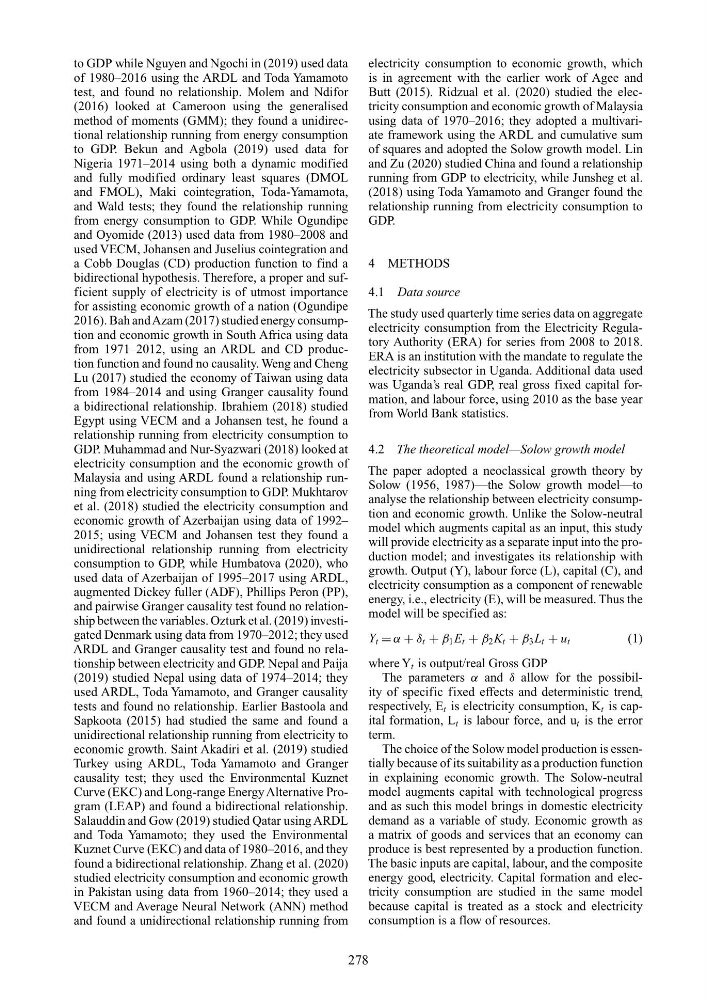
model will be specified as:
Y t = α + δ t + β 1 E t + β 2 K t + β 3 L t + u t
(1)
where Y t is output/real Gross GDP
The parameters α and δ allow for the possibility of specific fixed effects and deterministic trend,
respectively, E t is electricity consumption, K t is capital formation, L t is labour force, and u t is the error
term.
The choice of the Solow model production is essentially because of its suitability as a production function
in explaining economic growth. The Solow-neutral
model augments capital with technological progress
and as such this model brings in domestic electricity
demand as a variable of study. Economic growth as
a matrix of goods and services that an economy can
produce is best represented by a production function.
The basic inputs are capital, labour, and the composite
energy good, electricity. Capital formation and electricity consumption are studied in the same model
because capital is treated as a stock and electricity
consumption is a flow of resources.
278
of 1980–2016 using the ARDL and Toda Yamamoto
test, and found no relationship. Molem and Ndifor
(2016) looked at Cameroon using the generalised
method of moments (GMM); they found a unidirectional relationship running from energy consumption
to GDP. Bekun and Agbola (2019) used data for
Nigeria 1971–2014 using both a dynamic modified
and fully modified ordinary least squares (DMOL
and FMOL), Maki cointegration, Toda-Yamamota,
and Wald tests; they found the relationship running
from energy consumption to GDP. While Ogundipe
and Oyomide (2013) used data from 1980–2008 and
used VECM, Johansen and Juselius cointegration and
a Cobb Douglas (CD) production function to find a
bidirectional hypothesis. Therefore, a proper and sufficient supply of electricity is of utmost importance
for assisting economic growth of a nation (Ogundipe
2016). Bah and Azam (2017) studied energy consumption and economic growth in South Africa using data
from 1971–2012, using an ARDL and CD production function and found no causality. Weng and Cheng
Lu (2017) studied the economy of Taiwan using data
from 1984–2014 and using Granger causality found
a bidirectional relationship. Ibrahiem (2018) studied
Egypt using VECM and a Johansen test, he found a
relationship running from electricity consumption to
GDP. Muhammad and Nur-Syazwari (2018) looked at
electricity consumption and the economic growth of
Malaysia and using ARDL found a relationship running from electricity consumption to GDP. Mukhtarov
et al. (2018) studied the electricity consumption and
economic growth of Azerbaijan using data of 1992–
2015; using VECM and Johansen test they found a
unidirectional relationship running from electricity
consumption to GDP, while Humbatova (2020), who
used data of Azerbaijan of 1995–2017 using ARDL,
augmented Dickey fuller (ADF), Phillips Peron (PP),
and pairwise Granger causality test found no relationship between the variables. Ozturk et al. (2019) investigated Denmark using data from 1970–2012; they used
ARDL and Granger causality test and found no relationship between electricity and GDP. Nepal and Paija
(2019) studied Nepal using data of 1974–2014; they
used ARDL, Toda Yamamoto, and Granger causality
tests and found no relationship. Earlier Bastoola and
Sapkoota (2015) had studied the same and found a
unidirectional relationship running from electricity to
economic growth. Saint Akadiri et al. (2019) studied
Turkey using ARDL, Toda Yamamoto and Granger
causality test; they used the Environmental Kuznet
Curve (EKC) and Long-range Energy Alternative Program (LEAP) and found a bidirectional relationship.
Salauddin and Gow (2019) studied Qatar using ARDL
and Toda Yamamoto; they used the Environmental
Kuznet Curve (EKC) and data of 1980–2016, and they
found a bidirectional relationship. Zhang et al. (2020)
studied electricity consumption and economic growth
in Pakistan using data from 1960–2014; they used a
VECM and Average Neural Network (ANN) method
and found a unidirectional relationship running from
electricity consumption to economic growth, which
is in agreement with the earlier work of Agee and
Butt (2015). Ridzual et al. (2020) studied the electricity consumption and economic growth of Malaysia
using data of 1970–2016; they adopted a multivariate framework using the ARDL and cumulative sum
of squares and adopted the Solow growth model. Lin
and Zu (2020) studied China and found a relationship
running from GDP to electricity, while Junsheg et al.
(2018) using Toda Yamamoto and Granger found the
relationship running from electricity consumption to
GDP.
4 METHODS
4.1 Data source
The study used quarterly time series data on aggregate
electricity consumption from the Electricity Regulatory Authority (ERA) for series from 2008 to 2018.
ERA is an institution with the mandate to regulate the
electricity subsector in Uganda. Additional data used
was Uganda’s real GDP, real gross fixed capital formation, and labour force, using 2010 as the base year
from World Bank statistics.
4.2 The theoretical model—Solow growth model
The paper adopted a neoclassical growth theory by
Solow (1956, 1987)—the Solow growth model—to
analyse the relationship between electricity consumption and economic growth. Unlike the Solow-neutral
model which augments capital as an input, this study
will provide electricity as a separate input into the production model; and investigates its relationship with
growth. Output (Y), labour force (L), capital (C), and
electricity consumption as a component of renewable
energy, i.e., electricity (E), will be measured. Thus the
model will be specified as:
Y t = α + δ t + β 1 E t + β 2 K t + β 3 L t + u t
(1)
where Y t is output/real Gross GDP
The parameters α and δ allow for the possibility of specific fixed effects and deterministic trend,
respectively, E t is electricity consumption, K t is capital formation, L t is labour force, and u t is the error
term.
The choice of the Solow model production is essentially because of its suitability as a production function
in explaining economic growth. The Solow-neutral
model augments capital with technological progress
and as such this model brings in domestic electricity
demand as a variable of study. Economic growth as
a matrix of goods and services that an economy can
produce is best represented by a production function.
The basic inputs are capital, labour, and the composite
energy good, electricity. Capital formation and electricity consumption are studied in the same model
because capital is treated as a stock and electricity
consumption is a flow of resources.
278