

remains constant at the lowest concentration. During this phase, the valve is opened, allowing for the
refrigerant to flow into the evaporator, and the system pressure decreases until it reaches the evaporator
pressure, P evp .
Process IV- Isobaric Cooling Process 4-1
In this process, adsorption–cooling phase 4–1
occurs, producing the cooling effect in the evaporator, at evaporation temperature, T evp . At this stage,
the vaporized refrigerant in the evaporator flows to
the adsorbent bed where it is adsorbed until the maximum concentration is attained, at point 1. During this
phase, the adsorbent is cooled down until it reaches the
adsorption temperature, by rejecting the sensible heat
and the heat of adsorption. At the end of this phase,
the valve is closed and the cycle restarts.
3.1 Selection of working pair
The working pair influences system performance
which is dependent on temperature of the heat source
and the desired characteristics of the refrigeration system. Selection of the pair is based on cost, availability,
environmental impact, the constituent properties of
the working pair and their mutual affinity (which
depend on the chemical, physical and thermodynamic
properties of the substances).The commonly used
selection criteria is the temperature lift capability of
the pair at the adsorption-evaporation temperature and
generation-condensation temperature.
3.2 Choice of adsorbent
The most important features for choosing a suitable
adsorbent according to Sumathy et al. (2003) and
Odesola & Adebayo (2010) are:
(i) The ability to adsorb a large amount of adsorbate
when cooled to ambient temperature,
(ii) Desorption ability of the adsorbate when heated
by the available heat source,
(iii) Higher apparent density; high pore volume; high
surface area,
(iv) Low specific heat, good thermal conductivity,
high porosity
(v) Chemically and physically compatible with the
chosen refrigerant and
(vi) Low cost and wide availability.
When selection is done, there must be compromise between the high porosity required for rapid
vapor diffusion and the high density suitable for good
thermal conductivity (Wang et al., 2012). The most
commonly used adsorbents are activated carbon, zeolite and silica-gel. Activated carbon offers a good
compromise between high adsorption and desorption
capacities. Natural zeolites need to be present in large
quantities since only a small amount of adsorbate is
desorbed during the temperature increase. However,
the adsorption isotherms of zeolites have extremely
non-linear pressure dependence, which is relevant for
solar refrigeration applications. Contrarily, activated
carbon and silica-gel present almost linear pressuredependent isotherms. Silica-gel satisfies most of the
criteria above but it is expensive and may not be readily available. Besides, the deterioration phenomenon
of the adsorption capacity and aging of silica-gel
is another current issue as found by a number of
researchers (Gordeeva et al., 2007; Ruthven, 1984;
Sumathy et al., 2003).
3.3 Choice of adsorbate
The adsorbate or refrigerant must fulfil the following
requirements according to (Choudhury et al., 2013;
Odesola & Adebayo, 2010):
(i) High latent heat of vaporization and low specific
volume when in liquid state
(ii) High thermal conductivity
(iii) Low viscosity
(iv) Thermally and chemically stable with the adsorbent in the operating temperature range
(v) Non-toxic, non-corrosive and non-flammable
(vi) Low saturation pressures at normal operating
temperature and
(vii) Absence of ecological issues.
According to the basic principle and working characteristics of the adsorption refrigeration cycle, there
are no working pairs to completely meet the above
requirements in practice. However, commonly used
working pairs closely meet these requirements (Wang
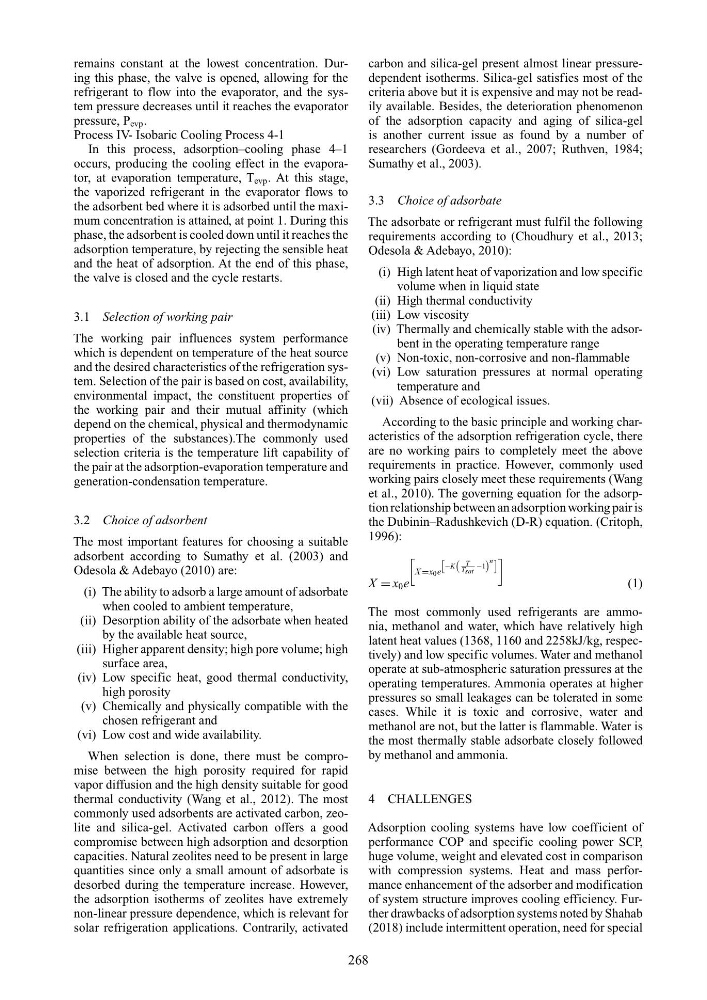
et al., 2010). The governing equation for the adsorption relationship between an adsorption working pair is
the Dubinin–Radushkevich (D-R) equation. (Critoph,
1996):
X = x 0 e
X =x0e
−K
T
T sat
−1
n
(1)
The most commonly used refrigerants are ammonia, methanol and water, which have relatively high
latent heat values (1368, 1160 and 2258kJ/kg, respectively) and low specific volumes. Water and methanol
operate at sub-atmospheric saturation pressures at the
operating temperatures. Ammonia operates at higher
pressures so small leakages can be tolerated in some
cases. While it is toxic and corrosive, water and
methanol are not, but the latter is flammable. Water is
the most thermally stable adsorbate closely followed
by methanol and ammonia.
4 CHALLENGES
Adsorption cooling systems have low coefficient of
performance COP and specific cooling power SCP,
huge volume, weight and elevated cost in comparison
with compression systems. Heat and mass performance enhancement of the adsorber and modification
of system structure improves cooling efficiency. Further drawbacks of adsorption systems noted by Shahab
(2018) include intermittent operation, need for special
268
refrigerant to flow into the evaporator, and the system pressure decreases until it reaches the evaporator
pressure, P evp .
Process IV- Isobaric Cooling Process 4-1
In this process, adsorption–cooling phase 4–1
occurs, producing the cooling effect in the evaporator, at evaporation temperature, T evp . At this stage,
the vaporized refrigerant in the evaporator flows to
the adsorbent bed where it is adsorbed until the maximum concentration is attained, at point 1. During this
phase, the adsorbent is cooled down until it reaches the
adsorption temperature, by rejecting the sensible heat
and the heat of adsorption. At the end of this phase,
the valve is closed and the cycle restarts.
3.1 Selection of working pair
The working pair influences system performance
which is dependent on temperature of the heat source
and the desired characteristics of the refrigeration system. Selection of the pair is based on cost, availability,
environmental impact, the constituent properties of
the working pair and their mutual affinity (which
depend on the chemical, physical and thermodynamic
properties of the substances).The commonly used
selection criteria is the temperature lift capability of
the pair at the adsorption-evaporation temperature and
generation-condensation temperature.
3.2 Choice of adsorbent
The most important features for choosing a suitable
adsorbent according to Sumathy et al. (2003) and
Odesola & Adebayo (2010) are:
(i) The ability to adsorb a large amount of adsorbate
when cooled to ambient temperature,
(ii) Desorption ability of the adsorbate when heated
by the available heat source,
(iii) Higher apparent density; high pore volume; high
surface area,
(iv) Low specific heat, good thermal conductivity,
high porosity
(v) Chemically and physically compatible with the
chosen refrigerant and
(vi) Low cost and wide availability.
When selection is done, there must be compromise between the high porosity required for rapid
vapor diffusion and the high density suitable for good
thermal conductivity (Wang et al., 2012). The most
commonly used adsorbents are activated carbon, zeolite and silica-gel. Activated carbon offers a good
compromise between high adsorption and desorption
capacities. Natural zeolites need to be present in large
quantities since only a small amount of adsorbate is
desorbed during the temperature increase. However,
the adsorption isotherms of zeolites have extremely
non-linear pressure dependence, which is relevant for
solar refrigeration applications. Contrarily, activated
carbon and silica-gel present almost linear pressuredependent isotherms. Silica-gel satisfies most of the
criteria above but it is expensive and may not be readily available. Besides, the deterioration phenomenon
of the adsorption capacity and aging of silica-gel
is another current issue as found by a number of
researchers (Gordeeva et al., 2007; Ruthven, 1984;
Sumathy et al., 2003).
3.3 Choice of adsorbate
The adsorbate or refrigerant must fulfil the following
requirements according to (Choudhury et al., 2013;
Odesola & Adebayo, 2010):
(i) High latent heat of vaporization and low specific
volume when in liquid state
(ii) High thermal conductivity
(iii) Low viscosity
(iv) Thermally and chemically stable with the adsorbent in the operating temperature range
(v) Non-toxic, non-corrosive and non-flammable
(vi) Low saturation pressures at normal operating
temperature and
(vii) Absence of ecological issues.
According to the basic principle and working characteristics of the adsorption refrigeration cycle, there
are no working pairs to completely meet the above
requirements in practice. However, commonly used
working pairs closely meet these requirements (Wang
et al., 2010). The governing equation for the adsorption relationship between an adsorption working pair is
the Dubinin–Radushkevich (D-R) equation. (Critoph,
1996):
X = x 0 e
X =x0e
−K
T
T sat
−1
n
(1)
The most commonly used refrigerants are ammonia, methanol and water, which have relatively high
latent heat values (1368, 1160 and 2258kJ/kg, respectively) and low specific volumes. Water and methanol
operate at sub-atmospheric saturation pressures at the
operating temperatures. Ammonia operates at higher
pressures so small leakages can be tolerated in some
cases. While it is toxic and corrosive, water and
methanol are not, but the latter is flammable. Water is
the most thermally stable adsorbate closely followed
by methanol and ammonia.
4 CHALLENGES
Adsorption cooling systems have low coefficient of
performance COP and specific cooling power SCP,
huge volume, weight and elevated cost in comparison
with compression systems. Heat and mass performance enhancement of the adsorber and modification
of system structure improves cooling efficiency. Further drawbacks of adsorption systems noted by Shahab
(2018) include intermittent operation, need for special
268