

3 THE ADSORPTION PROCESS
Adsorption is a process resulting from an interaction
between a solid (adsorbent) and a gas (refrigerant),
based on a physical or chemical reaction process.
Physical adsorption occurs when the molecules of
refrigerant (adsorbate) fix themselves at the surface
of an adsorbent by means of Vander Waals forces
and electrostatic forces. When heated, this process
can be reversed in which adsorbate molecules can
be released through a desorption process. In chemical adsorption, ionic or covalent bonds are formed
between the adsorbate molecules and the adsorbent.
The bonding forces are much greater than that of
physical adsorption, releasing more heat. The process
cannot be easily reversed and this type of bonding promotes chemical alteration of the adsorbed substance,
thus the adsorbate and adsorbent molecules never keep
their original state after adsorption .Therefore, most
of the adsorption refrigeration systems mainly involve
physical adsorption (Alghoul et al., 2007; Anyanwu,
2004).
The quantity of heat released during adsorption
depends on the magnitude of electrostatic forces, latent
heat and bond energy. A comparison of heat of adsorption between various solid adsorbent pairs is presented
in Table 1.
Table 1. Heat of adsorption between adsorbent-adsorbate
pairs.
Heat of
Adsorbent
Adsorbate
Adsorption
Activated alumina
H 2 O
3000
Zeolite
H 2 0
3300–4200
NH 3
4000–6000
CH 3 OH
2300–2600
Silica gel
CH 3 OH
1000–1500
Silica gel
H 2 O
2800
Charcoal
C 2 H 4
1000–1200
NH 3
2000–2700
H 2 O
2300–2600
CH 3 OH
1800–2000
C 2 H 5 OH
1200–1400
Calcium chloride
CH 3 OH
1800–2000
Metal hydrides
Hydrogen
2300–2600
Complex compounds
Salts and
2000–2700
ammonia or water
Source: Anirban & Randip (2010).
All adsorption processes are exothermic in nature.
The available energy during adsorption is represented
in the form G = H –TS where G is the change in
free energy, H is the change in enthalpy, T is adsorption temperature and S is the change in entropy. The
three terms which are used in adsorption process are:
(i) Integral heat of adsorption which is the total heat
released from initial stage to final stage of adsorption
loading, (ii) Differential heat of adsorption; the change
in integral heat of adsorption with change in loading
and (iii) Isosteric heat of adsorption,q st defined using
adsorption isosters. Differential and isosteric heat of
adsorption are usually identical and can be related as a
function of adsorption potential, heat of vaporization
and the change in adsorption capacity of an adsorbent
with temperature.
When fixed adsorbent beds are employed, which is
the common practice, adsorption cycles can be operated without any moving parts. The use of fixed beds
results in silence, mechanical simplicity, high reliability and a very long lifetime. On the other hand, it also
leads to intermittent cycle operation which decreases
the COP of the system. Hence, when constant flow of
vapour from the evaporator is required for continuous
cooling, two or more adsorbent beds must be operated
out of phase, which requires availability of the heat
source at all times, which is not the case with solar
radiation.
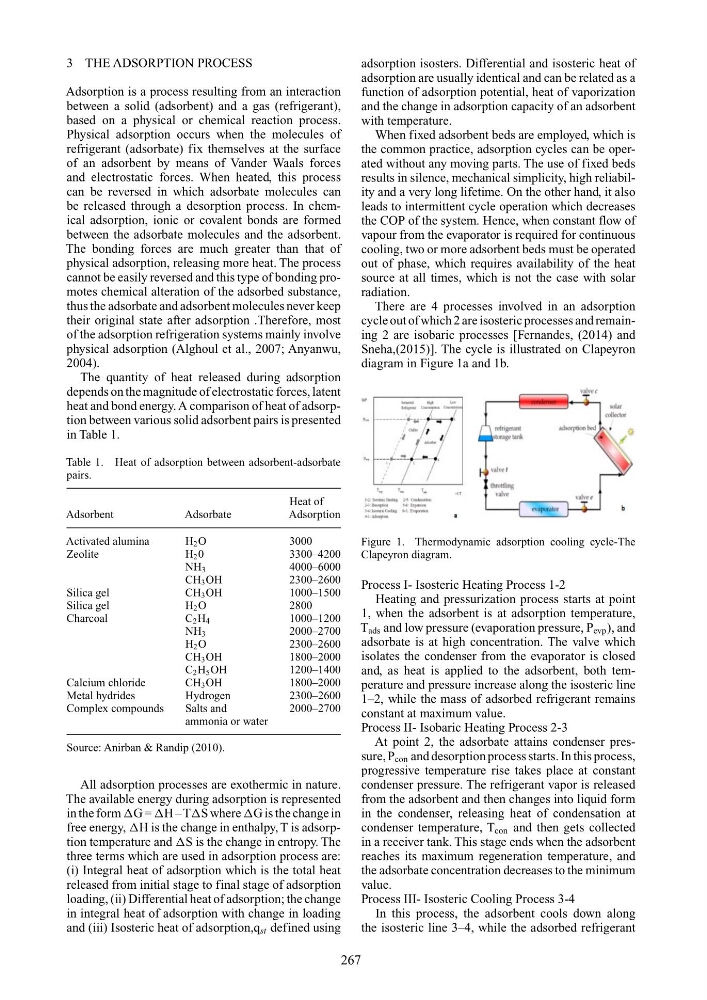
There are 4 processes involved in an adsorption
cycle out of which 2 are isosteric processes and remaining 2 are isobaric processes [Fernandes, (2014) and
Sneha,(2015)]. The cycle is illustrated on Clapeyron
diagram in Figure 1a and 1b.
Figure 1. Thermodynamic adsorption cooling cycle-The
Clapeyron diagram.
Process I- Isosteric Heating Process 1-2
Heating and pressurization process starts at point
1, when the adsorbent is at adsorption temperature,
T ads and low pressure (evaporation pressure, P evp ), and
adsorbate is at high concentration. The valve which
isolates the condenser from the evaporator is closed
and, as heat is applied to the adsorbent, both temperature and pressure increase along the isosteric line
1–2, while the mass of adsorbed refrigerant remains
constant at maximum value.
Process II- Isobaric Heating Process 2-3
At point 2, the adsorbate attains condenser pressure, P con and desorption process starts. In this process,
progressive temperature rise takes place at constant
condenser pressure. The refrigerant vapor is released
from the adsorbent and then changes into liquid form
in the condenser, releasing heat of condensation at
condenser temperature, T con and then gets collected
in a receiver tank. This stage ends when the adsorbent
reaches its maximum regeneration temperature, and
the adsorbate concentration decreases to the minimum
value.
Process III- Isosteric Cooling Process 3-4
In this process, the adsorbent cools down along
the isosteric line 3–4, while the adsorbed refrigerant
267
Adsorption is a process resulting from an interaction
between a solid (adsorbent) and a gas (refrigerant),
based on a physical or chemical reaction process.
Physical adsorption occurs when the molecules of
refrigerant (adsorbate) fix themselves at the surface
of an adsorbent by means of Vander Waals forces
and electrostatic forces. When heated, this process
can be reversed in which adsorbate molecules can
be released through a desorption process. In chemical adsorption, ionic or covalent bonds are formed
between the adsorbate molecules and the adsorbent.
The bonding forces are much greater than that of
physical adsorption, releasing more heat. The process
cannot be easily reversed and this type of bonding promotes chemical alteration of the adsorbed substance,
thus the adsorbate and adsorbent molecules never keep
their original state after adsorption .Therefore, most
of the adsorption refrigeration systems mainly involve
physical adsorption (Alghoul et al., 2007; Anyanwu,
2004).
The quantity of heat released during adsorption
depends on the magnitude of electrostatic forces, latent
heat and bond energy. A comparison of heat of adsorption between various solid adsorbent pairs is presented
in Table 1.
Table 1. Heat of adsorption between adsorbent-adsorbate
pairs.
Heat of
Adsorbent
Adsorbate
Adsorption
Activated alumina
H 2 O
3000
Zeolite
H 2 0
3300–4200
NH 3
4000–6000
CH 3 OH
2300–2600
Silica gel
CH 3 OH
1000–1500
Silica gel
H 2 O
2800
Charcoal
C 2 H 4
1000–1200
NH 3
2000–2700
H 2 O
2300–2600
CH 3 OH
1800–2000
C 2 H 5 OH
1200–1400
Calcium chloride
CH 3 OH
1800–2000
Metal hydrides
Hydrogen
2300–2600
Complex compounds
Salts and
2000–2700
ammonia or water
Source: Anirban & Randip (2010).
All adsorption processes are exothermic in nature.
The available energy during adsorption is represented
in the form G = H –TS where G is the change in
free energy, H is the change in enthalpy, T is adsorption temperature and S is the change in entropy. The
three terms which are used in adsorption process are:
(i) Integral heat of adsorption which is the total heat
released from initial stage to final stage of adsorption
loading, (ii) Differential heat of adsorption; the change
in integral heat of adsorption with change in loading
and (iii) Isosteric heat of adsorption,q st defined using
adsorption isosters. Differential and isosteric heat of
adsorption are usually identical and can be related as a
function of adsorption potential, heat of vaporization
and the change in adsorption capacity of an adsorbent
with temperature.
When fixed adsorbent beds are employed, which is
the common practice, adsorption cycles can be operated without any moving parts. The use of fixed beds
results in silence, mechanical simplicity, high reliability and a very long lifetime. On the other hand, it also
leads to intermittent cycle operation which decreases
the COP of the system. Hence, when constant flow of
vapour from the evaporator is required for continuous
cooling, two or more adsorbent beds must be operated
out of phase, which requires availability of the heat
source at all times, which is not the case with solar
radiation.
There are 4 processes involved in an adsorption
cycle out of which 2 are isosteric processes and remaining 2 are isobaric processes [Fernandes, (2014) and
Sneha,(2015)]. The cycle is illustrated on Clapeyron
diagram in Figure 1a and 1b.
Figure 1. Thermodynamic adsorption cooling cycle-The
Clapeyron diagram.
Process I- Isosteric Heating Process 1-2
Heating and pressurization process starts at point
1, when the adsorbent is at adsorption temperature,
T ads and low pressure (evaporation pressure, P evp ), and
adsorbate is at high concentration. The valve which
isolates the condenser from the evaporator is closed
and, as heat is applied to the adsorbent, both temperature and pressure increase along the isosteric line
1–2, while the mass of adsorbed refrigerant remains
constant at maximum value.
Process II- Isobaric Heating Process 2-3
At point 2, the adsorbate attains condenser pressure, P con and desorption process starts. In this process,
progressive temperature rise takes place at constant
condenser pressure. The refrigerant vapor is released
from the adsorbent and then changes into liquid form
in the condenser, releasing heat of condensation at
condenser temperature, T con and then gets collected
in a receiver tank. This stage ends when the adsorbent
reaches its maximum regeneration temperature, and
the adsorbate concentration decreases to the minimum
value.
Process III- Isosteric Cooling Process 3-4
In this process, the adsorbent cools down along
the isosteric line 3–4, while the adsorbed refrigerant
267