

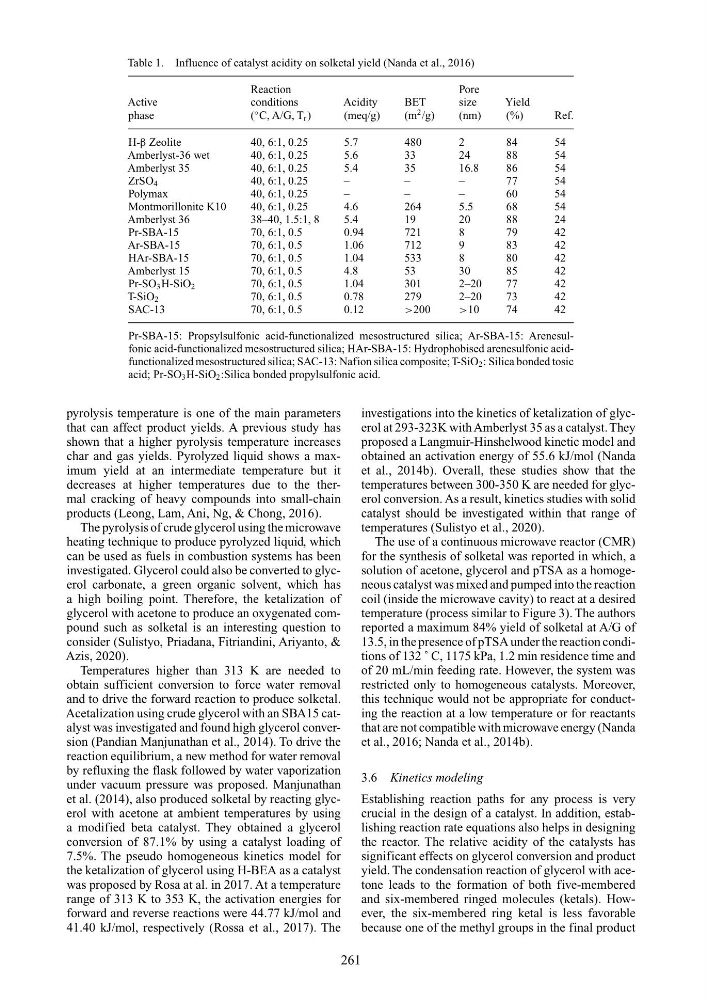
Table 1. Influence of catalyst acidity on solketal yield (Nanda et al., 2016)
Reaction
Pore
Active
conditions
Acidity
BET
size
Yield
phase
(
◦ C, A/G, T r )
(meq/g)
(m
2 /g)
(nm)
(%)
Ref.
H-β Zeolite
40, 6:1, 0.25
5.7
480
2
84
54
Amberlyst-36 wet
40, 6:1, 0.25
5.6
33
24
88
54
Amberlyst 35
40, 6:1, 0.25
5.4
35
16.8
86
54
ZrSO 4
40, 6:1, 0.25
–
–
–
77
54
Polymax
40, 6:1, 0.25
–
–
–
60
54
Montmorillonite K10
40, 6:1, 0.25
4.6
264
5.5
68
54
Amberlyst 36
38–40, 1.5:1, 8
5.4
19
20
88
24
Pr-SBA-15
70, 6:1, 0.5
0.94
721
8
79
42
Ar-SBA-15
70, 6:1, 0.5
1.06
712
9
83
42
HAr-SBA-15
70, 6:1, 0.5
1.04
533
8
80
42
Amberlyst 15
70, 6:1, 0.5
4.8
53
30
85
42
Pr-SO 3 H-SiO 2
70, 6:1, 0.5
1.04
301
2–20
77
42
T-SiO 2
70, 6:1, 0.5
0.78
279
2–20
73
42
SAC-13
70, 6:1, 0.5
0.12
>200
>10
74
42
Pr-SBA-15: Propsylsulfonic acid-functionalized mesostructured silica; Ar-SBA-15: Arenesulfonic acid-functionalized mesostructured silica; HAr-SBA-15: Hydrophobised arenesulfonic acidfunctionalized mesostructured silica; SAC-13: Nafion silica composite; T-SiO 2 : Silica bonded tosic
acid; Pr-SO 3 H-SiO 2 :Silica bonded propylsulfonic acid.
pyrolysis temperature is one of the main parameters
that can affect product yields. A previous study has
shown that a higher pyrolysis temperature increases
char and gas yields. Pyrolyzed liquid shows a maximum yield at an intermediate temperature but it
decreases at higher temperatures due to the thermal cracking of heavy compounds into small-chain
products (Leong, Lam, Ani, Ng, & Chong, 2016).
The pyrolysis of crude glycerol using the microwave
heating technique to produce pyrolyzed liquid, which
can be used as fuels in combustion systems has been
investigated. Glycerol could also be converted to glycerol carbonate, a green organic solvent, which has
a high boiling point. Therefore, the ketalization of
glycerol with acetone to produce an oxygenated compound such as solketal is an interesting question to
consider (Sulistyo, Priadana, Fitriandini, Ariyanto, &
Azis, 2020).
Temperatures higher than 313 K are needed to
obtain sufficient conversion to force water removal
and to drive the forward reaction to produce solketal.
Acetalization using crude glycerol with an SBA15 catalyst was investigated and found high glycerol conversion (Pandian Manjunathan et al., 2014). To drive the
reaction equilibrium, a new method for water removal
by refluxing the flask followed by water vaporization
under vacuum pressure was proposed. Manjunathan
et al. (2014), also produced solketal by reacting glycerol with acetone at ambient temperatures by using
a modified beta catalyst. They obtained a glycerol
conversion of 87.1% by using a catalyst loading of
7.5%. The pseudo homogeneous kinetics model for
the ketalization of glycerol using H-BEA as a catalyst
was proposed by Rosa at al. in 2017. At a temperature
range of 313 K to 353 K, the activation energies for
forward and reverse reactions were 44.77 kJ/mol and
41.40 kJ/mol, respectively (Rossa et al., 2017). The
investigations into the kinetics of ketalization of glycerol at 293-323K with Amberlyst 35 as a catalyst. They
proposed a Langmuir-Hinshelwood kinetic model and
obtained an activation energy of 55.6 kJ/mol (Nanda
et al., 2014b). Overall, these studies show that the
temperatures between 300-350 K are needed for glycerol conversion. As a result, kinetics studies with solid
catalyst should be investigated within that range of
temperatures (Sulistyo et al., 2020).
The use of a continuous microwave reactor (CMR)
for the synthesis of solketal was reported in which, a
solution of acetone, glycerol and pTSA as a homogeneous catalyst was mixed and pumped into the reaction
coil (inside the microwave cavity) to react at a desired
temperature (process similar to Figure 3). The authors
reported a maximum 84% yield of solketal at A/G of
13.5, in the presence of pTSA under the reaction conditions of 132 ˚ C, 1175 kPa, 1.2 min residence time and
of 20 mL/min feeding rate. However, the system was
restricted only to homogeneous catalysts. Moreover,
this technique would not be appropriate for conducting the reaction at a low temperature or for reactants
that are not compatible with microwave energy (Nanda
et al., 2016; Nanda et al., 2014b).
3.6 Kinetics modeling
Establishing reaction paths for any process is very
crucial in the design of a catalyst. In addition, establishing reaction rate equations also helps in designing
the reactor. The relative acidity of the catalysts has
significant effects on glycerol conversion and product
yield. The condensation reaction of glycerol with acetone leads to the formation of both five-membered
and six-membered ringed molecules (ketals). However, the six-membered ring ketal is less favorable
because one of the methyl groups in the final product
261
Reaction
Pore
Active
conditions
Acidity
BET
size
Yield
phase
(
◦ C, A/G, T r )
(meq/g)
(m
2 /g)
(nm)
(%)
Ref.
H-β Zeolite
40, 6:1, 0.25
5.7
480
2
84
54
Amberlyst-36 wet
40, 6:1, 0.25
5.6
33
24
88
54
Amberlyst 35
40, 6:1, 0.25
5.4
35
16.8
86
54
ZrSO 4
40, 6:1, 0.25
–
–
–
77
54
Polymax
40, 6:1, 0.25
–
–
–
60
54
Montmorillonite K10
40, 6:1, 0.25
4.6
264
5.5
68
54
Amberlyst 36
38–40, 1.5:1, 8
5.4
19
20
88
24
Pr-SBA-15
70, 6:1, 0.5
0.94
721
8
79
42
Ar-SBA-15
70, 6:1, 0.5
1.06
712
9
83
42
HAr-SBA-15
70, 6:1, 0.5
1.04
533
8
80
42
Amberlyst 15
70, 6:1, 0.5
4.8
53
30
85
42
Pr-SO 3 H-SiO 2
70, 6:1, 0.5
1.04
301
2–20
77
42
T-SiO 2
70, 6:1, 0.5
0.78
279
2–20
73
42
SAC-13
70, 6:1, 0.5
0.12
>200
>10
74
42
Pr-SBA-15: Propsylsulfonic acid-functionalized mesostructured silica; Ar-SBA-15: Arenesulfonic acid-functionalized mesostructured silica; HAr-SBA-15: Hydrophobised arenesulfonic acidfunctionalized mesostructured silica; SAC-13: Nafion silica composite; T-SiO 2 : Silica bonded tosic
acid; Pr-SO 3 H-SiO 2 :Silica bonded propylsulfonic acid.
pyrolysis temperature is one of the main parameters
that can affect product yields. A previous study has
shown that a higher pyrolysis temperature increases
char and gas yields. Pyrolyzed liquid shows a maximum yield at an intermediate temperature but it
decreases at higher temperatures due to the thermal cracking of heavy compounds into small-chain
products (Leong, Lam, Ani, Ng, & Chong, 2016).
The pyrolysis of crude glycerol using the microwave
heating technique to produce pyrolyzed liquid, which
can be used as fuels in combustion systems has been
investigated. Glycerol could also be converted to glycerol carbonate, a green organic solvent, which has
a high boiling point. Therefore, the ketalization of
glycerol with acetone to produce an oxygenated compound such as solketal is an interesting question to
consider (Sulistyo, Priadana, Fitriandini, Ariyanto, &
Azis, 2020).
Temperatures higher than 313 K are needed to
obtain sufficient conversion to force water removal
and to drive the forward reaction to produce solketal.
Acetalization using crude glycerol with an SBA15 catalyst was investigated and found high glycerol conversion (Pandian Manjunathan et al., 2014). To drive the
reaction equilibrium, a new method for water removal
by refluxing the flask followed by water vaporization
under vacuum pressure was proposed. Manjunathan
et al. (2014), also produced solketal by reacting glycerol with acetone at ambient temperatures by using
a modified beta catalyst. They obtained a glycerol
conversion of 87.1% by using a catalyst loading of
7.5%. The pseudo homogeneous kinetics model for
the ketalization of glycerol using H-BEA as a catalyst
was proposed by Rosa at al. in 2017. At a temperature
range of 313 K to 353 K, the activation energies for
forward and reverse reactions were 44.77 kJ/mol and
41.40 kJ/mol, respectively (Rossa et al., 2017). The
investigations into the kinetics of ketalization of glycerol at 293-323K with Amberlyst 35 as a catalyst. They
proposed a Langmuir-Hinshelwood kinetic model and
obtained an activation energy of 55.6 kJ/mol (Nanda
et al., 2014b). Overall, these studies show that the
temperatures between 300-350 K are needed for glycerol conversion. As a result, kinetics studies with solid
catalyst should be investigated within that range of
temperatures (Sulistyo et al., 2020).
The use of a continuous microwave reactor (CMR)
for the synthesis of solketal was reported in which, a
solution of acetone, glycerol and pTSA as a homogeneous catalyst was mixed and pumped into the reaction
coil (inside the microwave cavity) to react at a desired
temperature (process similar to Figure 3). The authors
reported a maximum 84% yield of solketal at A/G of
13.5, in the presence of pTSA under the reaction conditions of 132 ˚ C, 1175 kPa, 1.2 min residence time and
of 20 mL/min feeding rate. However, the system was
restricted only to homogeneous catalysts. Moreover,
this technique would not be appropriate for conducting the reaction at a low temperature or for reactants
that are not compatible with microwave energy (Nanda
et al., 2016; Nanda et al., 2014b).
3.6 Kinetics modeling
Establishing reaction paths for any process is very
crucial in the design of a catalyst. In addition, establishing reaction rate equations also helps in designing
the reactor. The relative acidity of the catalysts has
significant effects on glycerol conversion and product
yield. The condensation reaction of glycerol with acetone leads to the formation of both five-membered
and six-membered ringed molecules (ketals). However, the six-membered ring ketal is less favorable
because one of the methyl groups in the final product
261