

b. Life cycle cost analysis
A life cycle cost analysis (LCC) technique is applied
here to evaluate the residential PV system’s costs.
The initial PV system cost is normally relatively high
while the rest of operational related costs are relatively low since there is no fuel cost. Total costs from
PV component system acquisition, operating, maintenance to replacement over its lifetime are what life
cycle cost analysis (LCC) entails normally expressed
as the system present cost (17) as expressed:
LCC =
6
r=1
C r
(9)
Where C r is the individual component present worth
further represented by r in equation below as:
r∈ 1, 2, 3, 4, 5, 6 ≡[PV , B, CON , INV , INST , O&M ]
(10)
Where PV is the PV module cost, B represent battery
cost, CON represent charge controller cost, INV represent the inverter cost, INST represent installation cost
and O&M represent operation and maintenance cost.
The interest rate i (%), inflation rate d(%), initial
cost of the battery C BO (Ksh), number of replacements
j and battery life span n present worth of the battery
and given as:
C B = C BO +
j
k=1
C BO
1 + d
1 + i
kn
(11)
For operation and maintenance costs C O&M , the
present worth is expressed as (8):
C O&M = C O&M /y
1 + i
1 + d
1 −
1 + d
1 + i
1 −
1 + d
1 + i
N
(12)
Where C O&M /y is the operation and maintenance cost
per year and N is the life span of the PV module.
The total annualized cost is the sum of the annualized costs of each system component in terms of
the present worth. To calculate the annualized LCC
(ALCC) we use the following equation (20):
ALCC = LCC ×
1 −
1 + d
1 + i
1 + d
1 + i
N
(13)
To calculate the system unit electrical cost UEC we
use the following equation:
UEC = ALCC
366E d
(14)
The number of years it takes to recover an investment’s
initial cost i.e. payback time (PBT) is calculated using
the following equation:
PBT = LCC
Q AP × UEC KE
(15)
Where UEC KE is the cost of electricity supply in Kenya
and Q AP is the annual energy production from the PV
system expressed as:
Q AP = 8760E d
(16)
c. Levelized cost of energy
This is a widely used technique that gives a more accurate energy cost calculation defined as the ratio of LCC
of the PV system to the whole life cycle produced
energy (LCE) as is expressed (21):
LCOE = LCC
LCE
(17)
The LCE is calculated as in equation below (20):
LCE =
n
i=0
AEP ×
1 − f PV
i
(1 − r) r
(18)
Where AEP is the expected annual energy produced
which is the estimated life span of the PV system. As
the system time goes by, the output power yield will
be degraded with a factor f PV that is used here to get a
better energy forecast.
3 RESULTS AND DISCUSSION
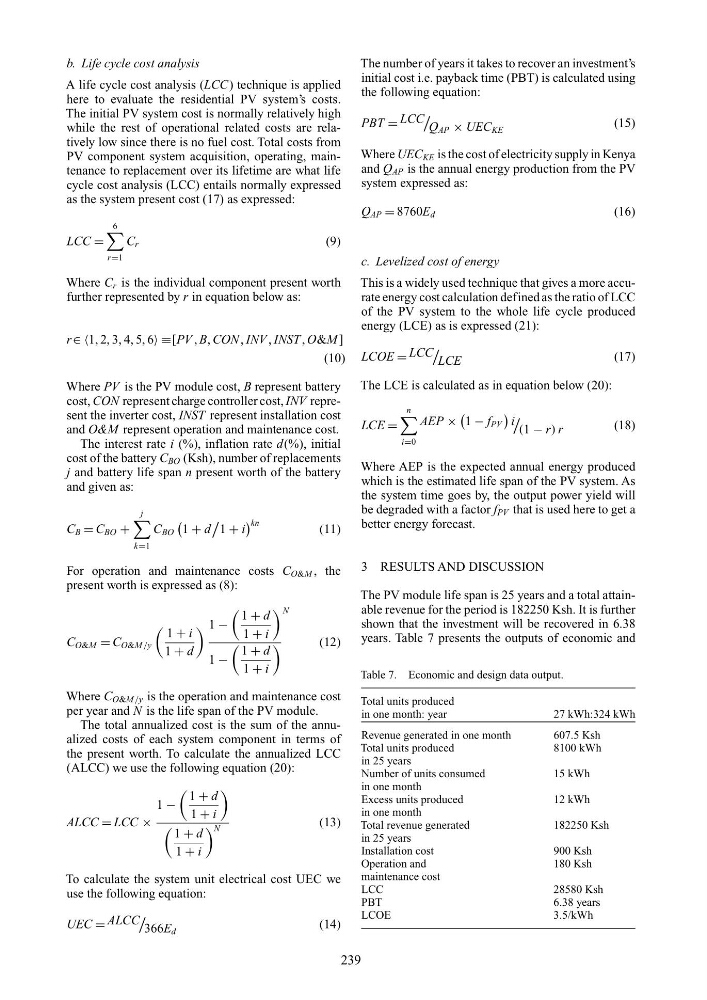
The PV module life span is 25 years and a total attainable revenue for the period is 182250 Ksh. It is further
shown that the investment will be recovered in 6.38
years. Table 7 presents the outputs of economic and
Table 7. Economic and design data output.
Total units produced
in one month: year
27 kWh:324 kWh
Revenue generated in one month
607.5 Ksh
Total units produced
8100 kWh
in 25 years
Number of units consumed
15 kWh
in one month
Excess units produced
12 kWh
in one month
Total revenue generated
182250 Ksh
in 25 years
Installation cost
900 Ksh
Operation and
180 Ksh
maintenance cost
LCC
28580 Ksh
PBT
6.38 years
LCOE
3.5/kWh
239
A life cycle cost analysis (LCC) technique is applied
here to evaluate the residential PV system’s costs.
The initial PV system cost is normally relatively high
while the rest of operational related costs are relatively low since there is no fuel cost. Total costs from
PV component system acquisition, operating, maintenance to replacement over its lifetime are what life
cycle cost analysis (LCC) entails normally expressed
as the system present cost (17) as expressed:
LCC =
6
r=1
C r
(9)
Where C r is the individual component present worth
further represented by r in equation below as:
r∈ 1, 2, 3, 4, 5, 6 ≡[PV , B, CON , INV , INST , O&M ]
(10)
Where PV is the PV module cost, B represent battery
cost, CON represent charge controller cost, INV represent the inverter cost, INST represent installation cost
and O&M represent operation and maintenance cost.
The interest rate i (%), inflation rate d(%), initial
cost of the battery C BO (Ksh), number of replacements
j and battery life span n present worth of the battery
and given as:
C B = C BO +
j
k=1
C BO
1 + d
1 + i
kn
(11)
For operation and maintenance costs C O&M , the
present worth is expressed as (8):
C O&M = C O&M /y
1 + i
1 + d
1 −
1 + d
1 + i
1 −
1 + d
1 + i
N
(12)
Where C O&M /y is the operation and maintenance cost
per year and N is the life span of the PV module.
The total annualized cost is the sum of the annualized costs of each system component in terms of
the present worth. To calculate the annualized LCC
(ALCC) we use the following equation (20):
ALCC = LCC ×
1 −
1 + d
1 + i
1 + d
1 + i
N
(13)
To calculate the system unit electrical cost UEC we
use the following equation:
UEC = ALCC
366E d
(14)
The number of years it takes to recover an investment’s
initial cost i.e. payback time (PBT) is calculated using
the following equation:
PBT = LCC
Q AP × UEC KE
(15)
Where UEC KE is the cost of electricity supply in Kenya
and Q AP is the annual energy production from the PV
system expressed as:
Q AP = 8760E d
(16)
c. Levelized cost of energy
This is a widely used technique that gives a more accurate energy cost calculation defined as the ratio of LCC
of the PV system to the whole life cycle produced
energy (LCE) as is expressed (21):
LCOE = LCC
LCE
(17)
The LCE is calculated as in equation below (20):
LCE =
n
i=0
AEP ×
1 − f PV
i
(1 − r) r
(18)
Where AEP is the expected annual energy produced
which is the estimated life span of the PV system. As
the system time goes by, the output power yield will
be degraded with a factor f PV that is used here to get a
better energy forecast.
3 RESULTS AND DISCUSSION
The PV module life span is 25 years and a total attainable revenue for the period is 182250 Ksh. It is further
shown that the investment will be recovered in 6.38
years. Table 7 presents the outputs of economic and
Table 7. Economic and design data output.
Total units produced
in one month: year
27 kWh:324 kWh
Revenue generated in one month
607.5 Ksh
Total units produced
8100 kWh
in 25 years
Number of units consumed
15 kWh
in one month
Excess units produced
12 kWh
in one month
Total revenue generated
182250 Ksh
in 25 years
Installation cost
900 Ksh
Operation and
180 Ksh
maintenance cost
LCC
28580 Ksh
PBT
6.38 years
LCOE
3.5/kWh
239