

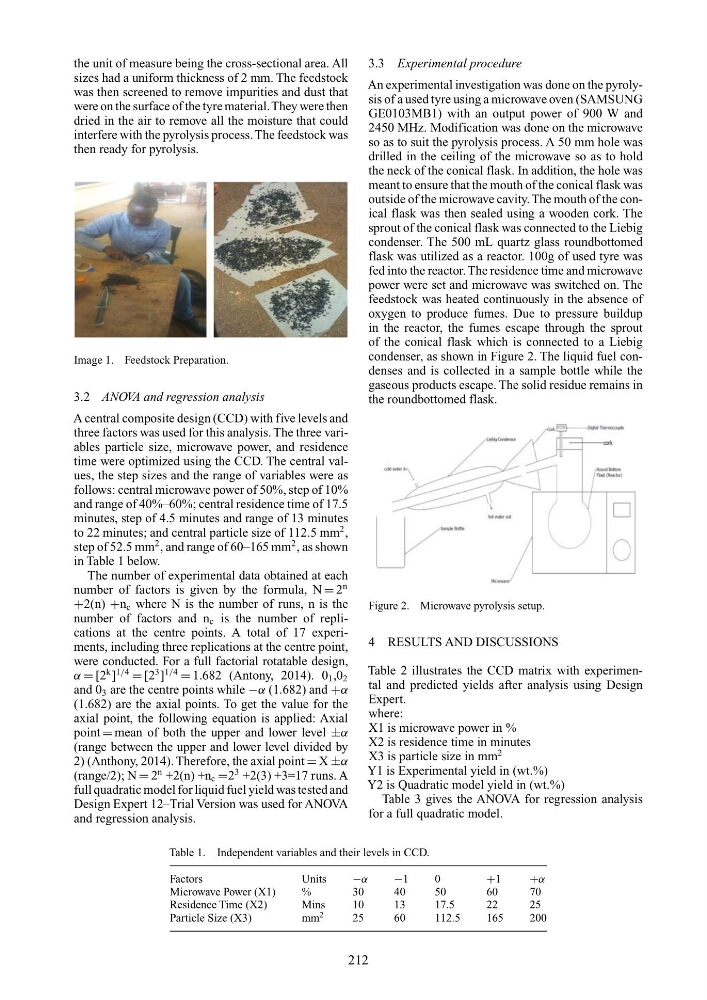
the unit of measure being the cross-sectional area. All
sizes had a uniform thickness of 2 mm. The feedstock
was then screened to remove impurities and dust that
were on the surface of the tyre material. They were then
dried in the air to remove all the moisture that could
interfere with the pyrolysis process. The feedstock was
then ready for pyrolysis.
Image 1. Feedstock Preparation.
3.2 ANOVA and regression analysis
A central composite design (CCD) with five levels and
three factors was used for this analysis. The three variables particle size, microwave power, and residence
time were optimized using the CCD. The central values, the step sizes and the range of variables were as
follows: central microwave power of 50%, step of 10%
and range of 40%–60%; central residence time of 17.5
minutes, step of 4.5 minutes and range of 13 minutes
to 22 minutes; and central particle size of 112.5 mm
2 ,
step of 52.5 mm
2 , and range of 60–165 mm
2 , as shown
in Table 1 below.
The number of experimental data obtained at each
number of factors is given by the formula, N = 2
n
+2(n) +n c where N is the number of runs, n is the
number of factors and n c is the number of replications at the centre points. A total of 17 experiments, including three replications at the centre point,
were conducted. For a full factorial rotatable design,
α = [2
k ]
1/4
= [2
3 ]
1/4
= 1.682 (Antony, 2014). 0 1 ,0 2
and 0 3 are the centre points while −α (1.682) and +α
(1.682) are the axial points. To get the value for the
axial point, the following equation is applied: Axial
point = mean of both the upper and lower level ±α
(range between the upper and lower level divided by
2) (Anthony, 2014). Therefore, the axial point = X ±α
(range/2); N = 2
n +2(n) +n c =2
3 +2(3) +3=17 runs. A
full quadratic model for liquid fuel yield was tested and
Design Expert 12–Trial Version was used for ANOVA
and regression analysis.
Table 1. Independent variables and their levels in CCD.
Factors
Units
−α
−1
0
+1
+α
Microwave Power (X1)
%
30
40
50
60
70
Residence Time (X2)
Mins
10
13
17.5
22
25
Particle Size (X3)
mm
2
25
60
112.5
165
200
3.3 Experimental procedure
An experimental investigation was done on the pyrolysis of a used tyre using a microwave oven (SAMSUNG
GE0103MB1) with an output power of 900 W and
2450 MHz. Modification was done on the microwave
so as to suit the pyrolysis process. A 50 mm hole was
drilled in the ceiling of the microwave so as to hold
the neck of the conical flask. In addition, the hole was
meant to ensure that the mouth of the conical flask was
outside of the microwave cavity. The mouth of the conical flask was then sealed using a wooden cork. The
sprout of the conical flask was connected to the Liebig
condenser. The 500 mL quartz glass roundbottomed
flask was utilized as a reactor. 100g of used tyre was
fed into the reactor. The residence time and microwave
power were set and microwave was switched on. The
feedstock was heated continuously in the absence of
oxygen to produce fumes. Due to pressure buildup
in the reactor, the fumes escape through the sprout
of the conical flask which is connected to a Liebig
condenser, as shown in Figure 2. The liquid fuel condenses and is collected in a sample bottle while the
gaseous products escape. The solid residue remains in
the roundbottomed flask.
Figure 2. Microwave pyrolysis setup.
4 RESULTS AND DISCUSSIONS
Table 2 illustrates the CCD matrix with experimental and predicted yields after analysis using Design
Expert.
where:
X1 is microwave power in %
X2 is residence time in minutes
X3 is particle size in mm
2
Y1 is Experimental yield in (wt.%)
Y2 is Quadratic model yield in (wt.%)
Table 3 gives the ANOVA for regression analysis
for a full quadratic model.
212
sizes had a uniform thickness of 2 mm. The feedstock
was then screened to remove impurities and dust that
were on the surface of the tyre material. They were then
dried in the air to remove all the moisture that could
interfere with the pyrolysis process. The feedstock was
then ready for pyrolysis.
Image 1. Feedstock Preparation.
3.2 ANOVA and regression analysis
A central composite design (CCD) with five levels and
three factors was used for this analysis. The three variables particle size, microwave power, and residence
time were optimized using the CCD. The central values, the step sizes and the range of variables were as
follows: central microwave power of 50%, step of 10%
and range of 40%–60%; central residence time of 17.5
minutes, step of 4.5 minutes and range of 13 minutes
to 22 minutes; and central particle size of 112.5 mm
2 ,
step of 52.5 mm
2 , and range of 60–165 mm
2 , as shown
in Table 1 below.
The number of experimental data obtained at each
number of factors is given by the formula, N = 2
n
+2(n) +n c where N is the number of runs, n is the
number of factors and n c is the number of replications at the centre points. A total of 17 experiments, including three replications at the centre point,
were conducted. For a full factorial rotatable design,
α = [2
k ]
1/4
= [2
3 ]
1/4
= 1.682 (Antony, 2014). 0 1 ,0 2
and 0 3 are the centre points while −α (1.682) and +α
(1.682) are the axial points. To get the value for the
axial point, the following equation is applied: Axial
point = mean of both the upper and lower level ±α
(range between the upper and lower level divided by
2) (Anthony, 2014). Therefore, the axial point = X ±α
(range/2); N = 2
n +2(n) +n c =2
3 +2(3) +3=17 runs. A
full quadratic model for liquid fuel yield was tested and
Design Expert 12–Trial Version was used for ANOVA
and regression analysis.
Table 1. Independent variables and their levels in CCD.
Factors
Units
−α
−1
0
+1
+α
Microwave Power (X1)
%
30
40
50
60
70
Residence Time (X2)
Mins
10
13
17.5
22
25
Particle Size (X3)
mm
2
25
60
112.5
165
200
3.3 Experimental procedure
An experimental investigation was done on the pyrolysis of a used tyre using a microwave oven (SAMSUNG
GE0103MB1) with an output power of 900 W and
2450 MHz. Modification was done on the microwave
so as to suit the pyrolysis process. A 50 mm hole was
drilled in the ceiling of the microwave so as to hold
the neck of the conical flask. In addition, the hole was
meant to ensure that the mouth of the conical flask was
outside of the microwave cavity. The mouth of the conical flask was then sealed using a wooden cork. The
sprout of the conical flask was connected to the Liebig
condenser. The 500 mL quartz glass roundbottomed
flask was utilized as a reactor. 100g of used tyre was
fed into the reactor. The residence time and microwave
power were set and microwave was switched on. The
feedstock was heated continuously in the absence of
oxygen to produce fumes. Due to pressure buildup
in the reactor, the fumes escape through the sprout
of the conical flask which is connected to a Liebig
condenser, as shown in Figure 2. The liquid fuel condenses and is collected in a sample bottle while the
gaseous products escape. The solid residue remains in
the roundbottomed flask.
Figure 2. Microwave pyrolysis setup.
4 RESULTS AND DISCUSSIONS
Table 2 illustrates the CCD matrix with experimental and predicted yields after analysis using Design
Expert.
where:
X1 is microwave power in %
X2 is residence time in minutes
X3 is particle size in mm
2
Y1 is Experimental yield in (wt.%)
Y2 is Quadratic model yield in (wt.%)
Table 3 gives the ANOVA for regression analysis
for a full quadratic model.
212