

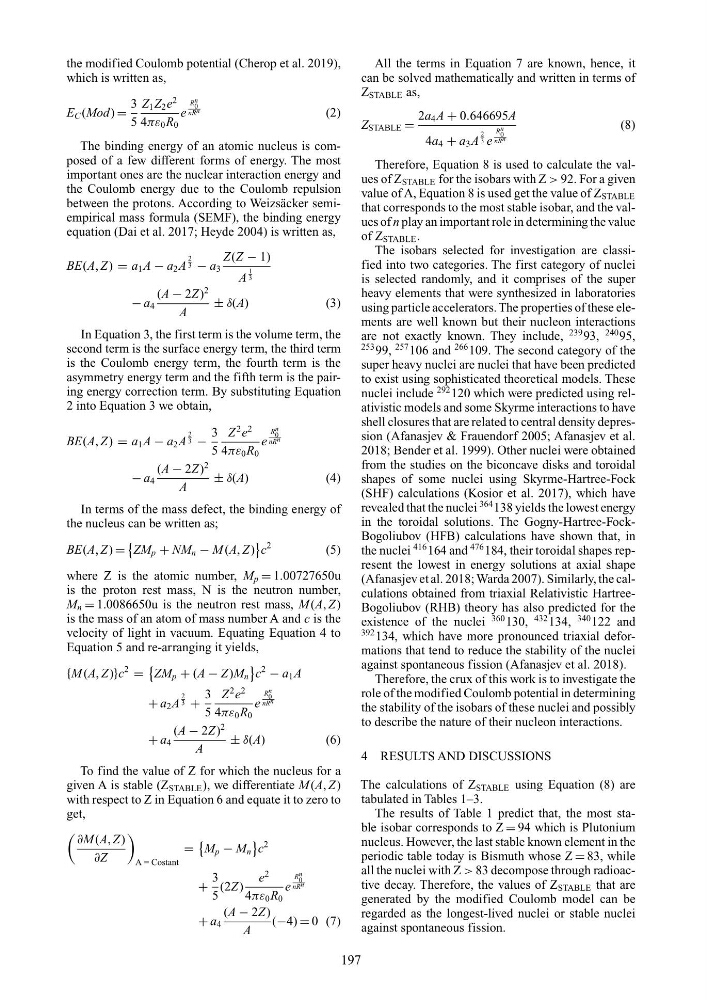
the modified Coulomb potential (Cherop et al. 2019),
which is written as,
E C (Mod) =
3
5
Z 1 Z 2 e
2
4πε 0 R 0
e
R n
0
nR n
(2)
The binding energy of an atomic nucleus is composed of a few different forms of energy. The most
important ones are the nuclear interaction energy and
the Coulomb energy due to the Coulomb repulsion
between the protons. According to Weizsäcker semiempirical mass formula (SEMF), the binding energy
equation (Dai et al. 2017; Heyde 2004) is written as,
BE(A, Z) = a 1 A − a 2 A
2
3 − a 3
Z(Z − 1)
A
1
3
− a 4
(A − 2Z)
2
A
± δ(A)
(3)
In Equation 3, the first term is the volume term, the
second term is the surface energy term, the third term
is the Coulomb energy term, the fourth term is the
asymmetry energy term and the fifth term is the pairing energy correction term. By substituting Equation
2 into Equation 3 we obtain,
BE(A, Z) = a 1 A − a 2 A
2
3 −
3
5
Z
2 e
2
4πε 0 R 0
e
R n
0
nR n
− a 4
(A − 2Z)
2
A
± δ(A)
(4)
In terms of the mass defect, the binding energy of
the nucleus can be written as;
BE(A, Z) =
ZM p + NM n − M (A, Z)
c
2
(5)
where Z is the atomic number, M p = 1.00727650u
is the proton rest mass, N is the neutron number,
M n = 1.0086650u is the neutron rest mass, M (A, Z)
is the mass of an atom of mass number A and c is the
velocity of light in vacuum. Equating Equation 4 to
Equation 5 and re-arranging it yields,
{M (A, Z)}c
2 =
ZM p + (A − Z)M n
c
2 − a 1 A
+ a 2 A
2
3 +
3
5
Z
2 e
2
4πε 0 R 0
e
R n
0
nR n
+ a 4
(A − 2Z)
2
A
± δ(A)
(6)
To find the value of Z for which the nucleus for a
given A is stable (Z STABLE ), we differentiate M (A, Z)
with respect to Z in Equation 6 and equate it to zero to
get,
∂M (A, Z)
∂Z
A = Costant
=
M p − M n
c
2
+
3
5
(2Z)
e
2
4πε 0 R 0
e
R n
0
nR n
+ a 4
(A − 2Z)
A
(−4) = 0 (7)
All the terms in Equation 7 are known, hence, it
can be solved mathematically and written in terms of
Z STABLE as,
Z STABLE =
2a 4 A + 0.646695A
4a 4 + a 3 A
2
3 e
R n
0
nR n
(8)
Therefore, Equation 8 is used to calculate the values of Z STABLE for the isobars with Z > 92. For a given
value of A, Equation 8 is used get the value of Z STABLE
that corresponds to the most stable isobar, and the values of n play an important role in determining the value
of Z STABLE .
The isobars selected for investigation are classified into two categories. The first category of nuclei
is selected randomly, and it comprises of the super
heavy elements that were synthesized in laboratories
using particle accelerators. The properties of these elements are well known but their nucleon interactions
are not exactly known. They include,
239 93,
240 95,
253 99,
257 106 and
266 109. The second category of the
super heavy nuclei are nuclei that have been predicted
to exist using sophisticated theoretical models. These
nuclei include
292 120 which were predicted using relativistic models and some Skyrme interactions to have
shell closures that are related to central density depression (Afanasjev & Frauendorf 2005; Afanasjev et al.
2018; Bender et al. 1999). Other nuclei were obtained
from the studies on the biconcave disks and toroidal
shapes of some nuclei using Skyrme-Hartree-Fock
(SHF) calculations (Kosior et al. 2017), which have
revealed that the nuclei
364 138 yields the lowest energy
in the toroidal solutions. The Gogny-Hartree-FockBogoliubov (HFB) calculations have shown that, in
the nuclei
416 164 and
476 184, their toroidal shapes represent the lowest in energy solutions at axial shape
(Afanasjev et al. 2018; Warda 2007). Similarly, the calculations obtained from triaxial Relativistic HartreeBogoliubov (RHB) theory has also predicted for the
existence of the nuclei
360 130,
432 134,
340 122 and
392 134, which have more pronounced triaxial deformations that tend to reduce the stability of the nuclei
against spontaneous fission (Afanasjev et al. 2018).
Therefore, the crux of this work is to investigate the
role of the modified Coulomb potential in determining
the stability of the isobars of these nuclei and possibly
to describe the nature of their nucleon interactions.
4 RESULTS AND DISCUSSIONS
The calculations of Z STABLE using Equation (8) are
tabulated in Tables 1–3.
The results of Table 1 predict that, the most stable isobar corresponds to Z = 94 which is Plutonium
nucleus. However, the last stable known element in the
periodic table today is Bismuth whose Z = 83, while
all the nuclei with Z > 83 decompose through radioactive decay. Therefore, the values of Z STABLE that are
generated by the modified Coulomb model can be
regarded as the longest-lived nuclei or stable nuclei
against spontaneous fission.
197
which is written as,
E C (Mod) =
3
5
Z 1 Z 2 e
2
4πε 0 R 0
e
R n
0
nR n
(2)
The binding energy of an atomic nucleus is composed of a few different forms of energy. The most
important ones are the nuclear interaction energy and
the Coulomb energy due to the Coulomb repulsion
between the protons. According to Weizsäcker semiempirical mass formula (SEMF), the binding energy
equation (Dai et al. 2017; Heyde 2004) is written as,
BE(A, Z) = a 1 A − a 2 A
2
3 − a 3
Z(Z − 1)
A
1
3
− a 4
(A − 2Z)
2
A
± δ(A)
(3)
In Equation 3, the first term is the volume term, the
second term is the surface energy term, the third term
is the Coulomb energy term, the fourth term is the
asymmetry energy term and the fifth term is the pairing energy correction term. By substituting Equation
2 into Equation 3 we obtain,
BE(A, Z) = a 1 A − a 2 A
2
3 −
3
5
Z
2 e
2
4πε 0 R 0
e
R n
0
nR n
− a 4
(A − 2Z)
2
A
± δ(A)
(4)
In terms of the mass defect, the binding energy of
the nucleus can be written as;
BE(A, Z) =
ZM p + NM n − M (A, Z)
c
2
(5)
where Z is the atomic number, M p = 1.00727650u
is the proton rest mass, N is the neutron number,
M n = 1.0086650u is the neutron rest mass, M (A, Z)
is the mass of an atom of mass number A and c is the
velocity of light in vacuum. Equating Equation 4 to
Equation 5 and re-arranging it yields,
{M (A, Z)}c
2 =
ZM p + (A − Z)M n
c
2 − a 1 A
+ a 2 A
2
3 +
3
5
Z
2 e
2
4πε 0 R 0
e
R n
0
nR n
+ a 4
(A − 2Z)
2
A
± δ(A)
(6)
To find the value of Z for which the nucleus for a
given A is stable (Z STABLE ), we differentiate M (A, Z)
with respect to Z in Equation 6 and equate it to zero to
get,
∂M (A, Z)
∂Z
A = Costant
=
M p − M n
c
2
+
3
5
(2Z)
e
2
4πε 0 R 0
e
R n
0
nR n
+ a 4
(A − 2Z)
A
(−4) = 0 (7)
All the terms in Equation 7 are known, hence, it
can be solved mathematically and written in terms of
Z STABLE as,
Z STABLE =
2a 4 A + 0.646695A
4a 4 + a 3 A
2
3 e
R n
0
nR n
(8)
Therefore, Equation 8 is used to calculate the values of Z STABLE for the isobars with Z > 92. For a given
value of A, Equation 8 is used get the value of Z STABLE
that corresponds to the most stable isobar, and the values of n play an important role in determining the value
of Z STABLE .
The isobars selected for investigation are classified into two categories. The first category of nuclei
is selected randomly, and it comprises of the super
heavy elements that were synthesized in laboratories
using particle accelerators. The properties of these elements are well known but their nucleon interactions
are not exactly known. They include,
239 93,
240 95,
253 99,
257 106 and
266 109. The second category of the
super heavy nuclei are nuclei that have been predicted
to exist using sophisticated theoretical models. These
nuclei include
292 120 which were predicted using relativistic models and some Skyrme interactions to have
shell closures that are related to central density depression (Afanasjev & Frauendorf 2005; Afanasjev et al.
2018; Bender et al. 1999). Other nuclei were obtained
from the studies on the biconcave disks and toroidal
shapes of some nuclei using Skyrme-Hartree-Fock
(SHF) calculations (Kosior et al. 2017), which have
revealed that the nuclei
364 138 yields the lowest energy
in the toroidal solutions. The Gogny-Hartree-FockBogoliubov (HFB) calculations have shown that, in
the nuclei
416 164 and
476 184, their toroidal shapes represent the lowest in energy solutions at axial shape
(Afanasjev et al. 2018; Warda 2007). Similarly, the calculations obtained from triaxial Relativistic HartreeBogoliubov (RHB) theory has also predicted for the
existence of the nuclei
360 130,
432 134,
340 122 and
392 134, which have more pronounced triaxial deformations that tend to reduce the stability of the nuclei
against spontaneous fission (Afanasjev et al. 2018).
Therefore, the crux of this work is to investigate the
role of the modified Coulomb potential in determining
the stability of the isobars of these nuclei and possibly
to describe the nature of their nucleon interactions.
4 RESULTS AND DISCUSSIONS
The calculations of Z STABLE using Equation (8) are
tabulated in Tables 1–3.
The results of Table 1 predict that, the most stable isobar corresponds to Z = 94 which is Plutonium
nucleus. However, the last stable known element in the
periodic table today is Bismuth whose Z = 83, while
all the nuclei with Z > 83 decompose through radioactive decay. Therefore, the values of Z STABLE that are
generated by the modified Coulomb model can be
regarded as the longest-lived nuclei or stable nuclei
against spontaneous fission.
197