

textiles such as Oeko-Tex Standards 100 led to technological innovation and the domestic development of
environment-friendly dye substitutes (Almahy & band
Ali, 2013).
Natural dyes are vastly superior to synthetic dyes
in that they age well and develop a patina, soft,
lustrous, and soothing shades to the human eye
(Kusumawati, Santoso, Sianita, & Muslim, 2017; Sanjeeda et al., 2014). They are non-pollutants, non-toxic,
non-carcinogenic, easy to handle, and biodegradable
(Alsehri, Naushad, Ahamad, Alothman, & Aldalbahi,
2014; Ghoulia et al., 2012). They are obtained from
renewable sources viz. plants, animals, and minerals
(Yusuf et al., 2017). For example, in plants they are
derived from roots, barks, leaves, fruits, and flowers. Natural dyes also contain bioactive compounds
beneficial to our health. Many natural dyes have
UV protective (Simpson, Simpson, & Aytug, 2015),
antimicrobial (Wangatia, Wangatia, & Moyo, 2015),
and deoxidizing (Baião et al., 2017) properties. The
limitations of the study were that the textile industry
has not readily considered the use of natural dyes in
their processes as there are no standard shade cards,
application procedures, set conditions, and parameters, thus they frequently require extraction and
process optimization. The apparatus and equipment
for extraction and analysis are limited in availability
or expensive. Moreover, colour fastness performance
ratings are inadequate for modern textile usage. Natural dyes require mordants to fix, modify, and hold
colour onto the fabric. Mordants can be metallic or
biomordants (Rather et al., 2016).
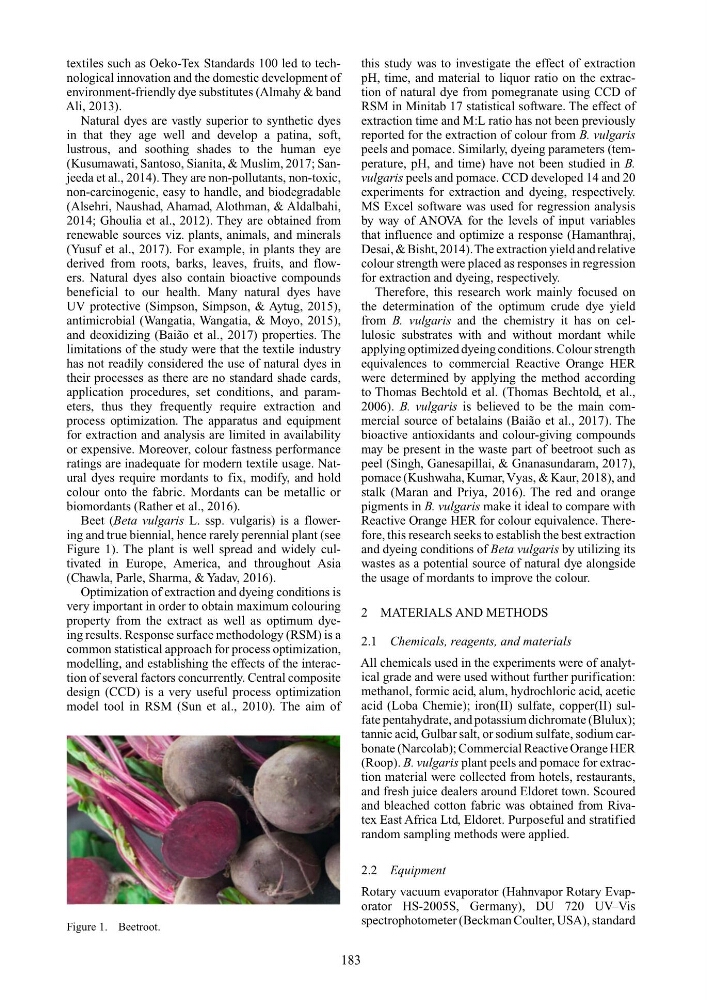
Beet (Beta vulgaris L. ssp. vulgaris) is a flowering and true biennial, hence rarely perennial plant (see
Figure 1). The plant is well spread and widely cultivated in Europe, America, and throughout Asia
(Chawla, Parle, Sharma, & Yadav, 2016).
Optimization of extraction and dyeing conditions is
very important in order to obtain maximum colouring
property from the extract as well as optimum dyeing results. Response surface methodology (RSM) is a
common statistical approach for process optimization,
modelling, and establishing the effects of the interaction of several factors concurrently. Central composite
design (CCD) is a very useful process optimization
model tool in RSM (Sun et al., 2010). The aim of
Figure 1. Beetroot.
this study was to investigate the effect of extraction
pH, time, and material to liquor ratio on the extraction of natural dye from pomegranate using CCD of
RSM in Minitab 17 statistical software. The effect of
extraction time and M:L ratio has not been previously
reported for the extraction of colour from B. vulgaris
peels and pomace. Similarly, dyeing parameters (temperature, pH, and time) have not been studied in B.
vulgaris peels and pomace. CCD developed 14 and 20
experiments for extraction and dyeing, respectively.
MS Excel software was used for regression analysis
by way of ANOVA for the levels of input variables
that influence and optimize a response (Hamanthraj,
Desai, & Bisht, 2014). The extraction yield and relative
colour strength were placed as responses in regression
for extraction and dyeing, respectively.
Therefore, this research work mainly focused on
the determination of the optimum crude dye yield
from B. vulgaris and the chemistry it has on cellulosic substrates with and without mordant while
applying optimized dyeing conditions. Colour strength
equivalences to commercial Reactive Orange HER
were determined by applying the method according
to Thomas Bechtold et al. (Thomas Bechtold, et al.,
2006). B. vulgaris is believed to be the main commercial source of betalains (Baião et al., 2017). The
bioactive antioxidants and colour-giving compounds
may be present in the waste part of beetroot such as
peel (Singh, Ganesapillai, & Gnanasundaram, 2017),
pomace (Kushwaha, Kumar, Vyas, & Kaur, 2018), and
stalk (Maran and Priya, 2016). The red and orange
pigments in B. vulgaris make it ideal to compare with
Reactive Orange HER for colour equivalence. Therefore, this research seeks to establish the best extraction
and dyeing conditions of Beta vulgaris by utilizing its
wastes as a potential source of natural dye alongside
the usage of mordants to improve the colour.
2 MATERIALS AND METHODS
2.1 Chemicals, reagents, and materials
All chemicals used in the experiments were of analytical grade and were used without further purification:
methanol, formic acid, alum, hydrochloric acid, acetic
acid (Loba Chemie); iron(II) sulfate, copper(II) sulfate pentahydrate, and potassium dichromate (Blulux);
tannic acid, Gulbar salt, or sodium sulfate, sodium carbonate (Narcolab); Commercial Reactive Orange HER
(Roop). B. vulgaris plant peels and pomace for extraction material were collected from hotels, restaurants,
and fresh juice dealers around Eldoret town. Scoured
and bleached cotton fabric was obtained from Rivatex East Africa Ltd, Eldoret. Purposeful and stratified
random sampling methods were applied.
2.2 Equipment
Rotary vacuum evaporator (Hahnvapor Rotary Evaporator HS-2005S, Germany), DU 720 UV–Vis
spectrophotometer (Beckman Coulter, USA), standard
183
environment-friendly dye substitutes (Almahy & band
Ali, 2013).
Natural dyes are vastly superior to synthetic dyes
in that they age well and develop a patina, soft,
lustrous, and soothing shades to the human eye
(Kusumawati, Santoso, Sianita, & Muslim, 2017; Sanjeeda et al., 2014). They are non-pollutants, non-toxic,
non-carcinogenic, easy to handle, and biodegradable
(Alsehri, Naushad, Ahamad, Alothman, & Aldalbahi,
2014; Ghoulia et al., 2012). They are obtained from
renewable sources viz. plants, animals, and minerals
(Yusuf et al., 2017). For example, in plants they are
derived from roots, barks, leaves, fruits, and flowers. Natural dyes also contain bioactive compounds
beneficial to our health. Many natural dyes have
UV protective (Simpson, Simpson, & Aytug, 2015),
antimicrobial (Wangatia, Wangatia, & Moyo, 2015),
and deoxidizing (Baião et al., 2017) properties. The
limitations of the study were that the textile industry
has not readily considered the use of natural dyes in
their processes as there are no standard shade cards,
application procedures, set conditions, and parameters, thus they frequently require extraction and
process optimization. The apparatus and equipment
for extraction and analysis are limited in availability
or expensive. Moreover, colour fastness performance
ratings are inadequate for modern textile usage. Natural dyes require mordants to fix, modify, and hold
colour onto the fabric. Mordants can be metallic or
biomordants (Rather et al., 2016).
Beet (Beta vulgaris L. ssp. vulgaris) is a flowering and true biennial, hence rarely perennial plant (see
Figure 1). The plant is well spread and widely cultivated in Europe, America, and throughout Asia
(Chawla, Parle, Sharma, & Yadav, 2016).
Optimization of extraction and dyeing conditions is
very important in order to obtain maximum colouring
property from the extract as well as optimum dyeing results. Response surface methodology (RSM) is a
common statistical approach for process optimization,
modelling, and establishing the effects of the interaction of several factors concurrently. Central composite
design (CCD) is a very useful process optimization
model tool in RSM (Sun et al., 2010). The aim of
Figure 1. Beetroot.
this study was to investigate the effect of extraction
pH, time, and material to liquor ratio on the extraction of natural dye from pomegranate using CCD of
RSM in Minitab 17 statistical software. The effect of
extraction time and M:L ratio has not been previously
reported for the extraction of colour from B. vulgaris
peels and pomace. Similarly, dyeing parameters (temperature, pH, and time) have not been studied in B.
vulgaris peels and pomace. CCD developed 14 and 20
experiments for extraction and dyeing, respectively.
MS Excel software was used for regression analysis
by way of ANOVA for the levels of input variables
that influence and optimize a response (Hamanthraj,
Desai, & Bisht, 2014). The extraction yield and relative
colour strength were placed as responses in regression
for extraction and dyeing, respectively.
Therefore, this research work mainly focused on
the determination of the optimum crude dye yield
from B. vulgaris and the chemistry it has on cellulosic substrates with and without mordant while
applying optimized dyeing conditions. Colour strength
equivalences to commercial Reactive Orange HER
were determined by applying the method according
to Thomas Bechtold et al. (Thomas Bechtold, et al.,
2006). B. vulgaris is believed to be the main commercial source of betalains (Baião et al., 2017). The
bioactive antioxidants and colour-giving compounds
may be present in the waste part of beetroot such as
peel (Singh, Ganesapillai, & Gnanasundaram, 2017),
pomace (Kushwaha, Kumar, Vyas, & Kaur, 2018), and
stalk (Maran and Priya, 2016). The red and orange
pigments in B. vulgaris make it ideal to compare with
Reactive Orange HER for colour equivalence. Therefore, this research seeks to establish the best extraction
and dyeing conditions of Beta vulgaris by utilizing its
wastes as a potential source of natural dye alongside
the usage of mordants to improve the colour.
2 MATERIALS AND METHODS
2.1 Chemicals, reagents, and materials
All chemicals used in the experiments were of analytical grade and were used without further purification:
methanol, formic acid, alum, hydrochloric acid, acetic
acid (Loba Chemie); iron(II) sulfate, copper(II) sulfate pentahydrate, and potassium dichromate (Blulux);
tannic acid, Gulbar salt, or sodium sulfate, sodium carbonate (Narcolab); Commercial Reactive Orange HER
(Roop). B. vulgaris plant peels and pomace for extraction material were collected from hotels, restaurants,
and fresh juice dealers around Eldoret town. Scoured
and bleached cotton fabric was obtained from Rivatex East Africa Ltd, Eldoret. Purposeful and stratified
random sampling methods were applied.
2.2 Equipment
Rotary vacuum evaporator (Hahnvapor Rotary Evaporator HS-2005S, Germany), DU 720 UV–Vis
spectrophotometer (Beckman Coulter, USA), standard
183