

Table 2. The list of identified compounds in Prosopis juliflora extract.
Retention
Chemical
time
M.W formula
Structure Name
25.180
180
C 11 H 16 O 2
a
2(4H)-Benzofuranone, 5,6,7,7a-tetrahydro-4,4,7a-trimethyl
25.180
180
C 11 H 16 O 2
b
2(4H)-Benzofuranone, 5,6,7,7a-tetrahydro-4,4,7a-trimethyl-, (R)25.180
293
C 16 H 20 FNO 3 c
Cyclopentane carboxylic acid, 3-(3-fluorophenylcarbamoyl)-1,2,2-trimethyl
25.180
180
C 12 H 20 O
d
6,6-Dimethyl-10-methylene-1-oxa-spiro[4.5]decane
5.182
116
C 7 H 16 O
e
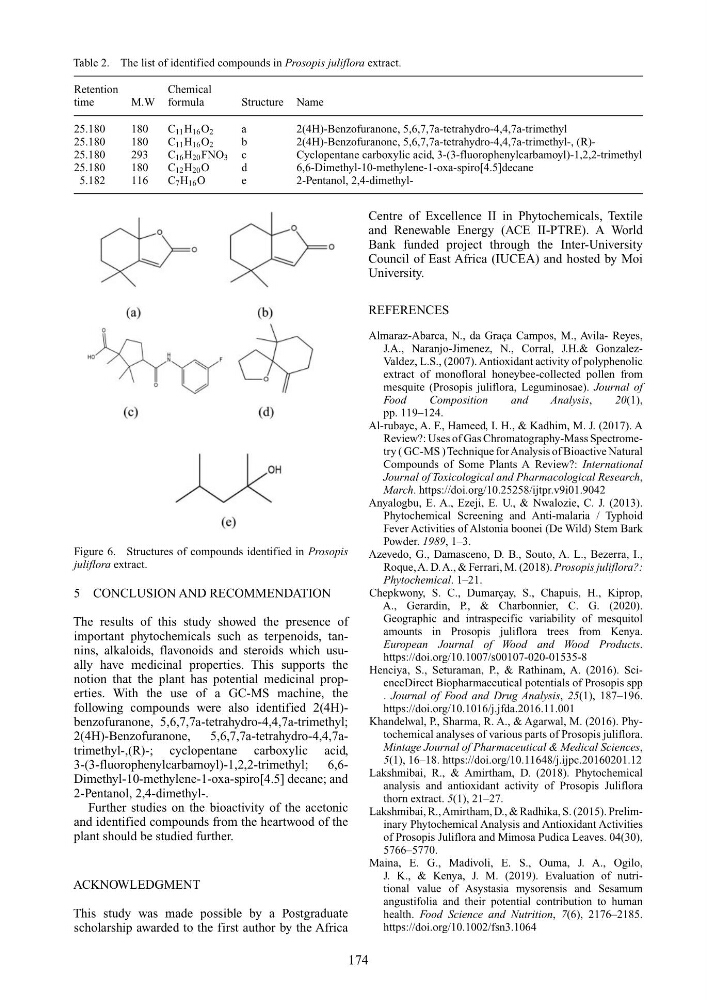
2-Pentanol, 2,4-dimethylFigure 6. Structures of compounds identified in Prosopis
juliflora extract.
5 CONCLUSION AND RECOMMENDATION
The results of this study showed the presence of
important phytochemicals such as terpenoids, tannins, alkaloids, flavonoids and steroids which usually have medicinal properties. This supports the
notion that the plant has potential medicinal properties. With the use of a GC-MS machine, the
following compounds were also identified 2(4H)benzofuranone, 5,6,7,7a-tetrahydro-4,4,7a-trimethyl;
2(4H)-Benzofuranone,
5,6,7,7a-tetrahydro-4,4,7atrimethyl-,(R)-; cyclopentane carboxylic acid,
3-(3-fluorophenylcarbamoyl)-1,2,2-trimethyl;
6,6Dimethyl-10-methylene-1-oxa-spiro[4.5] decane; and
2-Pentanol, 2,4-dimethyl-.
Further studies on the bioactivity of the acetonic
and identified compounds from the heartwood of the
plant should be studied further.
ACKNOWLEDGMENT
This study was made possible by a Postgraduate
scholarship awarded to the first author by the Africa
Centre of Excellence II in Phytochemicals, Textile
and Renewable Energy (ACE II-PTRE). A World
Bank funded project through the Inter-University
Council of East Africa (IUCEA) and hosted by Moi
University.
REFERENCES
Almaraz-Abarca, N., da Graça Campos, M., Avila- Reyes,
J.A., Naranjo-Jimenez, N., Corral, J.H.& GonzalezValdez, L.S., (2007). Antioxidant activity of polyphenolic
extract of monofloral honeybee-collected pollen from
mesquite (Prosopis juliflora, Leguminosae). Journal of
Food
Composition
and
Analysis,
20(1),
pp. 119–124.
Al-rubaye, A. F., Hameed, I. H., & Kadhim, M. J. (2017). A
Review?: Uses of Gas Chromatography-Mass Spectrometry ( GC-MS ) Technique for Analysis of Bioactive Natural
Compounds of Some Plants A Review?: International
Journal of Toxicological and Pharmacological Research,
March. https://doi.org/10.25258/ijtpr.v9i01.9042
Anyalogbu, E. A., Ezeji, E. U., & Nwalozie, C. J. (2013).
Phytochemical Screening and Anti-malaria / Typhoid
Fever Activities of Alstonia boonei (De Wild) Stem Bark
Powder. 1989, 1–3.
Azevedo, G., Damasceno, D. B., Souto, A. L., Bezerra, I.,
Roque, A. D. A., & Ferrari, M. (2018). Prosopis juliflora?:
Phytochemical. 1–21.
Chepkwony, S. C., Dumarçay, S., Chapuis, H., Kiprop,
A., Gerardin, P., & Charbonnier, C. G. (2020).
Geographic and intraspecific variability of mesquitol
amounts in Prosopis juliflora trees from Kenya.
European Journal of Wood and Wood Products.
https://doi.org/10.1007/s00107-020-01535-8
Henciya, S., Seturaman, P., & Rathinam, A. (2016). ScienceDirect Biopharmaceutical potentials of Prosopis spp
. Journal of Food and Drug Analysis, 25(1), 187–196.
https://doi.org/10.1016/j.jfda.2016.11.001
Khandelwal, P., Sharma, R. A., & Agarwal, M. (2016). Phytochemical analyses of various parts of Prosopis juliflora.
Mintage Journal of Pharmaceutical & Medical Sciences,
5(1), 16–18. https://doi.org/10.11648/j.ijpc.20160201.12
Lakshmibai, R., & Amirtham, D. (2018). Phytochemical
analysis and antioxidant activity of Prosopis Juliflora
thorn extract. 5(1), 21–27.
Lakshmibai, R.,Amirtham, D., & Radhika, S. (2015). Preliminary Phytochemical Analysis and Antioxidant Activities
of Prosopis Juliflora and Mimosa Pudica Leaves. 04(30),
5766–5770.
Maina, E. G., Madivoli, E. S., Ouma, J. A., Ogilo,
J. K., & Kenya, J. M. (2019). Evaluation of nutritional value of Asystasia mysorensis and Sesamum
angustifolia and their potential contribution to human
health. Food Science and Nutrition, 7(6), 2176–2185.
https://doi.org/10.1002/fsn3.1064
174
Retention
Chemical
time
M.W formula
Structure Name
25.180
180
C 11 H 16 O 2
a
2(4H)-Benzofuranone, 5,6,7,7a-tetrahydro-4,4,7a-trimethyl
25.180
180
C 11 H 16 O 2
b
2(4H)-Benzofuranone, 5,6,7,7a-tetrahydro-4,4,7a-trimethyl-, (R)25.180
293
C 16 H 20 FNO 3 c
Cyclopentane carboxylic acid, 3-(3-fluorophenylcarbamoyl)-1,2,2-trimethyl
25.180
180
C 12 H 20 O
d
6,6-Dimethyl-10-methylene-1-oxa-spiro[4.5]decane
5.182
116
C 7 H 16 O
e
2-Pentanol, 2,4-dimethylFigure 6. Structures of compounds identified in Prosopis
juliflora extract.
5 CONCLUSION AND RECOMMENDATION
The results of this study showed the presence of
important phytochemicals such as terpenoids, tannins, alkaloids, flavonoids and steroids which usually have medicinal properties. This supports the
notion that the plant has potential medicinal properties. With the use of a GC-MS machine, the
following compounds were also identified 2(4H)benzofuranone, 5,6,7,7a-tetrahydro-4,4,7a-trimethyl;
2(4H)-Benzofuranone,
5,6,7,7a-tetrahydro-4,4,7atrimethyl-,(R)-; cyclopentane carboxylic acid,
3-(3-fluorophenylcarbamoyl)-1,2,2-trimethyl;
6,6Dimethyl-10-methylene-1-oxa-spiro[4.5] decane; and
2-Pentanol, 2,4-dimethyl-.
Further studies on the bioactivity of the acetonic
and identified compounds from the heartwood of the
plant should be studied further.
ACKNOWLEDGMENT
This study was made possible by a Postgraduate
scholarship awarded to the first author by the Africa
Centre of Excellence II in Phytochemicals, Textile
and Renewable Energy (ACE II-PTRE). A World
Bank funded project through the Inter-University
Council of East Africa (IUCEA) and hosted by Moi
University.
REFERENCES
Almaraz-Abarca, N., da Graça Campos, M., Avila- Reyes,
J.A., Naranjo-Jimenez, N., Corral, J.H.& GonzalezValdez, L.S., (2007). Antioxidant activity of polyphenolic
extract of monofloral honeybee-collected pollen from
mesquite (Prosopis juliflora, Leguminosae). Journal of
Food
Composition
and
Analysis,
20(1),
pp. 119–124.
Al-rubaye, A. F., Hameed, I. H., & Kadhim, M. J. (2017). A
Review?: Uses of Gas Chromatography-Mass Spectrometry ( GC-MS ) Technique for Analysis of Bioactive Natural
Compounds of Some Plants A Review?: International
Journal of Toxicological and Pharmacological Research,
March. https://doi.org/10.25258/ijtpr.v9i01.9042
Anyalogbu, E. A., Ezeji, E. U., & Nwalozie, C. J. (2013).
Phytochemical Screening and Anti-malaria / Typhoid
Fever Activities of Alstonia boonei (De Wild) Stem Bark
Powder. 1989, 1–3.
Azevedo, G., Damasceno, D. B., Souto, A. L., Bezerra, I.,
Roque, A. D. A., & Ferrari, M. (2018). Prosopis juliflora?:
Phytochemical. 1–21.
Chepkwony, S. C., Dumarçay, S., Chapuis, H., Kiprop,
A., Gerardin, P., & Charbonnier, C. G. (2020).
Geographic and intraspecific variability of mesquitol
amounts in Prosopis juliflora trees from Kenya.
European Journal of Wood and Wood Products.
https://doi.org/10.1007/s00107-020-01535-8
Henciya, S., Seturaman, P., & Rathinam, A. (2016). ScienceDirect Biopharmaceutical potentials of Prosopis spp
. Journal of Food and Drug Analysis, 25(1), 187–196.
https://doi.org/10.1016/j.jfda.2016.11.001
Khandelwal, P., Sharma, R. A., & Agarwal, M. (2016). Phytochemical analyses of various parts of Prosopis juliflora.
Mintage Journal of Pharmaceutical & Medical Sciences,
5(1), 16–18. https://doi.org/10.11648/j.ijpc.20160201.12
Lakshmibai, R., & Amirtham, D. (2018). Phytochemical
analysis and antioxidant activity of Prosopis Juliflora
thorn extract. 5(1), 21–27.
Lakshmibai, R.,Amirtham, D., & Radhika, S. (2015). Preliminary Phytochemical Analysis and Antioxidant Activities
of Prosopis Juliflora and Mimosa Pudica Leaves. 04(30),
5766–5770.
Maina, E. G., Madivoli, E. S., Ouma, J. A., Ogilo,
J. K., & Kenya, J. M. (2019). Evaluation of nutritional value of Asystasia mysorensis and Sesamum
angustifolia and their potential contribution to human
health. Food Science and Nutrition, 7(6), 2176–2185.
https://doi.org/10.1002/fsn3.1064
174