

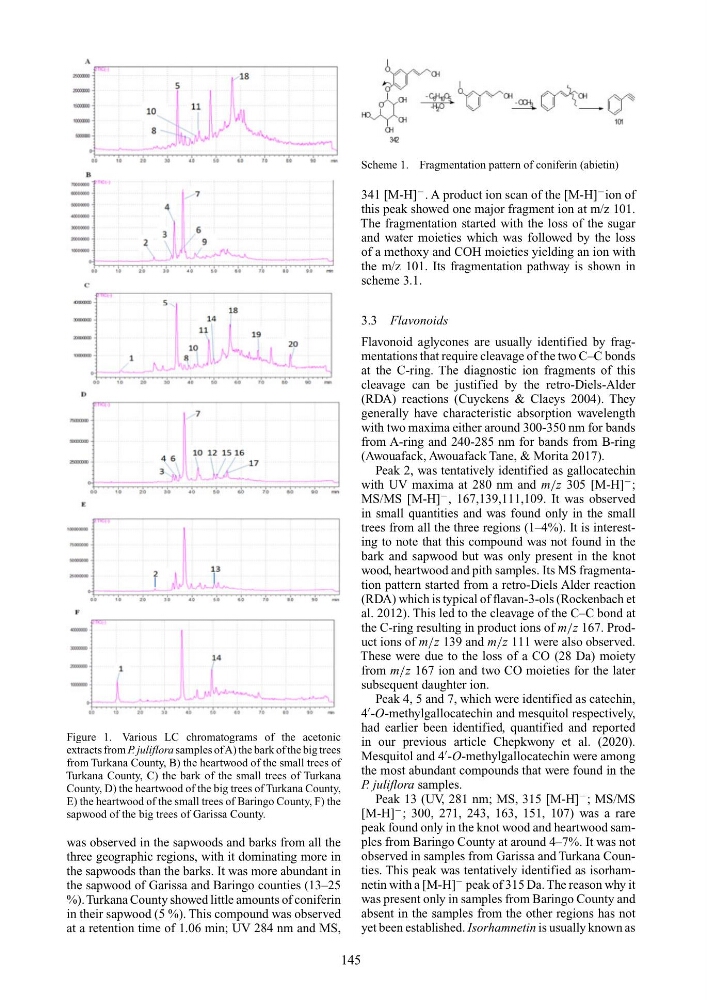
Figure 1. Various LC chromatograms of the acetonic
extracts from P. juliflora samples ofA) the bark of the big trees
from Turkana County, B) the heartwood of the small trees of
Turkana County, C) the bark of the small trees of Turkana
County, D) the heartwood of the big trees of Turkana County,
E) the heartwood of the small trees of Baringo County, F) the
sapwood of the big trees of Garissa County.
was observed in the sapwoods and barks from all the
three geographic regions, with it dominating more in
the sapwoods than the barks. It was more abundant in
the sapwood of Garissa and Baringo counties (13–25
%). Turkana County showed little amounts of coniferin
in their sapwood (5 %). This compound was observed
at a retention time of 1.06 min; UV 284 nm and MS,
Scheme 1. Fragmentation pattern of coniferin (abietin)
341 [M-H]
− . A product ion scan of the [M-H]
− ion of
this peak showed one major fragment ion at m/z 101.
The fragmentation started with the loss of the sugar
and water moieties which was followed by the loss
of a methoxy and COH moieties yielding an ion with
the m/z 101. Its fragmentation pathway is shown in
scheme 3.1.
3.3 Flavonoids
Flavonoid aglycones are usually identified by fragmentations that require cleavage of the two C–C bonds
at the C-ring. The diagnostic ion fragments of this
cleavage can be justified by the retro-Diels-Alder
(RDA) reactions (Cuyckens & Claeys 2004). They
generally have characteristic absorption wavelength
with two maxima either around 300-350 nm for bands
from A-ring and 240-285 nm for bands from B-ring
(Awouafack, Awouafack Tane, & Morita 2017).
Peak 2, was tentatively identified as gallocatechin
with UV maxima at 280 nm and m/z 305 [M-H]
− ;
MS/MS [M-H]
− , 167,139,111,109. It was observed
in small quantities and was found only in the small
trees from all the three regions (1–4%). It is interesting to note that this compound was not found in the
bark and sapwood but was only present in the knot
wood, heartwood and pith samples. Its MS fragmentation pattern started from a retro-Diels Alder reaction
(RDA) which is typical of flavan-3-ols (Rockenbach et
al. 2012). This led to the cleavage of the C–C bond at
the C-ring resulting in product ions of m/z 167. Product ions of m/z 139 and m/z 111 were also observed.
These were due to the loss of a CO (28 Da) moiety
from m/z 167 ion and two CO moieties for the later
subsequent daughter ion.
Peak 4, 5 and 7, which were identified as catechin,
4
-O-methylgallocatechin and mesquitol respectively,
had earlier been identified, quantified and reported
in our previous article Chepkwony et al. (2020).
Mesquitol and 4
-O-methylgallocatechin were among
the most abundant compounds that were found in the
P. juliflora samples.
Peak 13 (UV, 281 nm; MS, 315 [M-H]
− ; MS/MS
[M-H]
− ; 300, 271, 243, 163, 151, 107) was a rare
peak found only in the knot wood and heartwood samples from Baringo County at around 4–7%. It was not
observed in samples from Garissa and Turkana Counties. This peak was tentatively identified as isorhamnetin with a [M-H]
− peak of 315 Da. The reason why it
was present only in samples from Baringo County and
absent in the samples from the other regions has not
yet been established. Isorhamnetin is usually known as
145
extracts from P. juliflora samples ofA) the bark of the big trees
from Turkana County, B) the heartwood of the small trees of
Turkana County, C) the bark of the small trees of Turkana
County, D) the heartwood of the big trees of Turkana County,
E) the heartwood of the small trees of Baringo County, F) the
sapwood of the big trees of Garissa County.
was observed in the sapwoods and barks from all the
three geographic regions, with it dominating more in
the sapwoods than the barks. It was more abundant in
the sapwood of Garissa and Baringo counties (13–25
%). Turkana County showed little amounts of coniferin
in their sapwood (5 %). This compound was observed
at a retention time of 1.06 min; UV 284 nm and MS,
Scheme 1. Fragmentation pattern of coniferin (abietin)
341 [M-H]
− . A product ion scan of the [M-H]
− ion of
this peak showed one major fragment ion at m/z 101.
The fragmentation started with the loss of the sugar
and water moieties which was followed by the loss
of a methoxy and COH moieties yielding an ion with
the m/z 101. Its fragmentation pathway is shown in
scheme 3.1.
3.3 Flavonoids
Flavonoid aglycones are usually identified by fragmentations that require cleavage of the two C–C bonds
at the C-ring. The diagnostic ion fragments of this
cleavage can be justified by the retro-Diels-Alder
(RDA) reactions (Cuyckens & Claeys 2004). They
generally have characteristic absorption wavelength
with two maxima either around 300-350 nm for bands
from A-ring and 240-285 nm for bands from B-ring
(Awouafack, Awouafack Tane, & Morita 2017).
Peak 2, was tentatively identified as gallocatechin
with UV maxima at 280 nm and m/z 305 [M-H]
− ;
MS/MS [M-H]
− , 167,139,111,109. It was observed
in small quantities and was found only in the small
trees from all the three regions (1–4%). It is interesting to note that this compound was not found in the
bark and sapwood but was only present in the knot
wood, heartwood and pith samples. Its MS fragmentation pattern started from a retro-Diels Alder reaction
(RDA) which is typical of flavan-3-ols (Rockenbach et
al. 2012). This led to the cleavage of the C–C bond at
the C-ring resulting in product ions of m/z 167. Product ions of m/z 139 and m/z 111 were also observed.
These were due to the loss of a CO (28 Da) moiety
from m/z 167 ion and two CO moieties for the later
subsequent daughter ion.
Peak 4, 5 and 7, which were identified as catechin,
4
-O-methylgallocatechin and mesquitol respectively,
had earlier been identified, quantified and reported
in our previous article Chepkwony et al. (2020).
Mesquitol and 4
-O-methylgallocatechin were among
the most abundant compounds that were found in the
P. juliflora samples.
Peak 13 (UV, 281 nm; MS, 315 [M-H]
− ; MS/MS
[M-H]
− ; 300, 271, 243, 163, 151, 107) was a rare
peak found only in the knot wood and heartwood samples from Baringo County at around 4–7%. It was not
observed in samples from Garissa and Turkana Counties. This peak was tentatively identified as isorhamnetin with a [M-H]
− peak of 315 Da. The reason why it
was present only in samples from Baringo County and
absent in the samples from the other regions has not
yet been established. Isorhamnetin is usually known as
145