

(3 mL), 10% aluminum chloride (0.2 mL), 1M potassium acetate (0.2 mL) and 5.6 mL of distilled.
Quercetin (1 g) was dissolved in distilled water in
a 1 L volumetric to make a stock solution of 1000
mg/1L. From the stock solution of quercetin increasing concentrations of 10, 20, 40, 80 and 100mg/L were
prepared and subjected to similar treatment as the sample extracts. All the samples were incubated at room
temperature for 30 minutes and then the absorbance
was measured at 420 nm in triplicate. The quercetin
calibration curve was plotted and the concentration of
the total flavonoids in the sample extract was expressed
as mg of quercetin equivalent/g (mg QE/g) of the dry
sample extract.
2.2.4 Dyeing process
Wetting of the cotton fabric was done using 5 g/L of
non-ionic detergent for 30 minutes to enhance surface
wettability. A concentration of 20 % on weight of the
fabric (owf) and a material to liquor (M: L) of 1:40
was used during the preparation of the dye-bath using
the different dye extracts.
The dyeing process was carried out as described by
Yusuf et al. (2012). The dyeing time was 1 hour at a
temperature of 80
◦ C in open conical flasks with manual agitation of the dye bath. All dyeing processes were
carried out in triplicate. Temperature was regulated
using a water bath.
The dyed cotton fabrics were removed from the
dye bath and immersed in a beaker containing 10
gL
−1 of sodium chloride solution for 20 minutes (Savvidis et al. 2013). The saturated brine was used in
the post-treatment process as a dye fixing agent. The
dyed samples were washed with cold water to remove
the unfixed dyestuff. The dyed samples were subjected to soaping with 2 gL
−1 soap solution followed
by washing with tap water and then dried at room
temperature.
2.2.5 Evaluation of the dyed cotton fabric
The dyed cotton fabrics were subjected to color fastness tests to wash, light and rub.
2.2.5.1 Color fastness to washing
The wash fastness was measured with the SDL ATLAS
M228 Rotawash Launder-o-meter, according to standard test ISO 105-C02:1989. The wash fastness values
were determined using gray scale for assessing the
staining of white standard material attached and gray
scale for assessing change of color of the dyed samples. The color fastness rating is normally between 1
and 5, where 1 means very good fastness, 2 is poor, 3
is fairly good, 4 is good and 5 is excellent.
2.2.5.2 Color fastness to light
Light fastness was measured using a SDL ATLAS
M237 light fastness tester fitted with 500 W mercury–
tungsten lamp and a timer that had been preset. The
testing was carried out according to the ISO 105
A02:1993 standard. The samples were then assessed
for any fading using the gray scale.
2.2.5.3 Color fastness to rubbing
Rub fastness was measured using a SDL ATLAS
M238AA Crock-meter according to the ISO 105X12:2000 standard. The rubbed samples were evaluated for staining on white adjacent cotton using the
gray scale.
2.2.5.4 Determination of color coordinates and
color strength
Color coordinates of dyed samples which included L
∗ ,
a
∗ , b
∗ C
∗ and H
◦ were measured by spectrophotometer X-rite SP60X using D65 source of light and 10
◦
standard observer where the measurement was carried
out in the range of 390–710 nm wavelength. All measurements were done in triplicate and an average was
obtained. The R values obtained were used to calculate
the relative color strength K/S as per the Kubelka–
Munk equation (Hossen & Imran 2017). L
∗ , a
∗ , b
∗ ,
R, C
∗ and H
◦ represent lightness, redness-greenness
of color, yellowness–blueness of color, reflectance,
saturation of color, and hue angle, respectively.
3 RESULTS AND DISCUSSION
3.1 Preparation of plant materials and dye
extraction
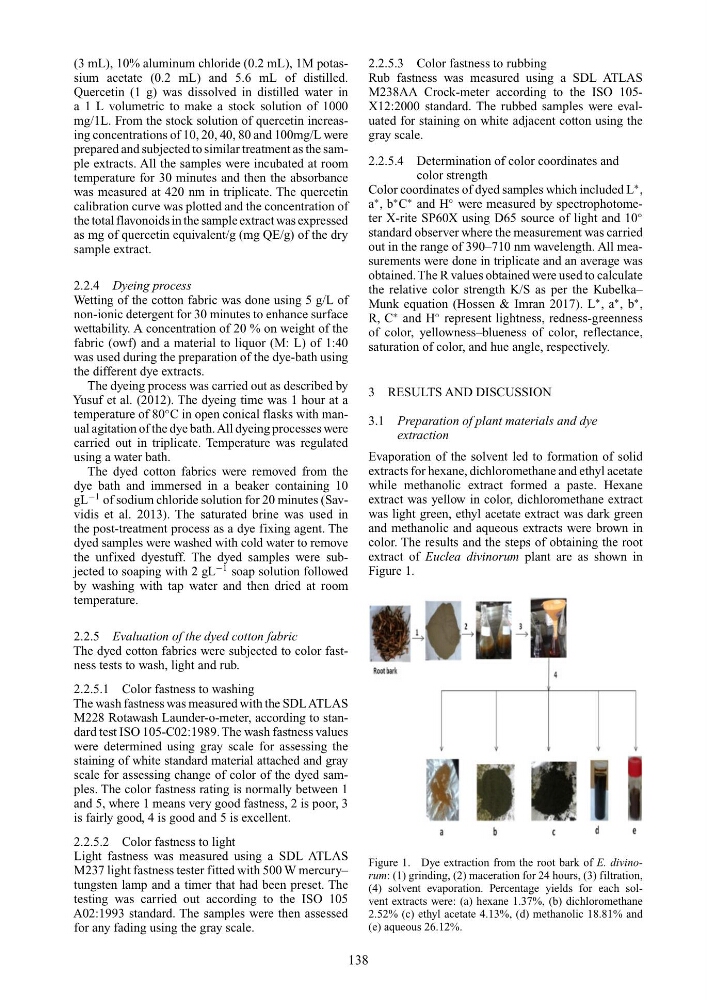
Evaporation of the solvent led to formation of solid
extracts for hexane, dichloromethane and ethyl acetate
while methanolic extract formed a paste. Hexane
extract was yellow in color, dichloromethane extract
was light green, ethyl acetate extract was dark green
and methanolic and aqueous extracts were brown in
color. The results and the steps of obtaining the root
extract of Euclea divinorum plant are as shown in
Figure 1.
Figure 1. Dye extraction from the root bark of E. divinorum: (1) grinding, (2) maceration for 24 hours, (3) filtration,
(4) solvent evaporation. Percentage yields for each solvent extracts were: (a) hexane 1.37%, (b) dichloromethane
2.52% (c) ethyl acetate 4.13%, (d) methanolic 18.81% and
(e) aqueous 26.12%.
138
Quercetin (1 g) was dissolved in distilled water in
a 1 L volumetric to make a stock solution of 1000
mg/1L. From the stock solution of quercetin increasing concentrations of 10, 20, 40, 80 and 100mg/L were
prepared and subjected to similar treatment as the sample extracts. All the samples were incubated at room
temperature for 30 minutes and then the absorbance
was measured at 420 nm in triplicate. The quercetin
calibration curve was plotted and the concentration of
the total flavonoids in the sample extract was expressed
as mg of quercetin equivalent/g (mg QE/g) of the dry
sample extract.
2.2.4 Dyeing process
Wetting of the cotton fabric was done using 5 g/L of
non-ionic detergent for 30 minutes to enhance surface
wettability. A concentration of 20 % on weight of the
fabric (owf) and a material to liquor (M: L) of 1:40
was used during the preparation of the dye-bath using
the different dye extracts.
The dyeing process was carried out as described by
Yusuf et al. (2012). The dyeing time was 1 hour at a
temperature of 80
◦ C in open conical flasks with manual agitation of the dye bath. All dyeing processes were
carried out in triplicate. Temperature was regulated
using a water bath.
The dyed cotton fabrics were removed from the
dye bath and immersed in a beaker containing 10
gL
−1 of sodium chloride solution for 20 minutes (Savvidis et al. 2013). The saturated brine was used in
the post-treatment process as a dye fixing agent. The
dyed samples were washed with cold water to remove
the unfixed dyestuff. The dyed samples were subjected to soaping with 2 gL
−1 soap solution followed
by washing with tap water and then dried at room
temperature.
2.2.5 Evaluation of the dyed cotton fabric
The dyed cotton fabrics were subjected to color fastness tests to wash, light and rub.
2.2.5.1 Color fastness to washing
The wash fastness was measured with the SDL ATLAS
M228 Rotawash Launder-o-meter, according to standard test ISO 105-C02:1989. The wash fastness values
were determined using gray scale for assessing the
staining of white standard material attached and gray
scale for assessing change of color of the dyed samples. The color fastness rating is normally between 1
and 5, where 1 means very good fastness, 2 is poor, 3
is fairly good, 4 is good and 5 is excellent.
2.2.5.2 Color fastness to light
Light fastness was measured using a SDL ATLAS
M237 light fastness tester fitted with 500 W mercury–
tungsten lamp and a timer that had been preset. The
testing was carried out according to the ISO 105
A02:1993 standard. The samples were then assessed
for any fading using the gray scale.
2.2.5.3 Color fastness to rubbing
Rub fastness was measured using a SDL ATLAS
M238AA Crock-meter according to the ISO 105X12:2000 standard. The rubbed samples were evaluated for staining on white adjacent cotton using the
gray scale.
2.2.5.4 Determination of color coordinates and
color strength
Color coordinates of dyed samples which included L
∗ ,
a
∗ , b
∗ C
∗ and H
◦ were measured by spectrophotometer X-rite SP60X using D65 source of light and 10
◦
standard observer where the measurement was carried
out in the range of 390–710 nm wavelength. All measurements were done in triplicate and an average was
obtained. The R values obtained were used to calculate
the relative color strength K/S as per the Kubelka–
Munk equation (Hossen & Imran 2017). L
∗ , a
∗ , b
∗ ,
R, C
∗ and H
◦ represent lightness, redness-greenness
of color, yellowness–blueness of color, reflectance,
saturation of color, and hue angle, respectively.
3 RESULTS AND DISCUSSION
3.1 Preparation of plant materials and dye
extraction
Evaporation of the solvent led to formation of solid
extracts for hexane, dichloromethane and ethyl acetate
while methanolic extract formed a paste. Hexane
extract was yellow in color, dichloromethane extract
was light green, ethyl acetate extract was dark green
and methanolic and aqueous extracts were brown in
color. The results and the steps of obtaining the root
extract of Euclea divinorum plant are as shown in
Figure 1.
Figure 1. Dye extraction from the root bark of E. divinorum: (1) grinding, (2) maceration for 24 hours, (3) filtration,
(4) solvent evaporation. Percentage yields for each solvent extracts were: (a) hexane 1.37%, (b) dichloromethane
2.52% (c) ethyl acetate 4.13%, (d) methanolic 18.81% and
(e) aqueous 26.12%.
138