

64
Pesticides, Organic Contaminants, and Pathogens in Air
forest fres. The devastating wildfres of 2020 in the Western United States
are thrusting the hazards of PM from smoke to the fore; smoke from wildfres will likely carry a range of toxins, similar to those in the by-products
of agricultural burning. Cigarette smoke and marijuana smoke (legalized
in many places in the United States) are a source of burned plant materials in and around the home. Because it is illegal in most places, and only
newly legal in some places, marijuana receives less pesticide monitoring than
tobacco (Taylor and Birkett, 2020). Common pesticides used to grow marijuana include insecticides, acaricides, and fungicides. Though amounts were
not reported, ~85% of tested cannabis samples had pesticides in Washington
State, and ~50% in California.
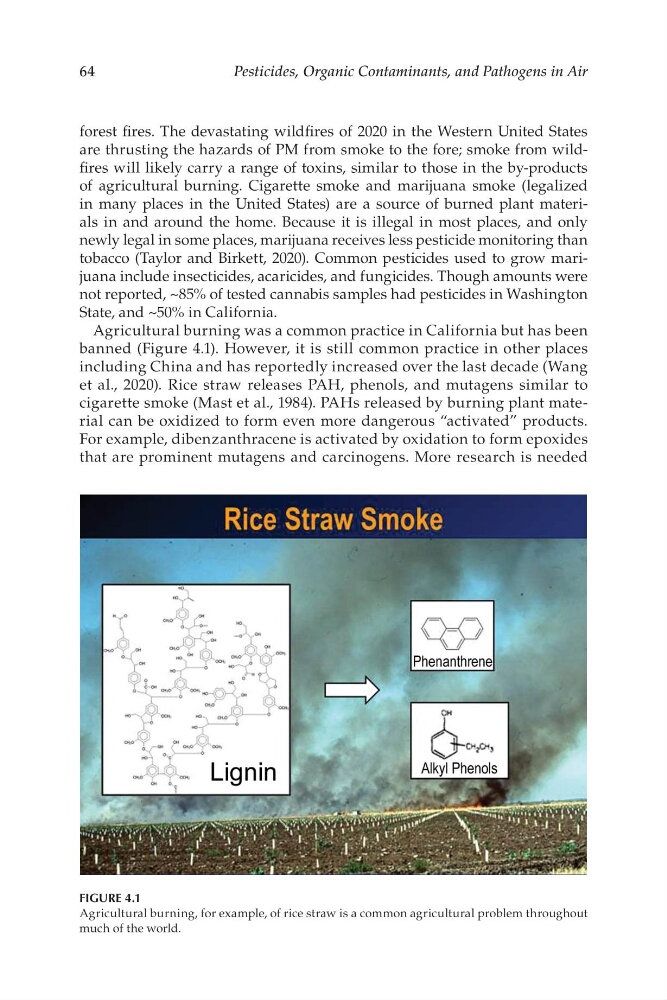
Agricultural burning was a common practice in California but has been
banned (Figure 4.1). However, it is still common practice in other places
including China and has reportedly increased over the last decade (Wang
et al., 2020). Rice straw releases PAH, phenols, and mutagens similar to
cigarette smoke (Mast et al., 1984). PAHs released by burning plant material can be oxidized to form even more dangerous “activated” products.
For example, dibenzanthracene is activated by oxidation to form epoxides
that are prominent mutagens and carcinogens. More research is needed
FIGURE 4.1
Agricultural burning, for example, of rice straw is a common agricultural problem throughout
much of the world.
Pesticides, Organic Contaminants, and Pathogens in Air
forest fres. The devastating wildfres of 2020 in the Western United States
are thrusting the hazards of PM from smoke to the fore; smoke from wildfres will likely carry a range of toxins, similar to those in the by-products
of agricultural burning. Cigarette smoke and marijuana smoke (legalized
in many places in the United States) are a source of burned plant materials in and around the home. Because it is illegal in most places, and only
newly legal in some places, marijuana receives less pesticide monitoring than
tobacco (Taylor and Birkett, 2020). Common pesticides used to grow marijuana include insecticides, acaricides, and fungicides. Though amounts were
not reported, ~85% of tested cannabis samples had pesticides in Washington
State, and ~50% in California.
Agricultural burning was a common practice in California but has been
banned (Figure 4.1). However, it is still common practice in other places
including China and has reportedly increased over the last decade (Wang
et al., 2020). Rice straw releases PAH, phenols, and mutagens similar to
cigarette smoke (Mast et al., 1984). PAHs released by burning plant material can be oxidized to form even more dangerous “activated” products.
For example, dibenzanthracene is activated by oxidation to form epoxides
that are prominent mutagens and carcinogens. More research is needed
FIGURE 4.1
Agricultural burning, for example, of rice straw is a common agricultural problem throughout
much of the world.