

62
Pesticides, Organic Contaminants, and Pathogens in Air
TABLE 4.2
POPs aka the “Dirty Dozen”
POP
Uses and Occurrences
Usage Cancelled
HAP
Aldrin and dieldrin
Insecticide (agricultural, urban)
1987
Chlordane
Insecticide (agricultural, urban)
1988
x
Heptachlor
Insecticide (agricultural, urban)
2000
Hexachlorobenzene
Fungicide, industrial,
1985 (pesticide use),
x
unintentional (combustion,
industrial uses allowed
by-product, trace impurity)
PCBs
Industrial, unintentional in
1978
x
combustion
Dioxins and furans
Unintentional (combustion,
x
by-product, trace impurity)
Source: Kovner (2002).
energy effcient buildings over recent decades has created buildings with
reduced ventilation from outdoors; attention now should also include design
of healthy buildings (Ghaffarianhoseini, 2018). Indoor pollutants come from
oil, gas, tobacco products, carpets, common household cleaning products, and
heating, ventilation, and air conditioning (HVAC) systems (U. S. EPA, 2015b).
Tightly sealed homes have lower ventilation rates from outdoors that can lead
to mucosal symptoms, especially at night in the winter (Sun et al., 2019).
There is a growing realization that people and their pets track in dirt and
other contaminants including pesticides to inside houses (Williams et al.,
2004). This is additive to the pesticides intentionally used in homes to kill
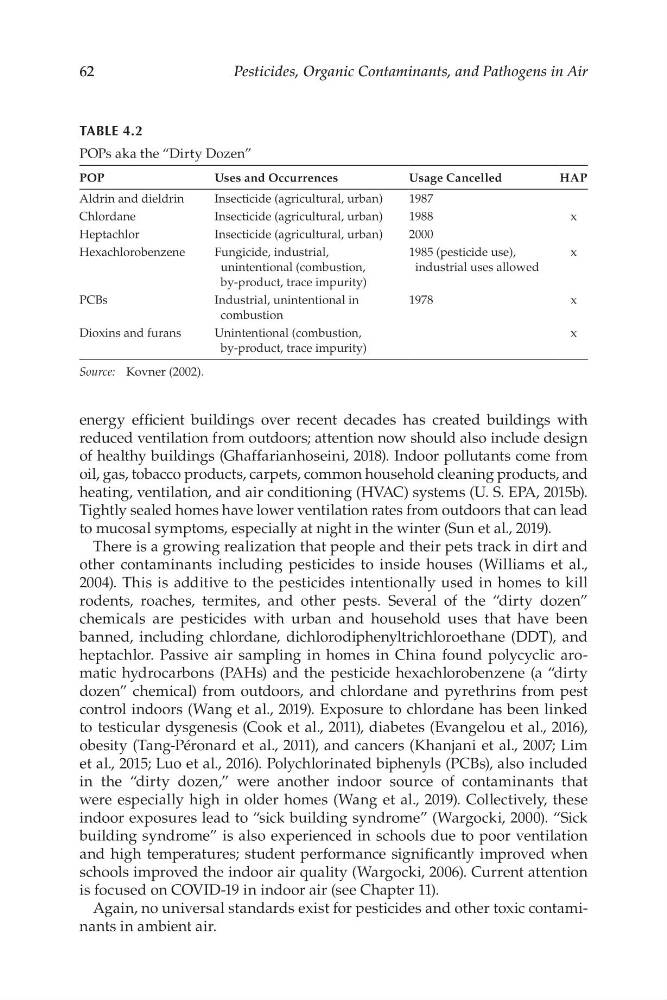
rodents, roaches, termites, and other pests. Several of the “dirty dozen”
chemicals are pesticides with urban and household uses that have been
banned, including chlordane, dichlorodiphenyltrichloroethane (DDT), and
heptachlor. Passive air sampling in homes in China found polycyclic aromatic hydrocarbons (PAHs) and the pesticide hexachlorobenzene (a “dirty
dozen” chemical) from outdoors, and chlordane and pyrethrins from pest
control indoors (Wang et al., 2019). Exposure to chlordane has been linked
to testicular dysgenesis (Cook et al., 2011), diabetes (Evangelou et al., 2016),
obesity (Tang-Péronard et al., 2011), and cancers (Khanjani et al., 2007; Lim
et al., 2015; Luo et al., 2016). Polychlorinated biphenyls (PCBs), also included
in the “dirty dozen,” were another indoor source of contaminants that
were especially high in older homes (Wang et al., 2019). Collectively, these
indoor exposures lead to “sick building syndrome” (Wargocki, 2000). “Sick
building syndrome” is also experienced in schools due to poor ventilation
and high temperatures; student performance signifcantly improved when
schools improved the indoor air quality (Wargocki, 2006). Current attention
is focused on COVID-19 in indoor air (see Chapter 11).
Again, no universal standards exist for pesticides and other toxic contaminants in ambient air.
Pesticides, Organic Contaminants, and Pathogens in Air
TABLE 4.2
POPs aka the “Dirty Dozen”
POP
Uses and Occurrences
Usage Cancelled
HAP
Aldrin and dieldrin
Insecticide (agricultural, urban)
1987
Chlordane
Insecticide (agricultural, urban)
1988
x
Heptachlor
Insecticide (agricultural, urban)
2000
Hexachlorobenzene
Fungicide, industrial,
1985 (pesticide use),
x
unintentional (combustion,
industrial uses allowed
by-product, trace impurity)
PCBs
Industrial, unintentional in
1978
x
combustion
Dioxins and furans
Unintentional (combustion,
x
by-product, trace impurity)
Source: Kovner (2002).
energy effcient buildings over recent decades has created buildings with
reduced ventilation from outdoors; attention now should also include design
of healthy buildings (Ghaffarianhoseini, 2018). Indoor pollutants come from
oil, gas, tobacco products, carpets, common household cleaning products, and
heating, ventilation, and air conditioning (HVAC) systems (U. S. EPA, 2015b).
Tightly sealed homes have lower ventilation rates from outdoors that can lead
to mucosal symptoms, especially at night in the winter (Sun et al., 2019).
There is a growing realization that people and their pets track in dirt and
other contaminants including pesticides to inside houses (Williams et al.,
2004). This is additive to the pesticides intentionally used in homes to kill
rodents, roaches, termites, and other pests. Several of the “dirty dozen”
chemicals are pesticides with urban and household uses that have been
banned, including chlordane, dichlorodiphenyltrichloroethane (DDT), and
heptachlor. Passive air sampling in homes in China found polycyclic aromatic hydrocarbons (PAHs) and the pesticide hexachlorobenzene (a “dirty
dozen” chemical) from outdoors, and chlordane and pyrethrins from pest
control indoors (Wang et al., 2019). Exposure to chlordane has been linked
to testicular dysgenesis (Cook et al., 2011), diabetes (Evangelou et al., 2016),
obesity (Tang-Péronard et al., 2011), and cancers (Khanjani et al., 2007; Lim
et al., 2015; Luo et al., 2016). Polychlorinated biphenyls (PCBs), also included
in the “dirty dozen,” were another indoor source of contaminants that
were especially high in older homes (Wang et al., 2019). Collectively, these
indoor exposures lead to “sick building syndrome” (Wargocki, 2000). “Sick
building syndrome” is also experienced in schools due to poor ventilation
and high temperatures; student performance signifcantly improved when
schools improved the indoor air quality (Wargocki, 2006). Current attention
is focused on COVID-19 in indoor air (see Chapter 11).
Again, no universal standards exist for pesticides and other toxic contaminants in ambient air.