

46
Pesticides, Organic Contaminants, and Pathogens in Air
neutral hydrophobic organics (e.g., DDT), sorption is directly proportional to
the quantity of organic matter associated with the solid. Normalizing the soil
or sediment-specifc sorption coeffcient to the organic carbon (oc) content
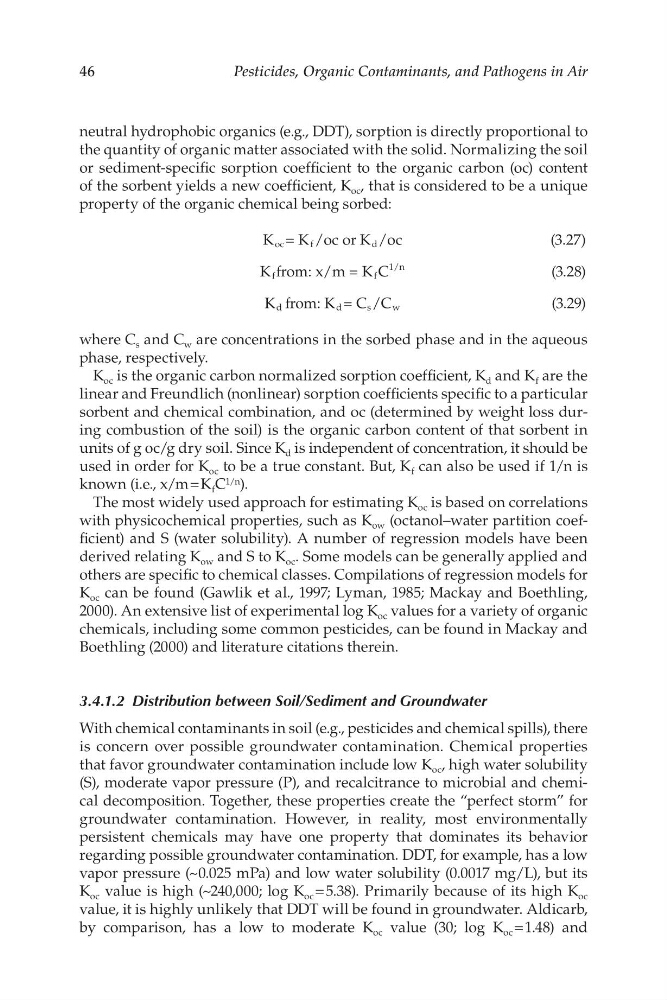
of the sorbent yields a new coeffcient, K oc , that is considered to be a unique
property of the organic chemical being sorbed:
K = K /oc or K /oc
(3.27)
oc
f
d
K from: x/m = K C
1/n
(3.28)
f
f
K from: K = C /C
(3.29)
d
d
s
w
where C s and C w are concentrations in the sorbed phase and in the aqueous
phase, respectively.
K oc is the organic carbon normalized sorption coeffcient, K d and K f are the
linear and Freundlich (nonlinear) sorption coeffcients specifc to a particular
sorbent and chemical combination, and oc (determined by weight loss during combustion of the soil) is the organic carbon content of that sorbent in
units of g oc/g dry soil. Since K d is independent of concentration, it should be
used in order for K oc to be a true constant. But, K f can also be used if 1/n is
K f C 1/n ).
known (i.e., x/m =
The most widely used approach for estimating K oc is based on correlations
with physicochemical properties, such as K ow (octanol–water partition coeffcient) and S (water solubility). A number of regression models have been
derived relating K ow and S to K oc . Some models can be generally applied and
others are specifc to chemical classes. Compilations of regression models for
K oc can be found (Gawlik et al., 1997; Lyman, 1985; Mackay and Boethling,
2000). An extensive list of experimental log K oc values for a variety of organic
chemicals, including some common pesticides, can be found in Mackay and
Boethling (2000) and literature citations therein.
3.4.1.2 Distribution between Soil/Sediment and Groundwater
With chemical contaminants in soil (e.g., pesticides and chemical spills), there
is concern over possible groundwater contamination. Chemical properties
that favor groundwater contamination include low K oc , high water solubility
(S), moderate vapor pressure (P), and recalcitrance to microbial and chemical decomposition. Together, these properties create the “perfect storm” for
groundwater contamination. However, in reality, most environmentally
persistent chemicals may have one property that dominates its behavior
regarding possible groundwater contamination. DDT, for example, has a low
vapor pressure (~0.025 mPa) and low water solubility (0.0017 mg/L), but its
K oc value is high (~240,000; log K oc = 5.38). Primarily because of its high K oc
value, it is highly unlikely that DDT will be found in groundwater. Aldicarb,
by comparison, has a low to moderate K oc value (30; log K oc = 1.48) and
Pesticides, Organic Contaminants, and Pathogens in Air
neutral hydrophobic organics (e.g., DDT), sorption is directly proportional to
the quantity of organic matter associated with the solid. Normalizing the soil
or sediment-specifc sorption coeffcient to the organic carbon (oc) content
of the sorbent yields a new coeffcient, K oc , that is considered to be a unique
property of the organic chemical being sorbed:
K = K /oc or K /oc
(3.27)
oc
f
d
K from: x/m = K C
1/n
(3.28)
f
f
K from: K = C /C
(3.29)
d
d
s
w
where C s and C w are concentrations in the sorbed phase and in the aqueous
phase, respectively.
K oc is the organic carbon normalized sorption coeffcient, K d and K f are the
linear and Freundlich (nonlinear) sorption coeffcients specifc to a particular
sorbent and chemical combination, and oc (determined by weight loss during combustion of the soil) is the organic carbon content of that sorbent in
units of g oc/g dry soil. Since K d is independent of concentration, it should be
used in order for K oc to be a true constant. But, K f can also be used if 1/n is
K f C 1/n ).
known (i.e., x/m =
The most widely used approach for estimating K oc is based on correlations
with physicochemical properties, such as K ow (octanol–water partition coeffcient) and S (water solubility). A number of regression models have been
derived relating K ow and S to K oc . Some models can be generally applied and
others are specifc to chemical classes. Compilations of regression models for
K oc can be found (Gawlik et al., 1997; Lyman, 1985; Mackay and Boethling,
2000). An extensive list of experimental log K oc values for a variety of organic
chemicals, including some common pesticides, can be found in Mackay and
Boethling (2000) and literature citations therein.
3.4.1.2 Distribution between Soil/Sediment and Groundwater
With chemical contaminants in soil (e.g., pesticides and chemical spills), there
is concern over possible groundwater contamination. Chemical properties
that favor groundwater contamination include low K oc , high water solubility
(S), moderate vapor pressure (P), and recalcitrance to microbial and chemical decomposition. Together, these properties create the “perfect storm” for
groundwater contamination. However, in reality, most environmentally
persistent chemicals may have one property that dominates its behavior
regarding possible groundwater contamination. DDT, for example, has a low
vapor pressure (~0.025 mPa) and low water solubility (0.0017 mg/L), but its
K oc value is high (~240,000; log K oc = 5.38). Primarily because of its high K oc
value, it is highly unlikely that DDT will be found in groundwater. Aldicarb,
by comparison, has a low to moderate K oc value (30; log K oc = 1.48) and