

43
Properties of Pesticides and Contaminants
solubility of the chemicals and their pressure and temperature. The rate and
amount of absorption also depend on the surface area of the interface and its
duration in time. For example, when the water is fnely divided and mixed
with air, as may happen in a waterfall or strong ocean surf, the water absorbs
more oxygen.
When a solid absorbs a liquid mixture or part of it (e.g., a chemical contaminant dissolved in the liquid), a mass of liquid moves into the solid. For
example, a clay pot used to store water may absorb some of the water. This
mass transfer takes place at the interface between the solid and the liquid, at
a rate depending on both the solid and the liquid. For example, pots made
from certain clays are more absorbent than others. Absorption involves the
whole volume of the material, while adsorption is a surface-based process.
The term sorption encompasses both processes, while desorption is the reverse
of them.
3.4 Environmental Distribution
In the environment, sorption of contaminants by various media involves
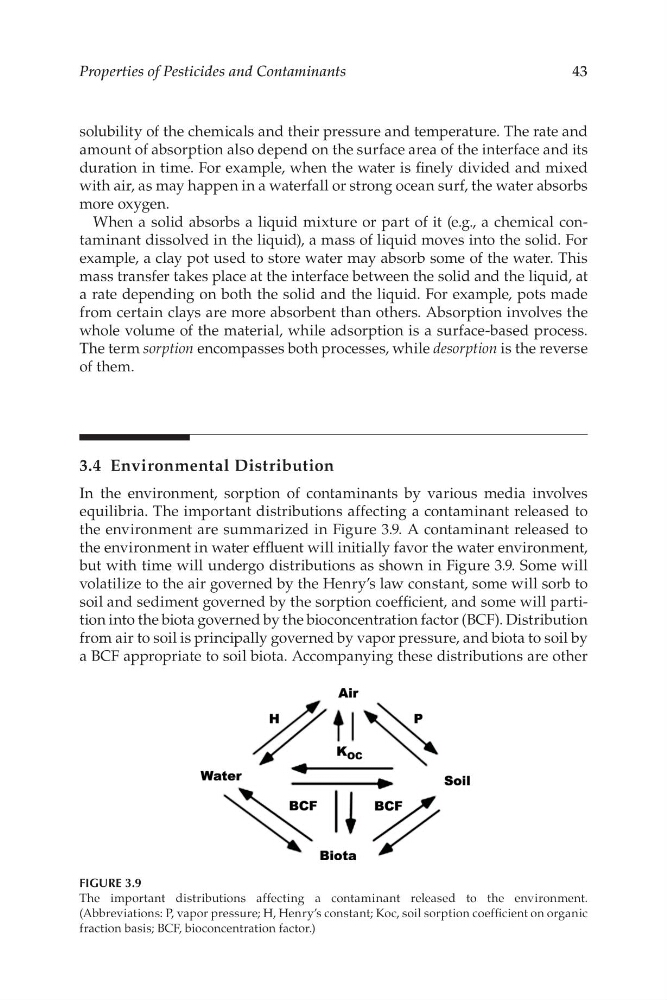
equilibria. The important distributions affecting a contaminant released to
the environment are summarized in Figure 3.9. A contaminant released to
the environment in water effuent will initially favor the water environment,
but with time will undergo distributions as shown in Figure 3.9. Some will
volatilize to the air governed by the Henry’s law constant, some will sorb to
soil and sediment governed by the sorption coeffcient, and some will partition into the biota governed by the bioconcentration factor (BCF). Distribution
from air to soil is principally governed by vapor pressure, and biota to soil by
a BCF appropriate to soil biota. Accompanying these distributions are other
FIGURE 3.9
The important distributions affecting a contaminant released to the environment.
(Abbreviations: P, vapor pressure; H, Henry’s constant; Koc, soil sorption coeffcient on organic
fraction basis; BCF, bioconcentration factor.)
Properties of Pesticides and Contaminants
solubility of the chemicals and their pressure and temperature. The rate and
amount of absorption also depend on the surface area of the interface and its
duration in time. For example, when the water is fnely divided and mixed
with air, as may happen in a waterfall or strong ocean surf, the water absorbs
more oxygen.
When a solid absorbs a liquid mixture or part of it (e.g., a chemical contaminant dissolved in the liquid), a mass of liquid moves into the solid. For
example, a clay pot used to store water may absorb some of the water. This
mass transfer takes place at the interface between the solid and the liquid, at
a rate depending on both the solid and the liquid. For example, pots made
from certain clays are more absorbent than others. Absorption involves the
whole volume of the material, while adsorption is a surface-based process.
The term sorption encompasses both processes, while desorption is the reverse
of them.
3.4 Environmental Distribution
In the environment, sorption of contaminants by various media involves
equilibria. The important distributions affecting a contaminant released to
the environment are summarized in Figure 3.9. A contaminant released to
the environment in water effuent will initially favor the water environment,
but with time will undergo distributions as shown in Figure 3.9. Some will
volatilize to the air governed by the Henry’s law constant, some will sorb to
soil and sediment governed by the sorption coeffcient, and some will partition into the biota governed by the bioconcentration factor (BCF). Distribution
from air to soil is principally governed by vapor pressure, and biota to soil by
a BCF appropriate to soil biota. Accompanying these distributions are other
FIGURE 3.9
The important distributions affecting a contaminant released to the environment.
(Abbreviations: P, vapor pressure; H, Henry’s constant; Koc, soil sorption coeffcient on organic
fraction basis; BCF, bioconcentration factor.)