

38
Pesticides, Organic Contaminants, and Pathogens in Air
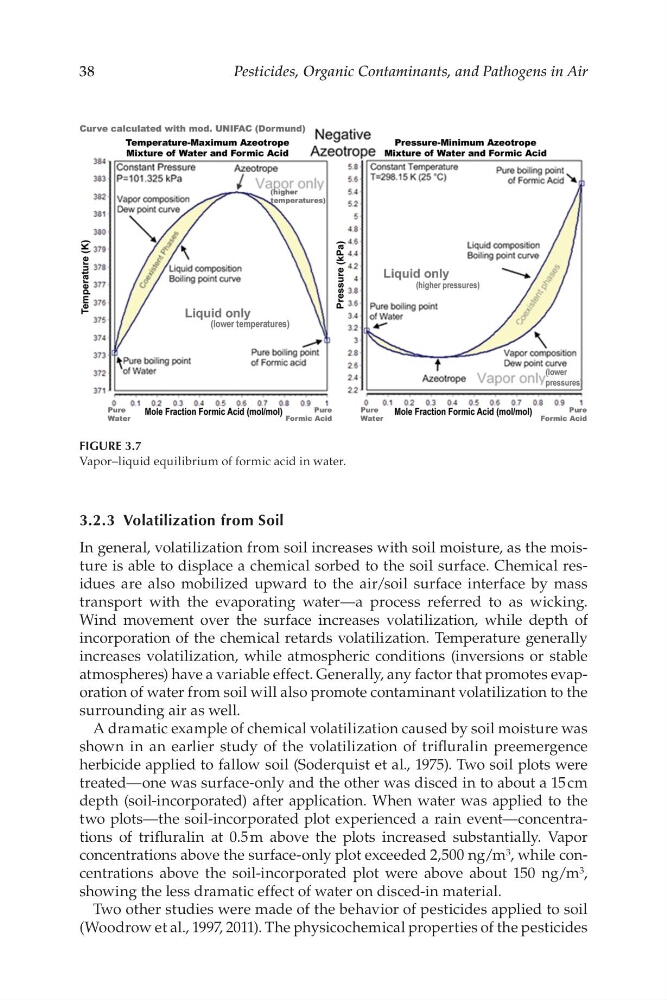
FIGURE 3.7
Vapor–liquid equilibrium of formic acid in water.
3.2.3 Volatilization from Soil
In general, volatilization from soil increases with soil moisture, as the moisture is able to displace a chemical sorbed to the soil surface. Chemical residues are also mobilized upward to the air/soil surface interface by mass
transport with the evaporating water—a process referred to as wicking.
Wind movement over the surface increases volatilization, while depth of
incorporation of the chemical retards volatilization. Temperature generally
increases volatilization, while atmospheric conditions (inversions or stable
atmospheres) have a variable effect. Generally, any factor that promotes evaporation of water from soil will also promote contaminant volatilization to the
surrounding air as well.
A dramatic example of chemical volatilization caused by soil moisture was
shown in an earlier study of the volatilization of trifuralin preemergence
herbicide applied to fallow soil (Soderquist et al., 1975). Two soil plots were
treated—one was surface-only and the other was disced in to about a 15 cm
depth (soil-incorporated) after application. When water was applied to the
two plots—the soil-incorporated plot experienced a rain event—concentrations of trifuralin at 0.5 m above the plots increased substantially. Vapor
concentrations above the surface-only plot exceeded 2,500 ng/m 3 , while concentrations above the soil-incorporated plot were above about 150 ng/m 3 ,
showing the less dramatic effect of water on disced-in material.
Two other studies were made of the behavior of pesticides applied to soil
(Woodrow et al., 1997, 2011). The physicochemical properties of the pesticides
Pesticides, Organic Contaminants, and Pathogens in Air
FIGURE 3.7
Vapor–liquid equilibrium of formic acid in water.
3.2.3 Volatilization from Soil
In general, volatilization from soil increases with soil moisture, as the moisture is able to displace a chemical sorbed to the soil surface. Chemical residues are also mobilized upward to the air/soil surface interface by mass
transport with the evaporating water—a process referred to as wicking.
Wind movement over the surface increases volatilization, while depth of
incorporation of the chemical retards volatilization. Temperature generally
increases volatilization, while atmospheric conditions (inversions or stable
atmospheres) have a variable effect. Generally, any factor that promotes evaporation of water from soil will also promote contaminant volatilization to the
surrounding air as well.
A dramatic example of chemical volatilization caused by soil moisture was
shown in an earlier study of the volatilization of trifuralin preemergence
herbicide applied to fallow soil (Soderquist et al., 1975). Two soil plots were
treated—one was surface-only and the other was disced in to about a 15 cm
depth (soil-incorporated) after application. When water was applied to the
two plots—the soil-incorporated plot experienced a rain event—concentrations of trifuralin at 0.5 m above the plots increased substantially. Vapor
concentrations above the surface-only plot exceeded 2,500 ng/m 3 , while concentrations above the soil-incorporated plot were above about 150 ng/m 3 ,
showing the less dramatic effect of water on disced-in material.
Two other studies were made of the behavior of pesticides applied to soil
(Woodrow et al., 1997, 2011). The physicochemical properties of the pesticides