

20
Pesticides, Organic Contaminants, and Pathogens in Air
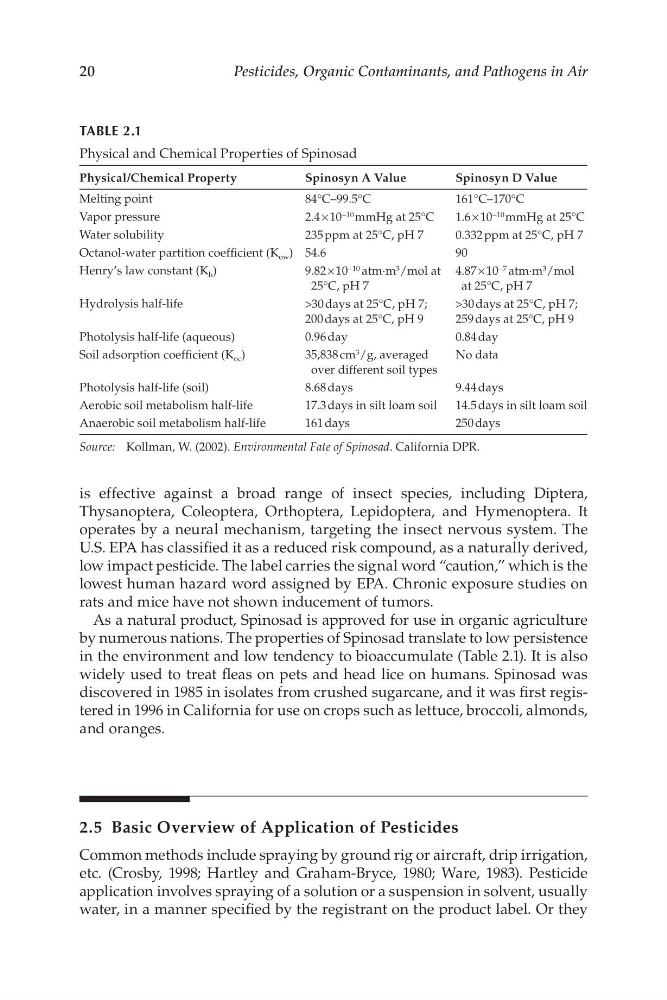
TABLE 2.1
Physical and Chemical Properties of Spinosad
Physical/Chemical Property
Spinosyn A Value
Spinosyn D Value
Melting point
84°C–99.5°C
161°C–170°C
Vapor pressure
2.4 × 10 −10 mmHg at 25°C
1.6 × 10 −10 mmHg at 25°C
Water solubility
235 ppm at 25°C, pH 7
0.332 ppm at 25°C, pH 7
Octanol-water partition coeffcient (K ow ) 54.6
90
Henry’s law constant (K h )
9.82 × 10 −10 atm·m 3 /mol at 4.87 × 10 −7 atm·m 3 /mol
25°C, pH 7
at 25°C, pH 7
Hydrolysis half-life
>30 days at 25°C, pH 7;
>30 days at 25°C, pH 7;
200 days at 25°C, pH 9
259 days at 25°C, pH 9
Photolysis half-life (aqueous)
0.96 day
0.84 day
Soil adsorption coeffcient (K oc )
35,838 cm 3 /g, averaged
No data
over different soil types
Photolysis half-life (soil)
8.68 days
9.44 days
Aerobic soil metabolism half-life
17.3 days in silt loam soil
14.5 days in silt loam soil
Anaerobic soil metabolism half-life
161 days
250 days
Source: Kollman, W. (2002). Environmental Fate of Spinosad. California DPR.
is effective against a broad range of insect species, including Diptera,
Thysanoptera, Coleoptera, Orthoptera, Lepidoptera, and Hymenoptera. It
operates by a neural mechanism, targeting the insect nervous system. The
U.S. EPA has classifed it as a reduced risk compound, as a naturally derived,
low impact pesticide. The label carries the signal word “caution,” which is the
lowest human hazard word assigned by EPA. Chronic exposure studies on
rats and mice have not shown inducement of tumors.
As a natural product, Spinosad is approved for use in organic agriculture
by numerous nations. The properties of Spinosad translate to low persistence
in the environment and low tendency to bioaccumulate (Table 2.1). It is also
widely used to treat feas on pets and head lice on humans. Spinosad was
discovered in 1985 in isolates from crushed sugarcane, and it was frst registered in 1996 in California for use on crops such as lettuce, broccoli, almonds,
and oranges.
2.5 Basic Overview of Application of Pesticides
Common methods include spraying by ground rig or aircraft, drip irrigation,
etc. (Crosby, 1998; Hartley and Graham-Bryce, 1980; Ware, 1983). Pesticide
application involves spraying of a solution or a suspension in solvent, usually
water, in a manner specifed by the registrant on the product label. Or they
Pesticides, Organic Contaminants, and Pathogens in Air
TABLE 2.1
Physical and Chemical Properties of Spinosad
Physical/Chemical Property
Spinosyn A Value
Spinosyn D Value
Melting point
84°C–99.5°C
161°C–170°C
Vapor pressure
2.4 × 10 −10 mmHg at 25°C
1.6 × 10 −10 mmHg at 25°C
Water solubility
235 ppm at 25°C, pH 7
0.332 ppm at 25°C, pH 7
Octanol-water partition coeffcient (K ow ) 54.6
90
Henry’s law constant (K h )
9.82 × 10 −10 atm·m 3 /mol at 4.87 × 10 −7 atm·m 3 /mol
25°C, pH 7
at 25°C, pH 7
Hydrolysis half-life
>30 days at 25°C, pH 7;
>30 days at 25°C, pH 7;
200 days at 25°C, pH 9
259 days at 25°C, pH 9
Photolysis half-life (aqueous)
0.96 day
0.84 day
Soil adsorption coeffcient (K oc )
35,838 cm 3 /g, averaged
No data
over different soil types
Photolysis half-life (soil)
8.68 days
9.44 days
Aerobic soil metabolism half-life
17.3 days in silt loam soil
14.5 days in silt loam soil
Anaerobic soil metabolism half-life
161 days
250 days
Source: Kollman, W. (2002). Environmental Fate of Spinosad. California DPR.
is effective against a broad range of insect species, including Diptera,
Thysanoptera, Coleoptera, Orthoptera, Lepidoptera, and Hymenoptera. It
operates by a neural mechanism, targeting the insect nervous system. The
U.S. EPA has classifed it as a reduced risk compound, as a naturally derived,
low impact pesticide. The label carries the signal word “caution,” which is the
lowest human hazard word assigned by EPA. Chronic exposure studies on
rats and mice have not shown inducement of tumors.
As a natural product, Spinosad is approved for use in organic agriculture
by numerous nations. The properties of Spinosad translate to low persistence
in the environment and low tendency to bioaccumulate (Table 2.1). It is also
widely used to treat feas on pets and head lice on humans. Spinosad was
discovered in 1985 in isolates from crushed sugarcane, and it was frst registered in 1996 in California for use on crops such as lettuce, broccoli, almonds,
and oranges.
2.5 Basic Overview of Application of Pesticides
Common methods include spraying by ground rig or aircraft, drip irrigation,
etc. (Crosby, 1998; Hartley and Graham-Bryce, 1980; Ware, 1983). Pesticide
application involves spraying of a solution or a suspension in solvent, usually
water, in a manner specifed by the registrant on the product label. Or they