

208
Pesticides, Organic Contaminants, and Pathogens in Air
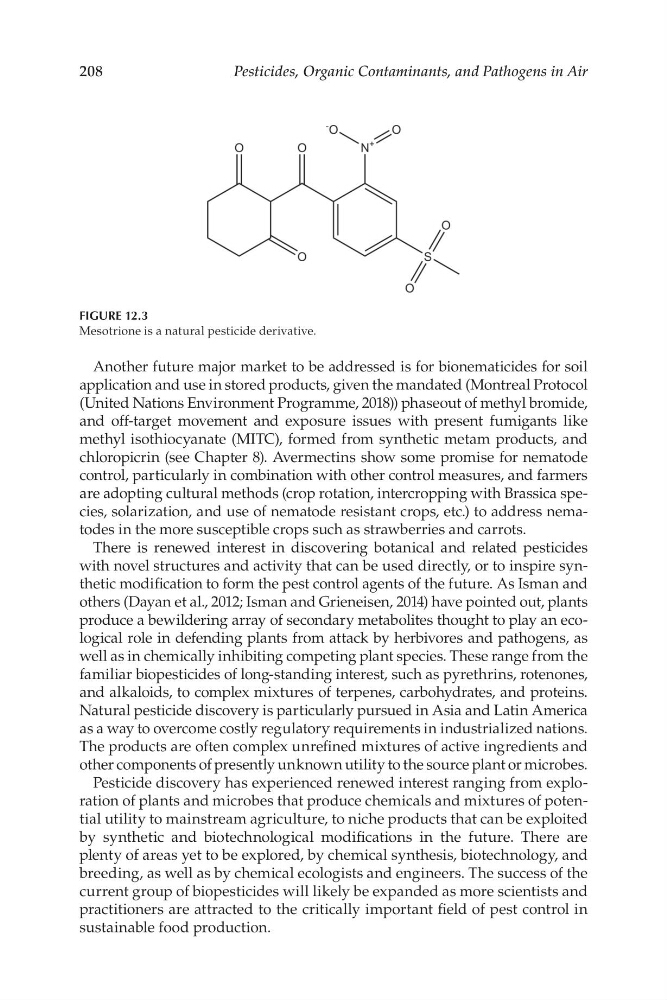
FIGURE 12.3
Mesotrione is a natural pesticide derivative.
Another future major market to be addressed is for bionematicides for soil
application and use in stored products, given the mandated (Montreal Protocol
(United Nations Environment Programme, 2018)) phaseout of methyl bromide,
and off-target movement and exposure issues with present fumigants like
methyl isothiocyanate (MITC), formed from synthetic metam products, and
chloropicrin (see Chapter 8). Avermectins show some promise for nematode
control, particularly in combination with other control measures, and farmers
are adopting cultural methods (crop rotation, intercropping with Brassica species, solarization, and use of nematode resistant crops, etc.) to address nematodes in the more susceptible crops such as strawberries and carrots.
There is renewed interest in discovering botanical and related pesticides
with novel structures and activity that can be used directly, or to inspire synthetic modifcation to form the pest control agents of the future. As Isman and
others (Dayan et al., 2012; Isman and Grieneisen, 2014) have pointed out, plants
produce a bewildering array of secondary metabolites thought to play an ecological role in defending plants from attack by herbivores and pathogens, as
well as in chemically inhibiting competing plant species. These range from the
familiar biopesticides of long-standing interest, such as pyrethrins, rotenones,
and alkaloids, to complex mixtures of terpenes, carbohydrates, and proteins.
Natural pesticide discovery is particularly pursued in Asia and Latin America
as a way to overcome costly regulatory requirements in industrialized nations.
The products are often complex unrefned mixtures of active ingredients and
other components of presently unknown utility to the source plant or microbes.
Pesticide discovery has experienced renewed interest ranging from exploration of plants and microbes that produce chemicals and mixtures of potential utility to mainstream agriculture, to niche products that can be exploited
by synthetic and biotechnological modifcations in the future. There are
plenty of areas yet to be explored, by chemical synthesis, biotechnology, and
breeding, as well as by chemical ecologists and engineers. The success of the
current group of biopesticides will likely be expanded as more scientists and
practitioners are attracted to the critically important feld of pest control in
sustainable food production.
Pesticides, Organic Contaminants, and Pathogens in Air
FIGURE 12.3
Mesotrione is a natural pesticide derivative.
Another future major market to be addressed is for bionematicides for soil
application and use in stored products, given the mandated (Montreal Protocol
(United Nations Environment Programme, 2018)) phaseout of methyl bromide,
and off-target movement and exposure issues with present fumigants like
methyl isothiocyanate (MITC), formed from synthetic metam products, and
chloropicrin (see Chapter 8). Avermectins show some promise for nematode
control, particularly in combination with other control measures, and farmers
are adopting cultural methods (crop rotation, intercropping with Brassica species, solarization, and use of nematode resistant crops, etc.) to address nematodes in the more susceptible crops such as strawberries and carrots.
There is renewed interest in discovering botanical and related pesticides
with novel structures and activity that can be used directly, or to inspire synthetic modifcation to form the pest control agents of the future. As Isman and
others (Dayan et al., 2012; Isman and Grieneisen, 2014) have pointed out, plants
produce a bewildering array of secondary metabolites thought to play an ecological role in defending plants from attack by herbivores and pathogens, as
well as in chemically inhibiting competing plant species. These range from the
familiar biopesticides of long-standing interest, such as pyrethrins, rotenones,
and alkaloids, to complex mixtures of terpenes, carbohydrates, and proteins.
Natural pesticide discovery is particularly pursued in Asia and Latin America
as a way to overcome costly regulatory requirements in industrialized nations.
The products are often complex unrefned mixtures of active ingredients and
other components of presently unknown utility to the source plant or microbes.
Pesticide discovery has experienced renewed interest ranging from exploration of plants and microbes that produce chemicals and mixtures of potential utility to mainstream agriculture, to niche products that can be exploited
by synthetic and biotechnological modifcations in the future. There are
plenty of areas yet to be explored, by chemical synthesis, biotechnology, and
breeding, as well as by chemical ecologists and engineers. The success of the
current group of biopesticides will likely be expanded as more scientists and
practitioners are attracted to the critically important feld of pest control in
sustainable food production.