

207
Biopesticides and the Toolbox Approach
example, rice can be grown along with tilapia in the paddies. The tilapia fsh
consume insect pests of rice, so that less chemical control may be needed,
and then become a nutritious coproduct harvestable along with the rice crop.
Bioherbicides are a future target for development, although research in herbicide discovery has been somewhat slow since the last new mode of action
herbicides was introduced about 30 years ago (Duke, 2012). The evolution of
weeds resistant to the leading herbicide glyphosate may accelerate developments in this area (Heap and Duke, 2018). Nonsynthetic chemical management of weeds in organic culture is a serious problem, limiting wider use of
organic farming methods. The few bio- or green products for weed control use
high application rates or multiple applications and even then are somewhat
unpredictable in effcacy (Dayan and Duke, 2010). Mechanical control methods include hoeing, mowing, burning, or solarization under plastic sheeting
tarps. Biocontrol of weeds with grazing sheep and goats has even been used.
Many of these mechanical and biocontrol methods are laborious, costly, and
often unreliable, or accompanied by undesirable environmental side effects.
Development of triketone herbicides is a case of a natural pesticide leading
to synthesis of highly effective synthetic pesticides. Observation of herbicidal
activity (allelopathy) of an ornamental plant (bottlebrush) led to the isolation
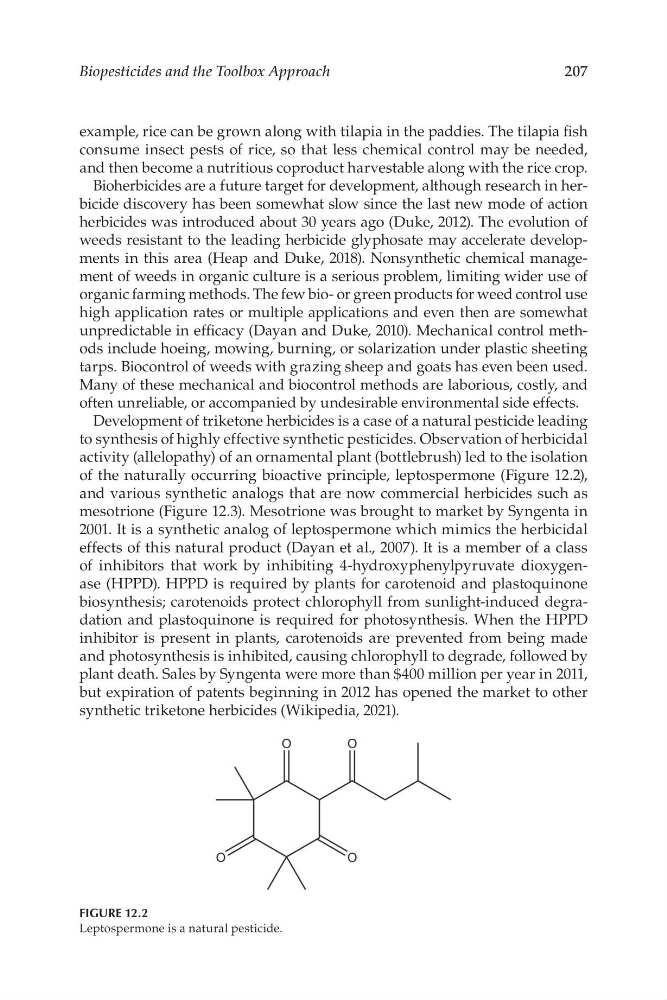
of the naturally occurring bioactive principle, leptospermone (Figure 12.2),
and various synthetic analogs that are now commercial herbicides such as
mesotrione (Figure 12.3). Mesotrione was brought to market by Syngenta in
2001. It is a synthetic analog of leptospermone which mimics the herbicidal
effects of this natural product (Dayan et al., 2007). It is a member of a class
of inhibitors that work by inhibiting 4-hydroxyphenylpyruvate dioxygenase (HPPD). HPPD is required by plants for carotenoid and plastoquinone
biosynthesis; carotenoids protect chlorophyll from sunlight-induced degradation and plastoquinone is required for photosynthesis. When the HPPD
inhibitor is present in plants, carotenoids are prevented from being made
and photosynthesis is inhibited, causing chlorophyll to degrade, followed by
plant death. Sales by Syngenta were more than $400 million per year in 2011,
but expiration of patents beginning in 2012 has opened the market to other
synthetic triketone herbicides (Wikipedia, 2021).
FIGURE 12.2
Leptospermone is a natural pesticide.
Biopesticides and the Toolbox Approach
example, rice can be grown along with tilapia in the paddies. The tilapia fsh
consume insect pests of rice, so that less chemical control may be needed,
and then become a nutritious coproduct harvestable along with the rice crop.
Bioherbicides are a future target for development, although research in herbicide discovery has been somewhat slow since the last new mode of action
herbicides was introduced about 30 years ago (Duke, 2012). The evolution of
weeds resistant to the leading herbicide glyphosate may accelerate developments in this area (Heap and Duke, 2018). Nonsynthetic chemical management of weeds in organic culture is a serious problem, limiting wider use of
organic farming methods. The few bio- or green products for weed control use
high application rates or multiple applications and even then are somewhat
unpredictable in effcacy (Dayan and Duke, 2010). Mechanical control methods include hoeing, mowing, burning, or solarization under plastic sheeting
tarps. Biocontrol of weeds with grazing sheep and goats has even been used.
Many of these mechanical and biocontrol methods are laborious, costly, and
often unreliable, or accompanied by undesirable environmental side effects.
Development of triketone herbicides is a case of a natural pesticide leading
to synthesis of highly effective synthetic pesticides. Observation of herbicidal
activity (allelopathy) of an ornamental plant (bottlebrush) led to the isolation
of the naturally occurring bioactive principle, leptospermone (Figure 12.2),
and various synthetic analogs that are now commercial herbicides such as
mesotrione (Figure 12.3). Mesotrione was brought to market by Syngenta in
2001. It is a synthetic analog of leptospermone which mimics the herbicidal
effects of this natural product (Dayan et al., 2007). It is a member of a class
of inhibitors that work by inhibiting 4-hydroxyphenylpyruvate dioxygenase (HPPD). HPPD is required by plants for carotenoid and plastoquinone
biosynthesis; carotenoids protect chlorophyll from sunlight-induced degradation and plastoquinone is required for photosynthesis. When the HPPD
inhibitor is present in plants, carotenoids are prevented from being made
and photosynthesis is inhibited, causing chlorophyll to degrade, followed by
plant death. Sales by Syngenta were more than $400 million per year in 2011,
but expiration of patents beginning in 2012 has opened the market to other
synthetic triketone herbicides (Wikipedia, 2021).
FIGURE 12.2
Leptospermone is a natural pesticide.