

Drift
179
TABLE 10.1
How Pesticide Properties and Use Impacts Distribution
Chlorpyrifos
Parathion
PCB
TFA
Sources
Agricultural
Agricultural
Variety of
HCFC breakdown,
sources and
potential natural
broad usage
sources
Polarity
Moderate
Moderate
Low
High
Volatility
Semivolatile
Semivolatile
Semivolatile
Nonvolatile
Water solubility
Moderate (200
Moderate
Low (1 ng/L)
High (10,000 ng/L,
(max in surface
ng/L)
vernal pools)
water)
Stability
Moderate
Moderate
Persistent
Persistent
Compartments
Precipitation,
Precipitation,
Biota (fsh),
Precipitation, air,
surface water,
surface water,
precipitation,
evapoconcentration
air, plant
air, plant
fog, surface
in terminal waters,
surfaces
surfaces
water
water bodies
Concentration
North to South North to South No clear
North to South
gradients
East to West
East to West
gradients
East to West
Source: Adapted from Woodrow et al. (2018).
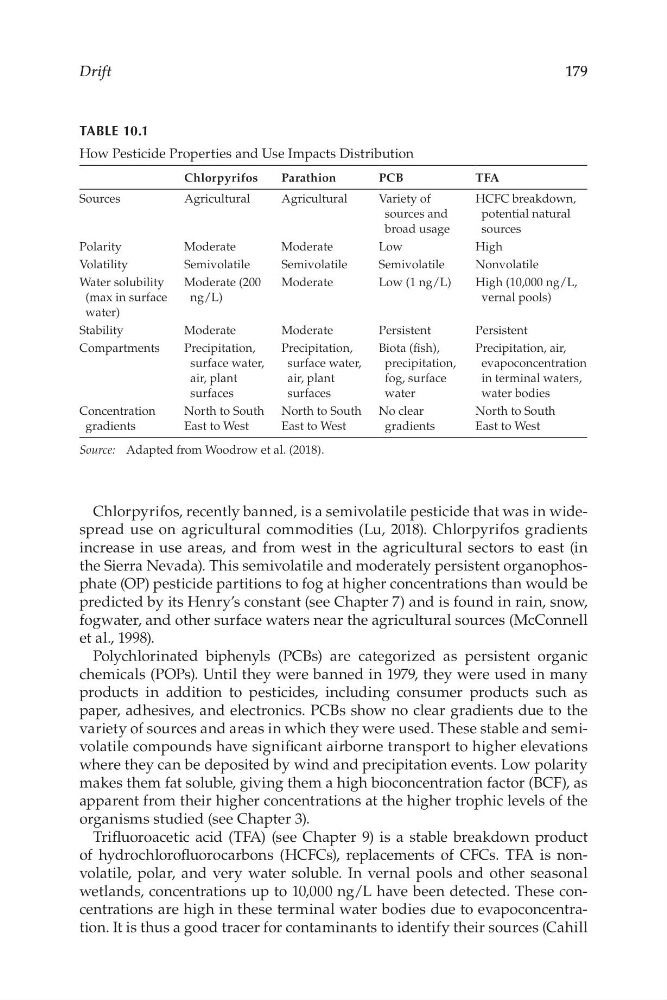
Chlorpyrifos, recently banned, is a semivolatile pesticide that was in widespread use on agricultural commodities (Lu, 2018). Chlorpyrifos gradients
increase in use areas, and from west in the agricultural sectors to east (in
the Sierra Nevada). This semivolatile and moderately persistent organophosphate (OP) pesticide partitions to fog at higher concentrations than would be
predicted by its Henry’s constant (see Chapter 7) and is found in rain, snow,
fogwater, and other surface waters near the agricultural sources (McConnell
et al., 1998).
Polychlorinated biphenyls (PCBs) are categorized as persistent organic
chemicals (POPs). Until they were banned in 1979, they were used in many
products in addition to pesticides, including consumer products such as
paper, adhesives, and electronics. PCBs show no clear gradients due to the
variety of sources and areas in which they were used. These stable and semivolatile compounds have signifcant airborne transport to higher elevations
where they can be deposited by wind and precipitation events. Low polarity
makes them fat soluble, giving them a high bioconcentration factor (BCF), as
apparent from their higher concentrations at the higher trophic levels of the
organisms studied (see Chapter 3).
Trifuoroacetic acid (TFA) (see Chapter 9) is a stable breakdown product
of hydrochlorofuorocarbons (HCFCs), replacements of CFCs. TFA is nonvolatile, polar, and very water soluble. In vernal pools and other seasonal
wetlands, concentrations up to 10,000 ng/L have been detected. These concentrations are high in these terminal water bodies due to evapoconcentration. It is thus a good tracer for contaminants to identify their sources (Cahill
179
TABLE 10.1
How Pesticide Properties and Use Impacts Distribution
Chlorpyrifos
Parathion
PCB
TFA
Sources
Agricultural
Agricultural
Variety of
HCFC breakdown,
sources and
potential natural
broad usage
sources
Polarity
Moderate
Moderate
Low
High
Volatility
Semivolatile
Semivolatile
Semivolatile
Nonvolatile
Water solubility
Moderate (200
Moderate
Low (1 ng/L)
High (10,000 ng/L,
(max in surface
ng/L)
vernal pools)
water)
Stability
Moderate
Moderate
Persistent
Persistent
Compartments
Precipitation,
Precipitation,
Biota (fsh),
Precipitation, air,
surface water,
surface water,
precipitation,
evapoconcentration
air, plant
air, plant
fog, surface
in terminal waters,
surfaces
surfaces
water
water bodies
Concentration
North to South North to South No clear
North to South
gradients
East to West
East to West
gradients
East to West
Source: Adapted from Woodrow et al. (2018).
Chlorpyrifos, recently banned, is a semivolatile pesticide that was in widespread use on agricultural commodities (Lu, 2018). Chlorpyrifos gradients
increase in use areas, and from west in the agricultural sectors to east (in
the Sierra Nevada). This semivolatile and moderately persistent organophosphate (OP) pesticide partitions to fog at higher concentrations than would be
predicted by its Henry’s constant (see Chapter 7) and is found in rain, snow,
fogwater, and other surface waters near the agricultural sources (McConnell
et al., 1998).
Polychlorinated biphenyls (PCBs) are categorized as persistent organic
chemicals (POPs). Until they were banned in 1979, they were used in many
products in addition to pesticides, including consumer products such as
paper, adhesives, and electronics. PCBs show no clear gradients due to the
variety of sources and areas in which they were used. These stable and semivolatile compounds have signifcant airborne transport to higher elevations
where they can be deposited by wind and precipitation events. Low polarity
makes them fat soluble, giving them a high bioconcentration factor (BCF), as
apparent from their higher concentrations at the higher trophic levels of the
organisms studied (see Chapter 3).
Trifuoroacetic acid (TFA) (see Chapter 9) is a stable breakdown product
of hydrochlorofuorocarbons (HCFCs), replacements of CFCs. TFA is nonvolatile, polar, and very water soluble. In vernal pools and other seasonal
wetlands, concentrations up to 10,000 ng/L have been detected. These concentrations are high in these terminal water bodies due to evapoconcentration. It is thus a good tracer for contaminants to identify their sources (Cahill