

178
Pesticides, Organic Contaminants, and Pathogens in Air
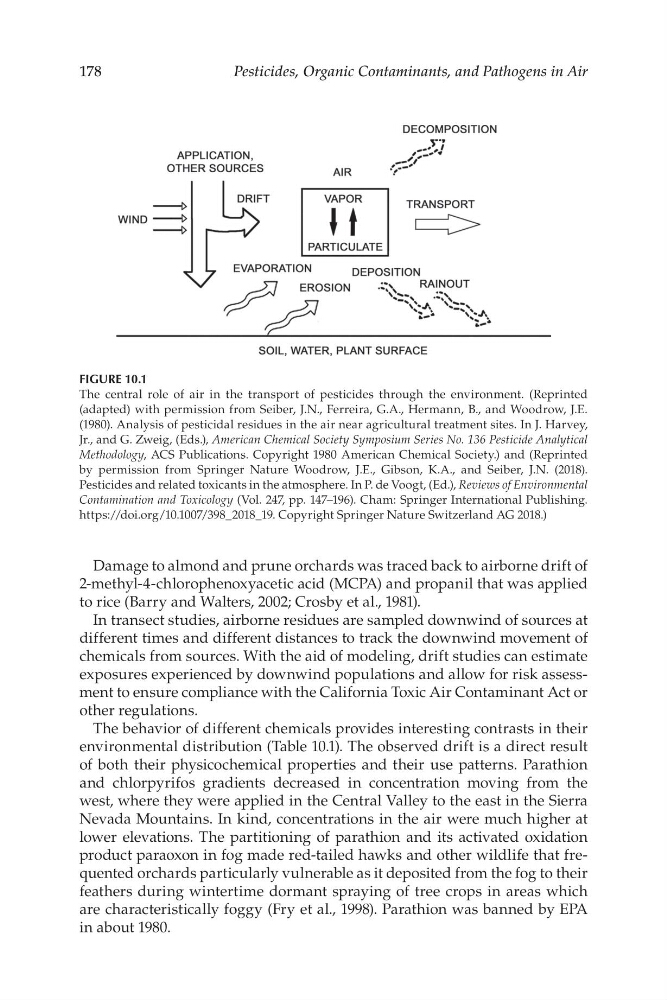
FIGURE 10.1
The central role of air in the transport of pesticides through the environment. (Reprinted
(adapted) with permission from Seiber, J.N., Ferreira, G.A., Hermann, B., and Woodrow, J.E.
(1980). Analysis of pesticidal residues in the air near agricultural treatment sites. In J. Harvey,
Jr., and G. Zweig, (Eds.), American Chemical Society Symposium Series No. 136 Pesticide Analytical
Methodology, ACS Publications. Copyright 1980 American Chemical Society.) and (Reprinted
by permission from Springer Nature Woodrow, J.E., Gibson, K.A., and Seiber, J.N. (2018).
Pesticides and related toxicants in the atmosphere. In P. de Voogt, (Ed.), Reviews of Environmental
Contamination and Toxicology (Vol. 247, pp. 147–196). Cham: Springer International Publishing.
https://doi.org/10.1007/398_2018_19. Copyright Springer Nature Switzerland AG 2018.)
Damage to almond and prune orchards was traced back to airborne drift of
2-methyl-4-chlorophenoxyacetic acid (MCPA) and propanil that was applied
to rice (Barry and Walters, 2002; Crosby et al., 1981).
In transect studies, airborne residues are sampled downwind of sources at
different times and different distances to track the downwind movement of
chemicals from sources. With the aid of modeling, drift studies can estimate
exposures experienced by downwind populations and allow for risk assessment to ensure compliance with the California Toxic Air Contaminant Act or
other regulations.
The behavior of different chemicals provides interesting contrasts in their
environmental distribution (Table 10.1). The observed drift is a direct result
of both their physicochemical properties and their use patterns. Parathion
and chlorpyrifos gradients decreased in concentration moving from the
west, where they were applied in the Central Valley to the east in the Sierra
Nevada Mountains. In kind, concentrations in the air were much higher at
lower elevations. The partitioning of parathion and its activated oxidation
product paraoxon in fog made red-tailed hawks and other wildlife that frequented orchards particularly vulnerable as it deposited from the fog to their
feathers during wintertime dormant spraying of tree crops in areas which
are characteristically foggy (Fry et al., 1998). Parathion was banned by EPA
in about 1980.
Pesticides, Organic Contaminants, and Pathogens in Air
FIGURE 10.1
The central role of air in the transport of pesticides through the environment. (Reprinted
(adapted) with permission from Seiber, J.N., Ferreira, G.A., Hermann, B., and Woodrow, J.E.
(1980). Analysis of pesticidal residues in the air near agricultural treatment sites. In J. Harvey,
Jr., and G. Zweig, (Eds.), American Chemical Society Symposium Series No. 136 Pesticide Analytical
Methodology, ACS Publications. Copyright 1980 American Chemical Society.) and (Reprinted
by permission from Springer Nature Woodrow, J.E., Gibson, K.A., and Seiber, J.N. (2018).
Pesticides and related toxicants in the atmosphere. In P. de Voogt, (Ed.), Reviews of Environmental
Contamination and Toxicology (Vol. 247, pp. 147–196). Cham: Springer International Publishing.
https://doi.org/10.1007/398_2018_19. Copyright Springer Nature Switzerland AG 2018.)
Damage to almond and prune orchards was traced back to airborne drift of
2-methyl-4-chlorophenoxyacetic acid (MCPA) and propanil that was applied
to rice (Barry and Walters, 2002; Crosby et al., 1981).
In transect studies, airborne residues are sampled downwind of sources at
different times and different distances to track the downwind movement of
chemicals from sources. With the aid of modeling, drift studies can estimate
exposures experienced by downwind populations and allow for risk assessment to ensure compliance with the California Toxic Air Contaminant Act or
other regulations.
The behavior of different chemicals provides interesting contrasts in their
environmental distribution (Table 10.1). The observed drift is a direct result
of both their physicochemical properties and their use patterns. Parathion
and chlorpyrifos gradients decreased in concentration moving from the
west, where they were applied in the Central Valley to the east in the Sierra
Nevada Mountains. In kind, concentrations in the air were much higher at
lower elevations. The partitioning of parathion and its activated oxidation
product paraoxon in fog made red-tailed hawks and other wildlife that frequented orchards particularly vulnerable as it deposited from the fog to their
feathers during wintertime dormant spraying of tree crops in areas which
are characteristically foggy (Fry et al., 1998). Parathion was banned by EPA
in about 1980.