

167
Trifuoroacetic Acid from CFC Replacements
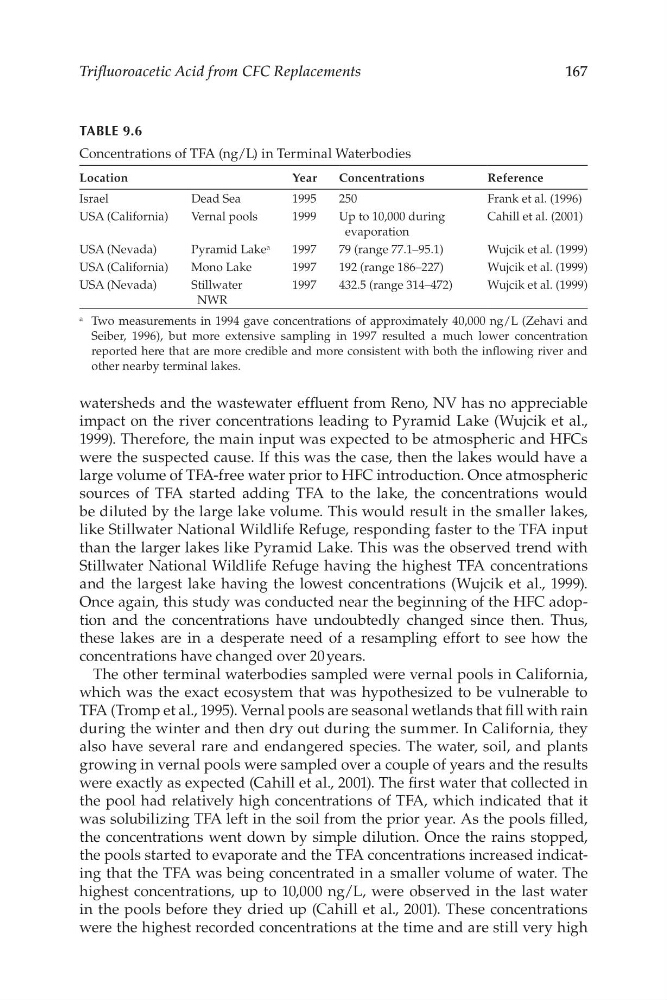
TABLE 9.6
Concentrations of TFA (ng/L) in Terminal Waterbodies
Location
Year
Concentrations
Reference
Israel
Dead Sea
1995
250
Frank et al. (1996)
USA (California)
Vernal pools
1999
Up to 10,000 during
evaporation
Cahill et al. (2001)
USA (Nevada)
USA (California)
USA (Nevada)
Pyramid Lake a
Mono Lake
Stillwater
NWR
1997
1997
1997
79 (range 77.1–95.1)
192 (range 186–227)
432.5 (range 314–472)
Wujcik et al. (1999)
Wujcik et al. (1999)
Wujcik et al. (1999)
a Two measurements in 1994 gave concentrations of approximately 40,000 ng/L (Zehavi and
Seiber, 1996), but more extensive sampling in 1997 resulted a much lower concentration
reported here that are more credible and more consistent with both the infowing river and
other nearby terminal lakes.
watersheds and the wastewater effuent from Reno, NV has no appreciable
impact on the river concentrations leading to Pyramid Lake (Wujcik et al.,
1999). Therefore, the main input was expected to be atmospheric and HFCs
were the suspected cause. If this was the case, then the lakes would have a
large volume of TFA-free water prior to HFC introduction. Once atmospheric
sources of TFA started adding TFA to the lake, the concentrations would
be diluted by the large lake volume. This would result in the smaller lakes,
like Stillwater National Wildlife Refuge, responding faster to the TFA input
than the larger lakes like Pyramid Lake. This was the observed trend with
Stillwater National Wildlife Refuge having the highest TFA concentrations
and the largest lake having the lowest concentrations (Wujcik et al., 1999).
Once again, this study was conducted near the beginning of the HFC adoption and the concentrations have undoubtedly changed since then. Thus,
these lakes are in a desperate need of a resampling effort to see how the
concentrations have changed over 20 years.
The other terminal waterbodies sampled were vernal pools in California,
which was the exact ecosystem that was hypothesized to be vulnerable to
TFA (Tromp et al., 1995). Vernal pools are seasonal wetlands that fll with rain
during the winter and then dry out during the summer. In California, they
also have several rare and endangered species. The water, soil, and plants
growing in vernal pools were sampled over a couple of years and the results
were exactly as expected (Cahill et al., 2001). The frst water that collected in
the pool had relatively high concentrations of TFA, which indicated that it
was solubilizing TFA left in the soil from the prior year. As the pools flled,
the concentrations went down by simple dilution. Once the rains stopped,
the pools started to evaporate and the TFA concentrations increased indicating that the TFA was being concentrated in a smaller volume of water. The
highest concentrations, up to 10,000 ng/L, were observed in the last water
in the pools before they dried up (Cahill et al., 2001). These concentrations
were the highest recorded concentrations at the time and are still very high
Trifuoroacetic Acid from CFC Replacements
TABLE 9.6
Concentrations of TFA (ng/L) in Terminal Waterbodies
Location
Year
Concentrations
Reference
Israel
Dead Sea
1995
250
Frank et al. (1996)
USA (California)
Vernal pools
1999
Up to 10,000 during
evaporation
Cahill et al. (2001)
USA (Nevada)
USA (California)
USA (Nevada)
Pyramid Lake a
Mono Lake
Stillwater
NWR
1997
1997
1997
79 (range 77.1–95.1)
192 (range 186–227)
432.5 (range 314–472)
Wujcik et al. (1999)
Wujcik et al. (1999)
Wujcik et al. (1999)
a Two measurements in 1994 gave concentrations of approximately 40,000 ng/L (Zehavi and
Seiber, 1996), but more extensive sampling in 1997 resulted a much lower concentration
reported here that are more credible and more consistent with both the infowing river and
other nearby terminal lakes.
watersheds and the wastewater effuent from Reno, NV has no appreciable
impact on the river concentrations leading to Pyramid Lake (Wujcik et al.,
1999). Therefore, the main input was expected to be atmospheric and HFCs
were the suspected cause. If this was the case, then the lakes would have a
large volume of TFA-free water prior to HFC introduction. Once atmospheric
sources of TFA started adding TFA to the lake, the concentrations would
be diluted by the large lake volume. This would result in the smaller lakes,
like Stillwater National Wildlife Refuge, responding faster to the TFA input
than the larger lakes like Pyramid Lake. This was the observed trend with
Stillwater National Wildlife Refuge having the highest TFA concentrations
and the largest lake having the lowest concentrations (Wujcik et al., 1999).
Once again, this study was conducted near the beginning of the HFC adoption and the concentrations have undoubtedly changed since then. Thus,
these lakes are in a desperate need of a resampling effort to see how the
concentrations have changed over 20 years.
The other terminal waterbodies sampled were vernal pools in California,
which was the exact ecosystem that was hypothesized to be vulnerable to
TFA (Tromp et al., 1995). Vernal pools are seasonal wetlands that fll with rain
during the winter and then dry out during the summer. In California, they
also have several rare and endangered species. The water, soil, and plants
growing in vernal pools were sampled over a couple of years and the results
were exactly as expected (Cahill et al., 2001). The frst water that collected in
the pool had relatively high concentrations of TFA, which indicated that it
was solubilizing TFA left in the soil from the prior year. As the pools flled,
the concentrations went down by simple dilution. Once the rains stopped,
the pools started to evaporate and the TFA concentrations increased indicating that the TFA was being concentrated in a smaller volume of water. The
highest concentrations, up to 10,000 ng/L, were observed in the last water
in the pools before they dried up (Cahill et al., 2001). These concentrations
were the highest recorded concentrations at the time and are still very high