

164
Pesticides, Organic Contaminants, and Pathogens in Air
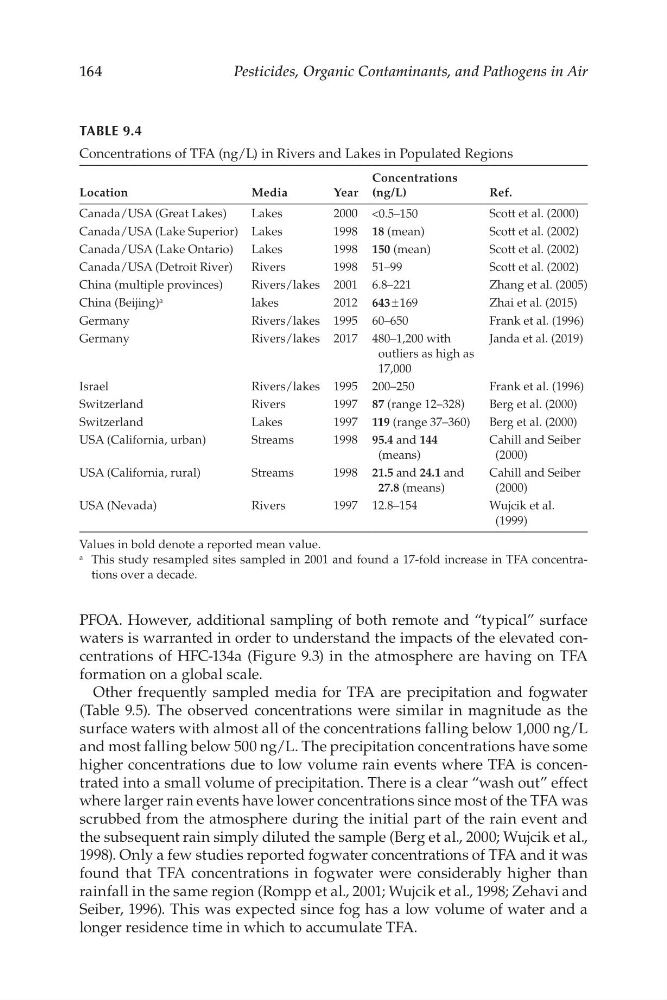
TABLE 9.4
Concentrations of TFA (ng/L) in Rivers and Lakes in Populated Regions
Concentrations
Location
Media
Year (ng/L)
Ref.
Canada/USA (Great Lakes)
Lakes
2000 <0.5–150
Scott et al. (2000)
Canada/USA (Lake Superior) Lakes
1998 18 (mean)
Scott et al. (2002)
Canada/USA (Lake Ontario)
Lakes
1998 150 (mean)
Scott et al. (2002)
Canada/USA (Detroit River)
Rivers
1998 51–99
Scott et al. (2002)
China (multiple provinces)
Rivers/lakes 2001 6.8–221
Zhang et al. (2005)
China (Beijing) a
lakes
2012 643 ± 169
Zhai et al. (2015)
Germany
Rivers/lakes 1995 60–650
Frank et al. (1996)
Germany
Rivers/lakes 2017 480–1,200 with
Janda et al. (2019)
outliers as high as
17,000
Israel
Rivers/lakes 1995 200–250
Frank et al. (1996)
Switzerland
Rivers
1997 87 (range 12–328)
Berg et al. (2000)
Switzerland
Lakes
1997 119 (range 37–360)
Berg et al. (2000)
USA (California, urban)
Streams
1998 95.4 and 144
Cahill and Seiber
(means)
(2000)
USA (California, rural)
Streams
1998 21.5 and 24.1 and
Cahill and Seiber
27.8 (means)
(2000)
USA (Nevada)
Rivers
1997 12.8–154
Wujcik et al.
(1999)
Values in bold denote a reported mean value.
a This study resampled sites sampled in 2001 and found a 17-fold increase in TFA concentrations over a decade.
PFOA. However, additional sampling of both remote and “typical” surface
waters is warranted in order to understand the impacts of the elevated concentrations of HFC-134a (Figure 9.3) in the atmosphere are having on TFA
formation on a global scale.
Other frequently sampled media for TFA are precipitation and fogwater
(Table 9.5). The observed concentrations were similar in magnitude as the
surface waters with almost all of the concentrations falling below 1,000 ng/L
and most falling below 500 ng/L. The precipitation concentrations have some
higher concentrations due to low volume rain events where TFA is concentrated into a small volume of precipitation. There is a clear “wash out” effect
where larger rain events have lower concentrations since most of the TFA was
scrubbed from the atmosphere during the initial part of the rain event and
the subsequent rain simply diluted the sample (Berg et al., 2000; Wujcik et al.,
1998). Only a few studies reported fogwater concentrations of TFA and it was
found that TFA concentrations in fogwater were considerably higher than
rainfall in the same region (Rompp et al., 2001; Wujcik et al., 1998; Zehavi and
Seiber, 1996). This was expected since fog has a low volume of water and a
longer residence time in which to accumulate TFA.
Pesticides, Organic Contaminants, and Pathogens in Air
TABLE 9.4
Concentrations of TFA (ng/L) in Rivers and Lakes in Populated Regions
Concentrations
Location
Media
Year (ng/L)
Ref.
Canada/USA (Great Lakes)
Lakes
2000 <0.5–150
Scott et al. (2000)
Canada/USA (Lake Superior) Lakes
1998 18 (mean)
Scott et al. (2002)
Canada/USA (Lake Ontario)
Lakes
1998 150 (mean)
Scott et al. (2002)
Canada/USA (Detroit River)
Rivers
1998 51–99
Scott et al. (2002)
China (multiple provinces)
Rivers/lakes 2001 6.8–221
Zhang et al. (2005)
China (Beijing) a
lakes
2012 643 ± 169
Zhai et al. (2015)
Germany
Rivers/lakes 1995 60–650
Frank et al. (1996)
Germany
Rivers/lakes 2017 480–1,200 with
Janda et al. (2019)
outliers as high as
17,000
Israel
Rivers/lakes 1995 200–250
Frank et al. (1996)
Switzerland
Rivers
1997 87 (range 12–328)
Berg et al. (2000)
Switzerland
Lakes
1997 119 (range 37–360)
Berg et al. (2000)
USA (California, urban)
Streams
1998 95.4 and 144
Cahill and Seiber
(means)
(2000)
USA (California, rural)
Streams
1998 21.5 and 24.1 and
Cahill and Seiber
27.8 (means)
(2000)
USA (Nevada)
Rivers
1997 12.8–154
Wujcik et al.
(1999)
Values in bold denote a reported mean value.
a This study resampled sites sampled in 2001 and found a 17-fold increase in TFA concentrations over a decade.
PFOA. However, additional sampling of both remote and “typical” surface
waters is warranted in order to understand the impacts of the elevated concentrations of HFC-134a (Figure 9.3) in the atmosphere are having on TFA
formation on a global scale.
Other frequently sampled media for TFA are precipitation and fogwater
(Table 9.5). The observed concentrations were similar in magnitude as the
surface waters with almost all of the concentrations falling below 1,000 ng/L
and most falling below 500 ng/L. The precipitation concentrations have some
higher concentrations due to low volume rain events where TFA is concentrated into a small volume of precipitation. There is a clear “wash out” effect
where larger rain events have lower concentrations since most of the TFA was
scrubbed from the atmosphere during the initial part of the rain event and
the subsequent rain simply diluted the sample (Berg et al., 2000; Wujcik et al.,
1998). Only a few studies reported fogwater concentrations of TFA and it was
found that TFA concentrations in fogwater were considerably higher than
rainfall in the same region (Rompp et al., 2001; Wujcik et al., 1998; Zehavi and
Seiber, 1996). This was expected since fog has a low volume of water and a
longer residence time in which to accumulate TFA.