

Fumigants
139
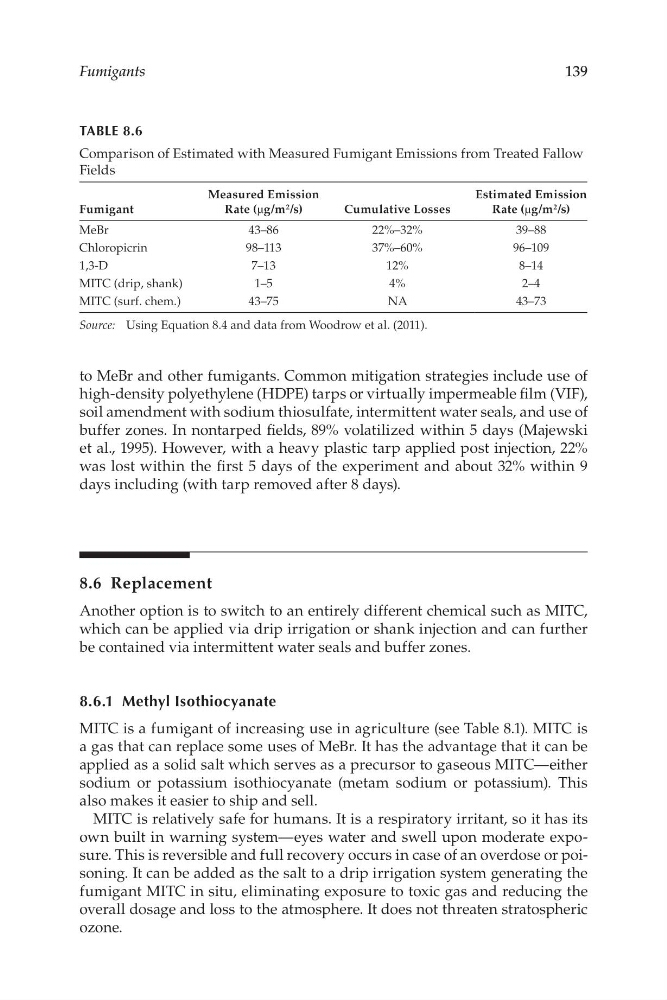
TABLE 8.6
Comparison of Estimated with Measured Fumigant Emissions from Treated Fallow
Fields
Measured Emission
Estimated Emission
Fumigant
Rate (µg/m 2 /s)
Cumulative Losses
Rate (µg/m 2 /s)
MeBr
43–86
22%–32%
39–88
Chloropicrin
98–113
37%–60%
96–109
1,3-D
7–13
12%
8–14
MITC (drip, shank)
1–5
4%
2–4
MITC (surf. chem.)
43–75
NA
43–73
Source: Using Equation 8.4 and data from Woodrow et al. (2011).
to MeBr and other fumigants. Common mitigation strategies include use of
high-density polyethylene (HDPE) tarps or virtually impermeable flm (VIF),
soil amendment with sodium thiosulfate, intermittent water seals, and use of
buffer zones. In nontarped felds, 89% volatilized within 5 days (Majewski
et al., 1995). However, with a heavy plastic tarp applied post injection, 22%
was lost within the frst 5 days of the experiment and about 32% within 9
days including (with tarp removed after 8 days).
8.6 Replacement
Another option is to switch to an entirely different chemical such as MITC,
which can be applied via drip irrigation or shank injection and can further
be contained via intermittent water seals and buffer zones.
8.6.1 Methyl Isothiocyanate
MITC is a fumigant of increasing use in agriculture (see Table 8.1). MITC is
a gas that can replace some uses of MeBr. It has the advantage that it can be
applied as a solid salt which serves as a precursor to gaseous MITC—either
sodium or potassium isothiocyanate (metam sodium or potassium). This
also makes it easier to ship and sell.
MITC is relatively safe for humans. It is a respiratory irritant, so it has its
own built in warning system—eyes water and swell upon moderate exposure. This is reversible and full recovery occurs in case of an overdose or poisoning. It can be added as the salt to a drip irrigation system generating the
fumigant MITC in situ, eliminating exposure to toxic gas and reducing the
overall dosage and loss to the atmosphere. It does not threaten stratospheric
ozone.
139
TABLE 8.6
Comparison of Estimated with Measured Fumigant Emissions from Treated Fallow
Fields
Measured Emission
Estimated Emission
Fumigant
Rate (µg/m 2 /s)
Cumulative Losses
Rate (µg/m 2 /s)
MeBr
43–86
22%–32%
39–88
Chloropicrin
98–113
37%–60%
96–109
1,3-D
7–13
12%
8–14
MITC (drip, shank)
1–5
4%
2–4
MITC (surf. chem.)
43–75
NA
43–73
Source: Using Equation 8.4 and data from Woodrow et al. (2011).
to MeBr and other fumigants. Common mitigation strategies include use of
high-density polyethylene (HDPE) tarps or virtually impermeable flm (VIF),
soil amendment with sodium thiosulfate, intermittent water seals, and use of
buffer zones. In nontarped felds, 89% volatilized within 5 days (Majewski
et al., 1995). However, with a heavy plastic tarp applied post injection, 22%
was lost within the frst 5 days of the experiment and about 32% within 9
days including (with tarp removed after 8 days).
8.6 Replacement
Another option is to switch to an entirely different chemical such as MITC,
which can be applied via drip irrigation or shank injection and can further
be contained via intermittent water seals and buffer zones.
8.6.1 Methyl Isothiocyanate
MITC is a fumigant of increasing use in agriculture (see Table 8.1). MITC is
a gas that can replace some uses of MeBr. It has the advantage that it can be
applied as a solid salt which serves as a precursor to gaseous MITC—either
sodium or potassium isothiocyanate (metam sodium or potassium). This
also makes it easier to ship and sell.
MITC is relatively safe for humans. It is a respiratory irritant, so it has its
own built in warning system—eyes water and swell upon moderate exposure. This is reversible and full recovery occurs in case of an overdose or poisoning. It can be added as the salt to a drip irrigation system generating the
fumigant MITC in situ, eliminating exposure to toxic gas and reducing the
overall dosage and loss to the atmosphere. It does not threaten stratospheric
ozone.